
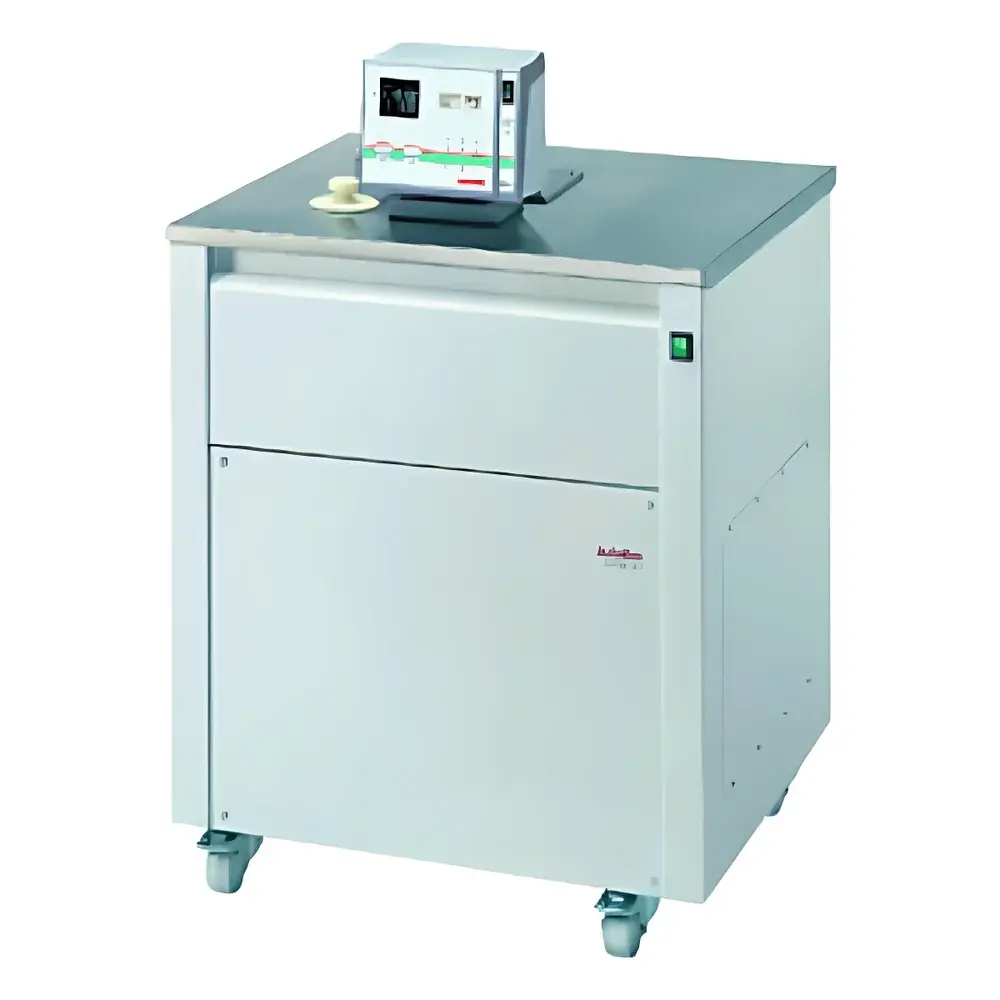
Julabo FPW91-SL Cryogenic Circulating Bath with Dual-Stage Refrigeration
| Brand | Julabo |
|---|---|
| Origin | Germany |
| Model | FPW91-SL |
| Temperature Range | −91 °C to +100 °C |
| Temperature Stability | ±0.2 °C |
| Bath Volume | 22 L |
| Heating Power | 3 kW |
| Refrigeration Power (at −80 °C) | 0.75 kW |
| Pump Flow Rate | 22–26 L/min |
| Pump Pressure | 0.4–0.7 bar |
| Communication Interfaces | RS232, RS485, optional Profibus |
| Compressor Stages | Two-stage (R404A + R23) |
| Safety Classification | DIN 12876-1 Class III (FL) |
| Dimensions (W×L×H) | 85 × 76 × 116 cm |
| Weight | 296 kg |
Overview
The Julabo FPW91-SL is a high-performance cryogenic circulating bath engineered for precision temperature control across an exceptionally wide operational range—from −91 °C to +100 °C. Designed for demanding laboratory and industrial applications requiring both deep cooling and rapid heating, the unit employs a dual-stage refrigeration architecture: a primary stage using R404A and a secondary stage utilizing R23—enabling stable sub-zero operation down to −91 °C without reliance on liquid nitrogen or external cryogens. Its thermally insulated stainless-steel bath vessel (22 L capacity) integrates intelligent thermal management, including adaptive insulation layers to suppress frost formation and condensation during ultra-low-temperature operation. The system delivers internal and external temperature control via a high-flow, pressure-regulated circulation pump (22–26 L/min, up to 0.7 bar), supporting jacketed reactors, vacuum systems, and analytical instrumentation requiring precise thermal coupling. Compliance with DIN 12876-1 Class III (FL) confirms its suitability for flammable liquid environments—a critical requirement for organic synthesis and high-vacuum reactor cooling.
Key Features
- VFD white-backlit display with simultaneous real-time monitoring of setpoint, actual bath temperature, external sensor reading (via PT100 input), and system status indicators
- Intelligent ICC (Intelligent Control Circuit) auto-tuning algorithm that dynamically optimizes PID parameters for minimal overshoot and fastest settling time across the full temperature span
- TCF (Temperature Control Function) technology enabling seamless transition between heating and cooling modes without manual intervention
- ATC3 three-point calibration function for traceable temperature accuracy verification at −40 °C, 0 °C, and +60 °C
- SmartPump™ variable-speed circulation system—automatically adjusts motor torque in response to fluid viscosity changes (e.g., ethylene glycol/water mixtures at low T), maintaining consistent flow and pressure
- Dual-level safety architecture: hardware-based overtemperature cutoff (mechanical dial preset) plus software-enforced upper/lower limits with audible/visual alarms and automatic shutdown
- Removable front air-intake grilles and rear condenser access panels for routine maintenance under GLP-compliant service protocols
- Standard RS232 and RS485 interfaces; optional Profibus DP module for integration into automated process control networks (e.g., Siemens PCS7, Rockwell FactoryTalk)
- Built-in 6×60-step programmable temperature ramping sequence memory, supporting complex thermal profiles for reaction calorimetry or material testing
Sample Compatibility & Compliance
The FPW91-SL supports direct immersion of samples in the bath fluid (water, ethanol, silicone oil, or custom heat-transfer fluids) and indirect temperature control of external systems via closed-loop circulation through jacketed vessels, columns, or detectors. Its M16×1 pump ports accommodate 8 mm and 12 mm ID tubing (supplied), while G3/4″ cooling water inlet ensures compatibility with standard lab chilled-water infrastructure. The unit conforms to IEC 61010-1 (safety), EN 61326-1 (EMC), and DIN 12876-1 Class III (FL) for use with flammable liquids—making it suitable for API synthesis, polymerization, and catalytic hydrogenation under inert atmosphere. All firmware and control logic are designed to support audit trails and electronic signature requirements per FDA 21 CFR Part 11 when paired with validated data acquisition software.
Software & Data Management
Julabo’s proprietary WinTherm software (included) enables remote configuration, real-time graphing, and export of timestamped temperature logs in CSV or Excel format. The RS232/RS485 interface supports SCPI command sets for integration into LabVIEW, MATLAB, or custom Python-based automation frameworks. Optional analog I/O modules provide 0–10 V or 4–20 mA outputs for PLC interfacing, while the embedded electromagnetic valve port allows synchronized control of auxiliary cooling water solenoids or high-pressure booster pumps (HSP). System diagnostics—including compressor runtime, refrigerant pressure trends, and pump duty cycle—are logged internally and retrievable via serial query, facilitating predictive maintenance planning aligned with ISO/IEC 17025 quality management systems.
Applications
- Cryogenic reaction control in Schlenk-line and glovebox environments (e.g., organolithium chemistry, Grignard additions below −70 °C)
- Temperature stabilization of FTIR, UV-Vis, and fluorescence spectrometers requiring <±0.1 °C stability over extended acquisition periods
- Calibration of thermocouples, RTDs, and infrared sensors across extreme ranges per ASTM E220 and ISO 17025
- Thermal cycling of battery cells and semiconductor packages during reliability testing (JEDEC JESD22-A104)
- Support of high-vacuum distillation and short-path evaporation systems up to 80 L capacity, where condenser temperature must remain ≤−80 °C
- Material science studies involving phase transitions in polymers, liquid crystals, and superconductors
FAQ
What refrigerants does the FPW91-SL use, and why is a two-stage system necessary?
The unit employs R404A in the first stage and R23 in the second stage. A single-stage system cannot achieve −91 °C reliably due to thermodynamic limitations near the triple point of common refrigerants; the cascade architecture enables efficient heat rejection across the entire range.
Can the FPW91-SL operate unattended overnight for long-term stability tests?
Yes—its dual safety layer (hardware cutoff + software limits), low-level detection, and continuous self-diagnostic logging meet GLP/GMP requirements for unattended operation when configured with appropriate validation documentation.
Is external PT100 feedback supported for controlling an external reactor jacket?
Yes—the rear panel features a dedicated 4-wire PT100 input enabling direct measurement and closed-loop control of external systems, with configurable control mode (bath vs. external sensor priority).
How is frost accumulation prevented at −90 °C operation?
The bath vessel incorporates multi-layer vacuum-insulated walls and active dew-point suppression via sealed dry-air purge channels adjacent to cold surfaces, minimizing moisture ingress and surface icing.
Does the unit comply with energy efficiency standards such as EU ErP Directive 2019/2023?
Yes—its ACC (Active Cooling Control) and FP (Fractional Power) algorithms dynamically modulate compressor load and heater output, achieving >35% lower annual energy consumption versus fixed-speed equivalents under typical lab cycling conditions.



