
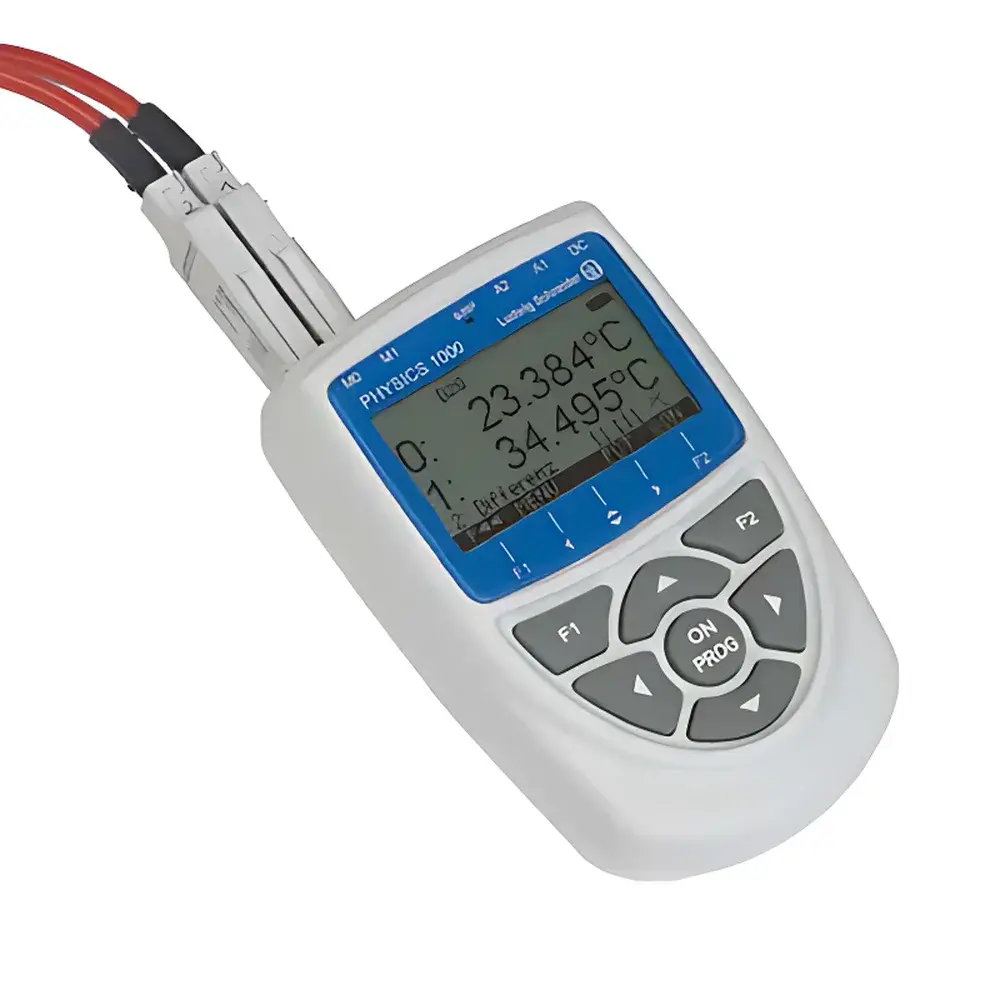
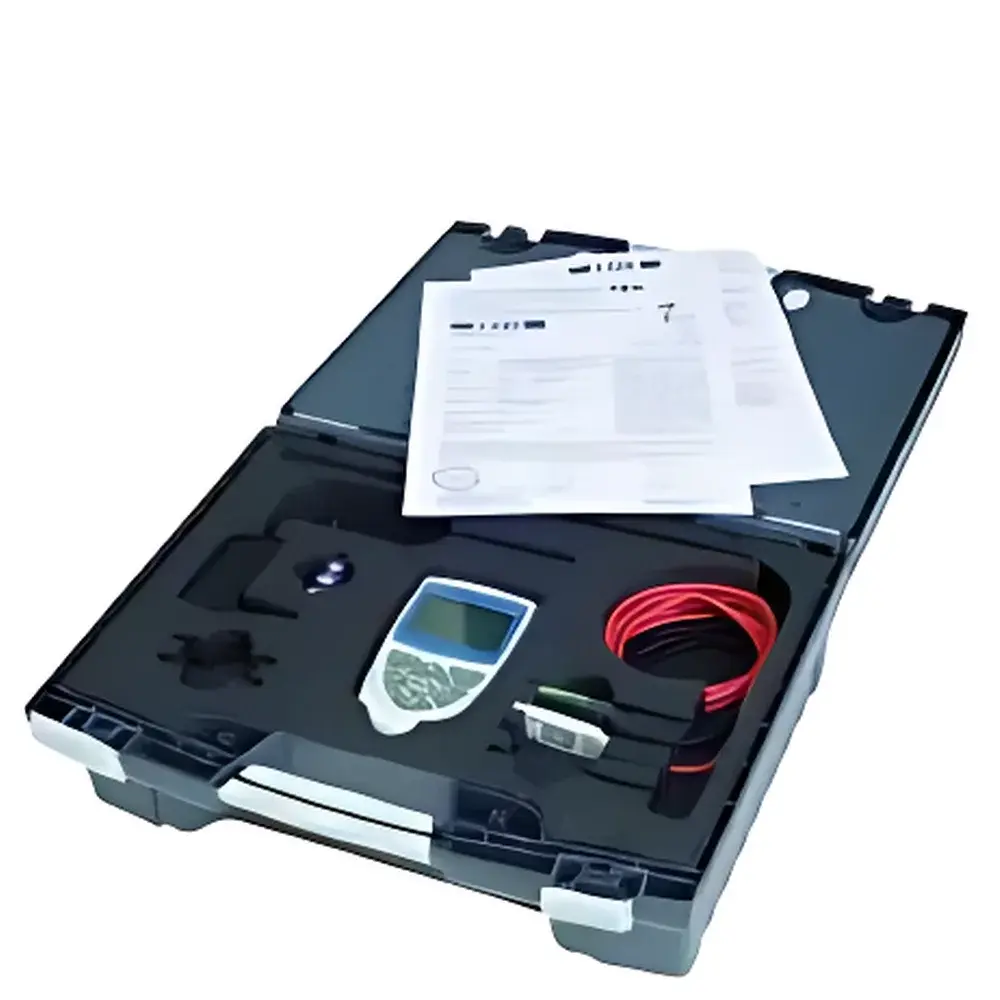
ChemTron PHYSICS 1000 High-Precision Digital Temperature Meter
| Brand | ChemTron |
|---|---|
| Origin | Germany |
| Model | PHYSICS 1000 |
| Measurement Principle | Dual-channel Pt100 resistance thermometry |
| Resolution | 0.001 K (selectable) |
| Accuracy | ±0.01% of reading + 3 digits |
| Temperature Range | −200 °C to +400 °C |
| Input Channels | 2 electrically isolated Pt100 inputs |
| Display | 128 × 64 pixel graphical LCD with dual-line backlight |
| Interfaces | USB, RS-232 (V.24), Ethernet, Bluetooth |
| IP Rating | IP54 |
| Data Storage | 99 manual readings + internal 25,000-point logging memory |
| Power | 3 × AA alkaline batteries (20 mA typical, 40 mA with backlight) or external 12 V DC adapter |
| Dimensions | 127 × 83 × 42 mm |
| Weight | 290 g |
| Compliance | DKD/DAkkS traceable calibration available |
| Software Support | PC-based configuration and data export (CSV, Excel-compatible) |
Overview
The ChemTron PHYSICS 1000 is a high-precision digital temperature meter engineered for laboratory, pilot-scale, and industrial process environments where metrological integrity and long-term stability are critical. It operates on the fundamental principle of platinum resistance thermometry—specifically, the IEC 60751-compliant Pt100 sensor standard—delivering traceable, repeatable temperature measurements across an extended range from −200 °C to +400 °C. Unlike generic thermo-hygrometers, the PHYSICS 1000 is purpose-built for quantitative thermal metrology: its 24-bit analog-to-digital converter (2.5 Mbit/s sampling rate), low-drift current source, and electrically isolated dual-input architecture eliminate common-mode interference and ensure minimal self-heating error—even during continuous monitoring of cryogenic or high-temperature processes. Its design reflects DIN EN ISO/IEC 17025-aligned instrumentation philosophy: each unit supports factory calibration with optional DKD-accredited certificates (traceable to PTB standards), enabling compliance with GLP, GMP, and FDA 21 CFR Part 11 requirements when integrated into validated workflows.
Key Features
- Dual electrically isolated Pt100 input channels with semiconductor-based galvanic protection (rated to 50 V), supporting simultaneous differential or independent measurements
- Selectable resolution modes: 0.001 K (high-resolution mode) or 0.01 K (optimized for dynamic response)
- Full unit flexibility: direct switching between °C, °F, and Kelvin without recalibration
- Graphical 128 × 64 pixel LCD display with dual white LED backlight—engineered for readability under ambient lighting extremes (e.g., cleanroom or cold storage environments)
- Multi-interface connectivity: native USB 2.0, RS-232 (V.24), 10/100 Mbps Ethernet, and Bluetooth 4.2 for seamless integration into SCADA, LIMS, or MES platforms
- On-device data management: 99 manually stored readings plus internal non-volatile memory capable of logging up to 25,000 timestamped values at user-defined intervals
- Configurable operational parameters—including zero offset, filtering (attenuation), sensor-specific scaling, annotation fields, contrast, backlight timeout, and serial communication baud rate
Sample Compatibility & Compliance
The PHYSICS 1000 is compatible with all standard 2-, 3-, or 4-wire Pt100 sensors meeting IEC 60751 Class A or B tolerances. Its electrical isolation enables safe use with grounded or floating sensor installations—critical in pharmaceutical autoclave validation, bioreactor jacket temperature mapping, or exothermic reaction calorimetry. The device conforms to EN 61326-1 (EMC for laboratory equipment) and EN 61010-1 (safety requirements for electrical equipment). Optional DKD calibration documentation satisfies ISO/IEC 17025 clause 6.5.2 for measurement traceability and supports audit readiness under EU Annex 11, USP , and ASTM E2877-21 (Standard Guide for Thermometer Calibration). IP54-rated enclosure ensures dust resistance and limited water ingress protection—suitable for controlled but non-sterile production floors or QC labs.
Software & Data Management
The PHYSICS 1000 includes a Windows-compatible configuration utility that enables full device parameterization, firmware updates, and bidirectional data exchange. Logged datasets export natively to CSV format with embedded timestamps, channel identifiers, and metadata (e.g., sensor ID, operator tag, calibration status). Audit trail functionality—when used with compliant PC software—supports electronic signature capture, change history, and 21 CFR Part 11–compliant user access control (role-based permissions, password enforcement, and immutable log archiving). Raw measurement files retain full 24-bit ADC resolution, permitting post-acquisition reprocessing without loss of fidelity.
Applications
- Pharmaceutical: Sterilization cycle validation (steam, dry heat), stability chamber monitoring, lyophilizer shelf temperature profiling
- Chemical R&D: Reaction calorimetry baseline stabilization, catalyst bed temperature uniformity assessment, distillation column tray monitoring
- Food & Beverage: Pasteurization hold-time verification, cold chain temperature mapping, fermentation temperature control loop verification
- Materials Science: Thermal expansion coefficient determination, cryogenic material testing (LN₂-cooled stages), polymer curing profile validation
- Calibration Laboratories: Reference thermometer intercomparison, secondary standard verification against PRTs or SPRTs
FAQ
What calibration certificates are available for the PHYSICS 1000?
Factory calibration certificates (with uncertainty budget per ISO/IEC 17025) are included. DKD/DAkkS-accredited calibration—traceable to Physikalisch-Technische Bundesanstalt (PTB)—is available as an optional service with documented measurement uncertainty and compliance statement.
Can the PHYSICS 1000 measure temperature differences between two points simultaneously?
Yes. Its dual-channel architecture supports real-time differential calculation (ΔT) with configurable averaging and filtering—ideal for heat transfer coefficient estimation or thermal gradient analysis.
Is the device suitable for use in hazardous areas?
No. The PHYSICS 1000 is not intrinsically safe or ATEX-certified. It is rated for general-purpose industrial and laboratory environments only (IP54, non-explosive atmospheres).
How is sensor drift compensated over time?
The instrument supports multi-point adjustment using certified reference standards. Users may perform on-site zero-point and span corrections at up to three defined temperatures, preserving linearity across the full operating range.
Does the Ethernet interface support Modbus TCP or other industrial protocols?
The native Ethernet port provides raw ASCII command/response over TCP/IP. Modbus TCP implementation requires middleware integration via the provided SDK or third-party OPC UA gateway solutions.



