
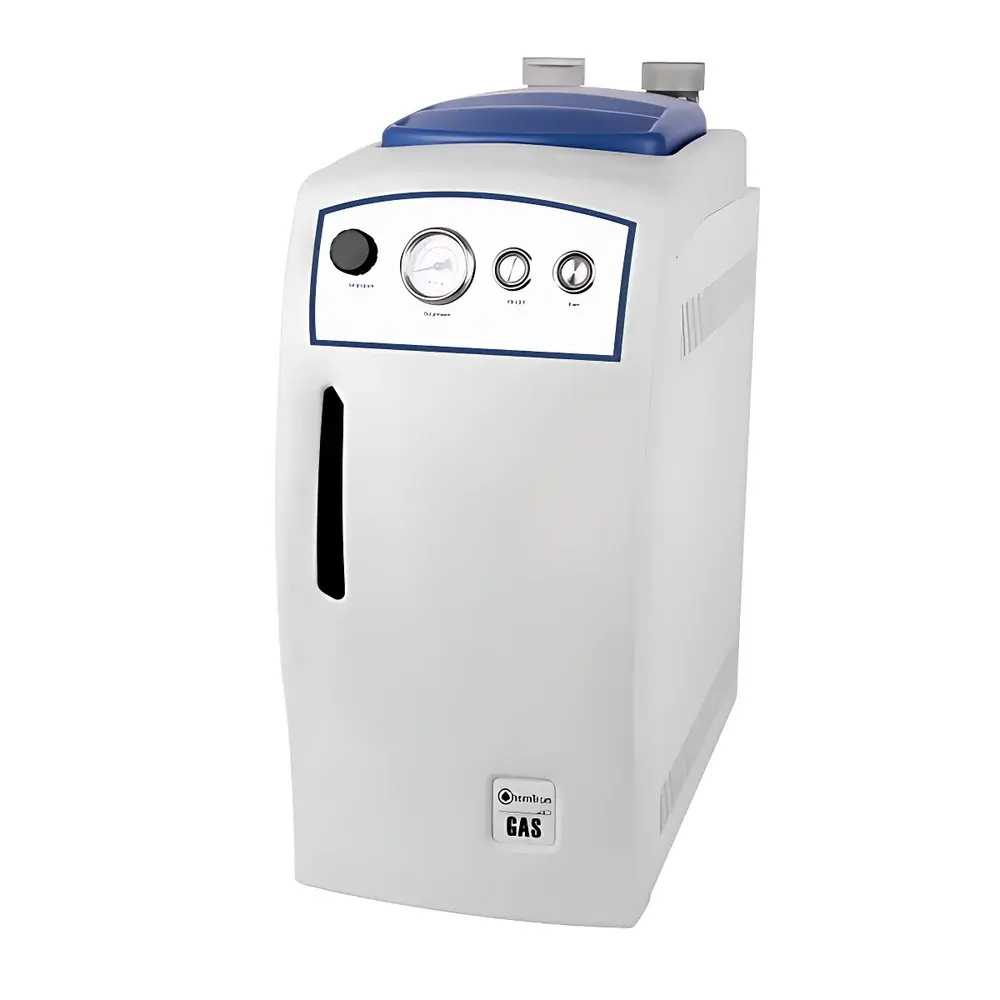
ChemTron EZ Series Silent Oil-Free Air Generator
| Brand | ChemTron |
|---|---|
| Origin | Switzerland |
| Model | EZA-1 / EZA-2 |
| Output Flow | 0–1000 mL/min (EZA-1), 0–2000 mL/min (EZA-2) |
| Output Pressure | 0–0.4 MPa |
| Pressure Stability | < 0.003 MPa |
| Filtration Precision | 5 µm |
| Power Consumption | ≤150 W (EZA-1), ≤200 W (EZA-2) |
| Operating Temperature | 1–40 °C |
| Relative Humidity | ≤85% RH |
| Dimensions (W×D×H) | 220×500×510 mm (EZA-1), 220×515×510 mm (EZA-2) |
| Weight | 15 kg (EZA-1), 20 kg (EZA-2) |
Overview
The ChemTron EZ Series Silent Oil-Free Air Generator is an engineered solution for laboratories requiring continuous, high-purity compressed air as a support gas in analytical instrumentation—particularly for flame ionization detection (FID) in gas chromatography (GC) systems. Unlike oil-lubricated compressors, the EZ series employs a maintenance-free, diaphragm-based compression mechanism coupled with multi-stage purification to deliver oil-free, dry, particle-free air without risk of hydrocarbon contamination or lubricant carryover. The system draws ambient air, passes it through a three-stage filtration train—including coalescing, desiccant, and activated carbon stages—followed by precision pressure regulation and stabilization. Its silent operation (< 45 dB(A)) and compact footprint make it suitable for benchtop integration in QC labs, research facilities, and regulated environments where noise, footprint, and gas purity are critical constraints.
Key Features
- Silent diaphragm compressor technology ensures oil-free, low-vibration, low-noise operation—ideal for shared laboratory spaces.
- Integrated automatic condensate drain with 5 µm particulate filtration eliminates manual moisture removal and prevents downstream blockage.
- Dual-output configuration supports simultaneous supply to GC-FID burners and external nitrogen generators, improving lab workflow efficiency.
- Large-capacity internal buffer tank with auto-pressure-hold control minimizes compressor cycling, extending service life and ensuring stable delivery pressure (< ±0.003 MPa deviation).
- Electromagnetic interference (EMI) filter suppresses electrical noise that could affect GC detector signal integrity or data acquisition stability.
- Tool-free replaceable desiccant and activated carbon columns—featuring color-indicating silica gel—enable rapid, operator-level maintenance without disassembly or specialized tools.
- Safety-certified pressure relief valve enables safe startup at atmospheric pressure, preventing mechanical stress on the compressor head during initial energization.
Sample Compatibility & Compliance
The EZ Series is designed to meet the stringent air quality requirements of ISO 8573-1 Class 1:2:1 (for particles, water, and oil) when operated within specified environmental conditions (1–40 °C, ≤85% RH). It complies with IEC 61000-6-3 (EMC emission standards) and carries CE marking per EU Machinery Directive 2006/42/EC. While not certified to FDA 21 CFR Part 11 out-of-the-box, its stable output, audit-ready pressure logging capability (via optional analog/digital interface), and traceable filter replacement intervals support alignment with GLP and GMP documentation practices. The unit is compatible with all major GC platforms requiring zero-air-grade combustion support gas—including Agilent, Thermo Fisher, Shimadzu, and PerkinElmer systems—as well as standalone nitrogen generators requiring clean, dry feed air.
Software & Data Management
The EZ Series operates as a stand-alone hardware system with no embedded firmware or proprietary software. All operational parameters—including real-time pressure, flow status, and compressor duty cycle—are indicated via front-panel LED displays and tactile controls. For integration into centralized lab monitoring networks, optional 0–5 V or 4–20 mA analog outputs provide continuous pressure and flow feedback signals. These interfaces enable connection to SCADA systems, LIMS, or building management platforms for preventive maintenance scheduling and environmental compliance logging. Filter replacement history, operating hours, and pressure deviation logs can be manually recorded in lab notebooks or digital SOPs to satisfy internal QA audits and ISO/IEC 17025 documentation requirements.
Applications
- Primary combustion air source for GC-FID detectors across pharmaceutical, environmental, petrochemical, and food safety testing laboratories.
- Clean, dry feed gas for membrane- or PSA-based nitrogen generators used in LC-MS, FTIR, or elemental analyzers.
- Instrument air supply for pneumatic actuators, sample introduction valves, and purge-and-trap systems requiring consistent low-oil-content airflow.
- Benchtop alternative to centralized compressed air systems in facilities lacking dedicated oil-free piping infrastructure.
- Backup or redundancy air source in regulated labs undergoing HVAC or utility maintenance cycles.
FAQ
What is the maximum allowable ambient humidity for reliable operation?
The unit is rated for continuous operation at relative humidity ≤85% RH. In high-humidity environments (>70% RH), more frequent condensate drainage and earlier desiccant replacement may be required to maintain pressure stability and prevent filter saturation.
Can the EZ Series replace bottled compressed air in GC-FID applications?
Yes—when maintained per ChemTron’s recommended service intervals and operated within specified temperature/humidity limits, the EZ Series delivers equivalent or superior air purity compared to Grade D cylinder air, eliminating cylinder logistics, rental fees, and contamination risks from valve leaks or regulator degradation.
Is the output air suitable for use with mass spectrometry systems?
No—the EZ Series is not configured for ultra-high-purity (UHP) requirements of MS inlet gases (e.g., < 1 ppb hydrocarbons). It is validated specifically for FID combustion support and nitrogen generator feed; UHP applications require additional catalytic purification stages.
How often should the silica gel and activated carbon filters be replaced?
Under typical lab conditions (25 °C, 50% RH), replacement is recommended every 6–12 months or after 2000–3000 hours of cumulative operation—whichever occurs first. Visual inspection of color-change indicators provides early warning of desiccant exhaustion.
Does the unit require external cooling or ventilation?
No—passive convection cooling is sufficient. However, minimum clearance of 10 cm on all sides is advised to ensure unrestricted airflow around heat-dissipating components and maintain long-term reliability.



