
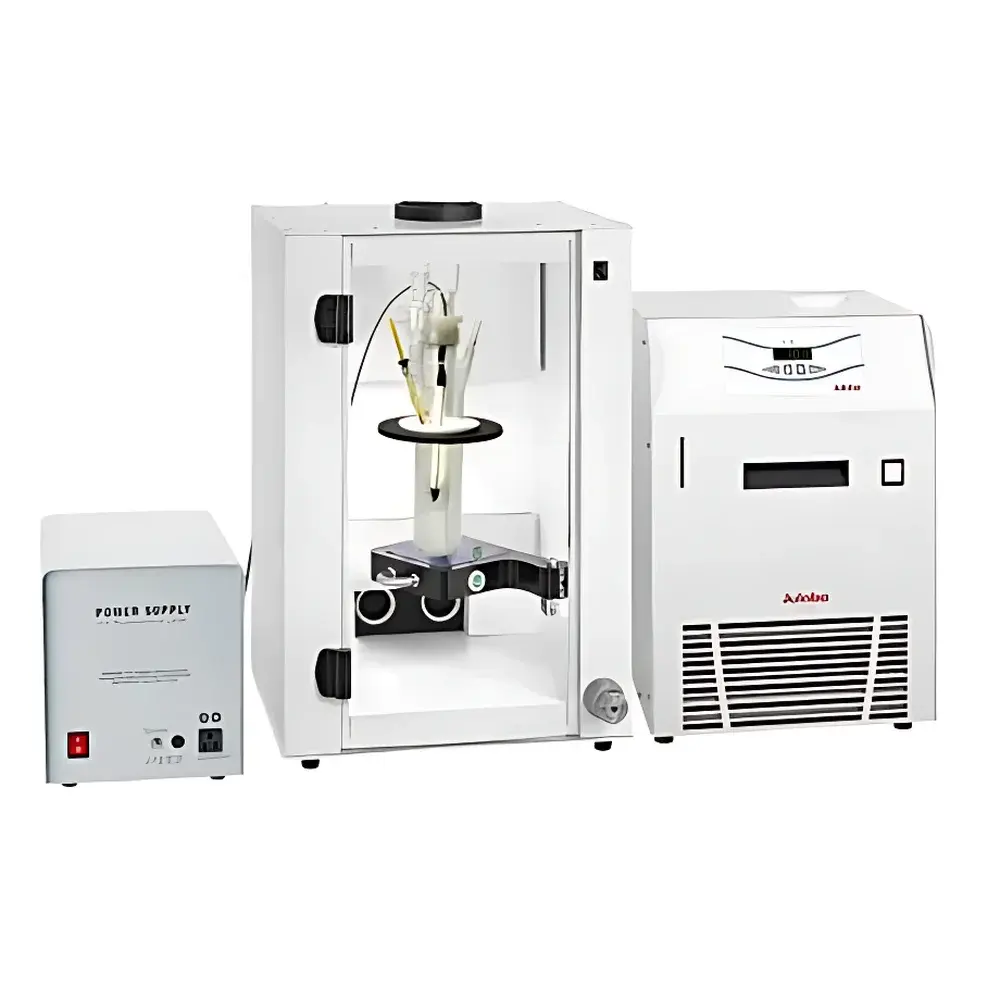
ChemTron PR Series Photochemical Reactor
| Brand | ChemTron |
|---|---|
| Origin | Germany |
| Model | PR Series |
| Vessel Material | Borosilicate Glass or Quartz |
| Working Pressure | Low-Pressure |
| Volume Options | 250 mL, 500 mL, 1000 mL |
| Light Source | Hanovia Medium-Pressure Mercury Lamp (450 W) |
| Cooling Interface | 8 mm water inlet/outlet |
| Temperature Control | Optional jacketed configuration with external circulator |
| Safety System | Integrated flow-monitoring and automatic lamp cutoff (WFM series) |
| Compliance | Designed for GLP-compliant photochemistry workflows under ISO/IEC 17025-aligned laboratory practices |
Overview
The ChemTron PR Series Photochemical Reactor is a precision-engineered, benchtop-scale photoreaction system designed for controlled, reproducible, and safe execution of light-driven chemical transformations. Built upon fundamental principles of photochemistry—where photons induce electronic excitation leading to bond cleavage, radical generation, or energy transfer—the PR Series enables rigorous investigation of reaction kinetics, quantum yield determination, photocatalytic mechanisms, and wavelength-dependent selectivity. Each reactor integrates a coaxial irradiation architecture: a central quartz or borosilicate glass lamp sleeve houses a stabilized medium-pressure mercury lamp (450 W), delivering intense UV–visible output (254 nm, 365 nm, and broadband emission) directly into the reaction mixture. The vessel geometry ensures uniform photon flux distribution across the sample volume while minimizing thermal gradients and wall effects—critical for quantitative photochemical studies in synthetic organic chemistry, materials science, and environmental catalysis.
Key Features
- Modular vessel design with standardized #50 Ace-thread ports (60/40 taper) for seamless integration of condensers, thermometers (#15), gas inlets, and reflux accessories
- Selectable vessel material: high-purity borosilicate glass (Duran®/Pyrex® grade) for general UV transparency; fused quartz options available for enhanced deep-UV transmission (<220 nm)
- Dual-cooling architecture: lamp sleeve actively cooled via regulated deionized water flow (2–30 L/min); optional jacketed variants support precise temperature control (−20 °C to +150 °C) using external JULABO heating/cooling circulators
- Integrated safety interlock system (WFM-230/WFM-OC): real-time monitoring of coolant flow rate; automatic lamp power cutoff within <1 second upon detection of low-flow or dry-run conditions
- Expandable platform: supports parallel operation (up to 6 reactors), continuous-flow photolysis (with peristaltic or HPLC-grade pump integration), and pilot-scale adaptation (20–100 L vessels with submerged lamp arrays)
- Comprehensive accessory ecosystem: interchangeable PTFE/FEP-coated stirrers, silicone-sealed stopcocks, spectral filter holders (14/24 thread), and explosion-resistant safety cabinets (JRS-9860-34) rated for Class I, Division 2 hazardous locations
Sample Compatibility & Compliance
The PR Series accommodates a broad range of photochemically active substrates—including organometallic complexes, photocatalysts (e.g., Ru(bpy)₃²⁺, Ir(ppy)₃), semiconductor nanoparticles, and polymerizable monomers—under inert (N₂, Ar) or reactive (O₂, Cl₂) atmospheres. All wetted parts comply with USP Class VI and FDA 21 CFR Part 110 requirements for material biocompatibility and extractables profiling. The system meets mechanical integrity standards per EN 13445-1 (Unfired Pressure Vessels) for low-pressure operation (<0.5 bar gauge). When configured with JULABO’s certified temperature controllers and WFM-series flow monitors, the full setup satisfies audit readiness criteria for GLP (OECD Principles) and GMP (ICH Q7) environments. Traceable calibration certificates are available for all sensor modules (flow, temperature, UV intensity) in accordance with ISO/IEC 17025:2017.
Software & Data Management
While the base PR Series operates via analog controls (230 V / 50 Hz stabilized power supply), optional digital upgrades enable full process documentation. The WFM-OC alarm module provides open-collector outputs compatible with PLCs and SCADA systems for centralized event logging. When paired with JULABO’s COBRA software suite (via RS485 or Ethernet), users gain access to time-stamped flow/temperature profiles, lamp-on duration tracking, and automated pass/fail flagging against pre-defined safety thresholds. Audit trails include operator ID, parameter changes, and emergency shutdown events—all compliant with FDA 21 CFR Part 11 requirements for electronic records and signatures. Raw sensor data exports to CSV or .tdms formats support post-acquisition kinetic modeling in MATLAB, OriginLab, or Python-based analysis pipelines.
Applications
- Synthetic methodology development: C–H functionalization, [2+2] cycloadditions, decarboxylative couplings, and asymmetric photocatalysis
- Photopolymerization kinetics: real-time monitoring of conversion (via inline FTIR or Raman) under controlled irradiance
- Environmental photochemistry: simulated solar degradation of micropollutants (pharmaceuticals, pesticides) in aqueous matrices
- Materials synthesis: sol-gel photocondensation, quantum dot surface ligand exchange, and MOF photoactivation
- Pharmaceutical photostability testing: ICH Q1B-compliant forced degradation studies under controlled UV exposure
- Photoelectrochemical screening: integration with potentiostats for in situ charge-transfer characterization
FAQ
What wavelength ranges are accessible with the standard Hanovia lamp?
The 450 W medium-pressure mercury lamp emits discrete lines at 254 nm (UVC), 313 nm (UVB), 365 nm (UVA), and 405 nm (violet), plus broadband continuum from ~220–700 nm. Optional bandpass filters (e.g., 10 nm FWHM) enable monochromatic irradiation.
Can the reactor be used under vacuum or elevated pressure?
The standard PR Series is rated for low-pressure operation only (≤0.5 bar gauge). For vacuum or high-pressure photochemistry, custom quartz vessels with reinforced flange seals and pressure-rated lamp sleeves are available upon engineering review.
Is temperature control mandatory during photolysis?
Yes—photonic energy deposition inevitably generates heat. Uncontrolled exotherms degrade quantum efficiency, promote side reactions, and risk thermal runaway. Jacketed configurations with external circulators are strongly recommended for kinetic studies requiring ±0.5 °C stability.
How is UV intensity calibrated and verified?
Each system ships with NIST-traceable radiometric calibration data for the installed lamp/filter combination. Users may validate irradiance (W/m²) at the vessel center using a handheld spectroradiometer (e.g., Ocean Insight USB2000+) mounted on the condenser port.
What maintenance intervals apply to the lamp and cooling system?
Hanovia lamps are rated for ≥1000 hours at nominal power. Coolant filters (JRS-12160-35) require replacement every 6 months; flow sensors should be recalibrated annually per ISO/IEC 17025 protocols.



