
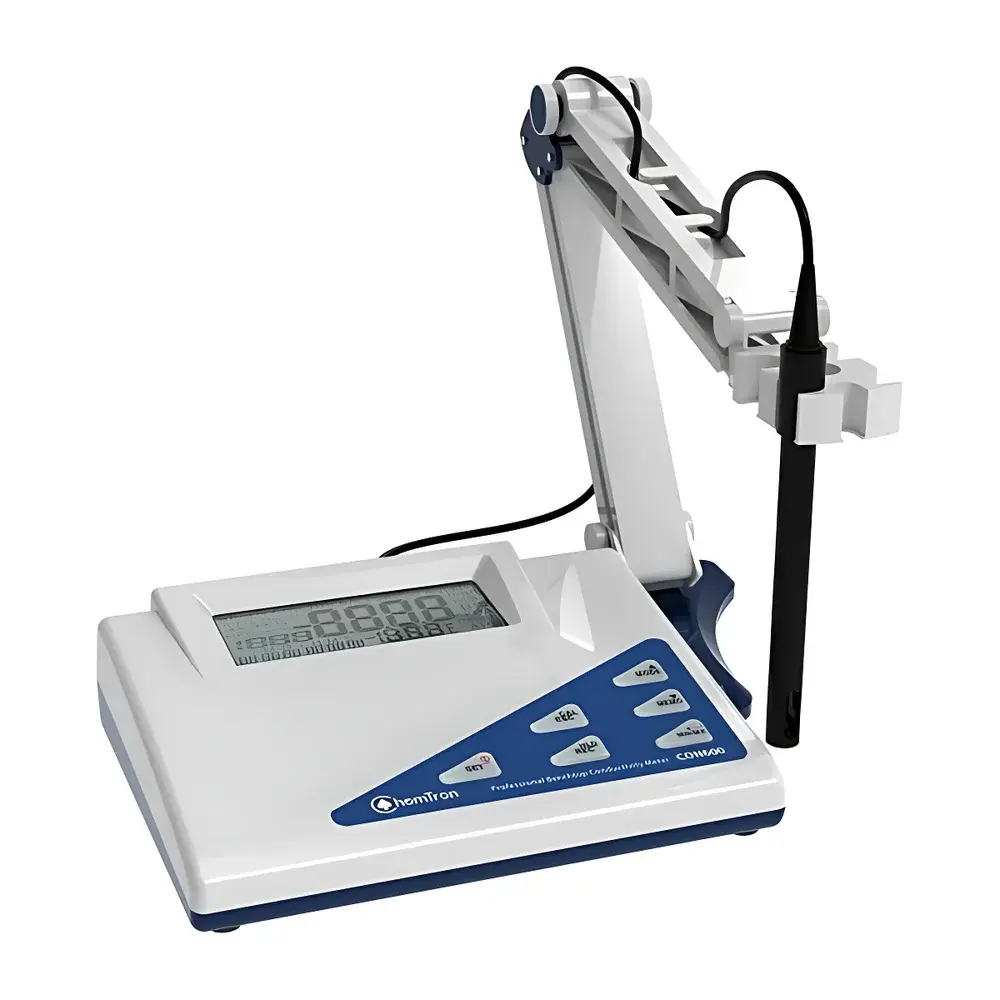
ChemTron CON600 Expert Desktop Conductivity Meter
| Brand | ChemTron |
|---|---|
| Origin | Germany |
| Model | CON600 |
| Configuration | Benchtop |
| Application | Laboratory Use |
| Conductivity Range | 0–199.9 mS/cm (5 ranges: 0–19.99 µS/cm, 0–199.9 µS/cm, 0–1999 µS/cm, 0–19.99 mS/cm, 0–199.9 mS/cm) |
| TDS Range | Adjustable factor 0.3–1.00 |
| Temperature Range | 5–40 °C (measurement), 0–80 °C (auto-compensation) |
| Accuracy | ±1% F.S. + 1 digit |
| Minimum Resolution | 0.01 µS/cm |
| Data Storage | 99 sets with timestamp |
| Interface | RS232 (optional AX30-232-RS232PC kit) |
| Dimensions | 217 × 168 × 58 mm |
| Weight | 2.1 kg |
Overview
The ChemTron CON600 Expert Desktop Conductivity Meter is a precision-engineered laboratory instrument designed for reliable, repeatable measurement of electrical conductivity and derived parameters—including Total Dissolved Solids (TDS)—in aqueous solutions. Operating on the principle of two-electrode or four-electrode AC conductivity measurement (depending on selected sensor), the CON600 applies a low-frequency alternating current across a calibrated cell to determine solution resistance, which is then converted to conductivity using the cell constant (K = 0.1, 1.0, or 10 cm⁻¹). Its five auto-ranging conductivity scales—spanning from 0.01 µS/cm to 199.9 mS/cm—enable seamless transition between ultra-pure water analysis and high-salinity industrial effluent testing. Built to meet routine QC/QA requirements in pharmaceutical, environmental, food & beverage, and academic laboratories, the CON600 complies with fundamental metrological practices outlined in ISO/IEC 17025 and supports traceable calibration per ASTM D1125 and USP . The integrated temperature compensation algorithm (0–80 °C, linear or non-linear NIST-based) ensures thermally corrected readings without manual correction tables.
Key Features
- Five auto-ranging conductivity scales with independent calibration points—each range calibrated at one certified reference point for optimized accuracy across full span
- Adjustable TDS conversion factor (0.3–1.00) supporting multiple industry-specific conversion models (e.g., NaCl-equivalent, KCl-equivalent)
- High-resolution display with dynamic digit resolution: 0.01 µS/cm (low range) up to 0.1 mS/cm (high range)
- Onboard data logging of up to 99 measurements with automatic date/time stamping—exportable via RS232 interface using optional AX30-232-RS232PC communication kit
- Dedicated electrode holder (included) ensures stable, vibration-damped positioning during kinetic or long-term monitoring applications
- Robust benchtop architecture with IP20-rated enclosure, CE-marked power adapter (input: 100–240 VAC), and operating humidity tolerance up to 95% RH (non-condensing)
- Support for three interchangeable conductivity cells: CT25-A0016 (K = 1.0 cm⁻¹), CT25-A0026 (K = 0.1 cm⁻¹), and CT25-A0036 (K = 10 cm⁻¹), enabling optimal cell constant selection per sample matrix
Sample Compatibility & Compliance
The CON600 is validated for use with deionized water, buffer solutions, process streams, wastewater, seawater dilutions, and pharmaceutical preparations. Its K = 0.1 cell option enables high-precision measurement in ultrapure water (UPW) systems where conductivity falls below 1 µS/cm—critical for semiconductor rinse validation and pharmacopeial water-for-injection (WFI) testing per USP . For higher ionic strength samples—including brines, electroplating baths, and desalination feedwater—the K = 10 cell maintains signal integrity and minimizes polarization error. All factory-supplied standards (SDC014-A125: 1413 µS/cm; SDC128-A125: 12.88 mS/cm) are traceable to NIST SRM 3199 and certified per ISO Guide 34. The instrument’s design facilitates GLP-compliant operation: audit-ready calibration logs, user-accessible calibration history, and no internal battery-backed memory that could compromise data integrity during power loss.
Software & Data Management
While the CON600 operates as a standalone meter, its RS232 serial port (enabled via optional AX30-232-RS232PC interface cable and terminal emulation software) permits real-time data streaming or batch download of stored measurements. Exported CSV files include columns for conductivity value, TDS equivalent, temperature, timestamp, and active range—enabling direct import into LIMS, Excel, or statistical process control (SPC) platforms. No proprietary software installation is required; standard terminal programs (e.g., PuTTY, Tera Term) suffice for ASCII protocol communication. Calibration records remain embedded in device memory and can be recalled locally without PC connection—ensuring continuity during FDA 21 CFR Part 11-aligned workflows where electronic signature and audit trail functionality are managed externally.
Applications
- Pharmaceutical water system validation (Purified Water, WFI, Clean Steam condensate)
- Environmental monitoring of surface water, groundwater, and wastewater treatment effluents
- Food & beverage quality control: brewing liquor analysis, dairy processing rinse validation, soft drink formulation
- Academic teaching labs for electrochemistry fundamentals and solution thermodynamics
- Industrial boiler feedwater and cooling tower chemistry management
- Calibration verification of inline conductivity sensors in continuous process environments
FAQ
Does the CON600 support automatic temperature compensation (ATC)?
Yes—it features programmable linear or non-linear ATC across 0–80 °C using either built-in RTD sensing or optional PT9020 external stainless-steel probe.
Can I perform multi-point calibration within a single range?
No—the CON600 implements one-point calibration per range, aligned with ISO 7888 and ASTM D1125 best practices for routine conductivity instrumentation.
Is the memory volatile if power is disconnected?
No—stored data and calibration settings persist through power cycles due to non-volatile EEPROM memory.
What regulatory standards does the CON600 help satisfy?
It supports compliance with USP , EP 2.2.38, JP 2.05, ISO 7888, and ASTM D1125; full traceability requires use of NIST-traceable standards and documented calibration procedures.
How often should the conductivity cell be recalibrated?
Frequency depends on usage intensity and sample fouling risk; typical lab practice is daily verification with a check standard and full recalibration every 24–48 hours or per SOP-defined intervals.
Related Products




