
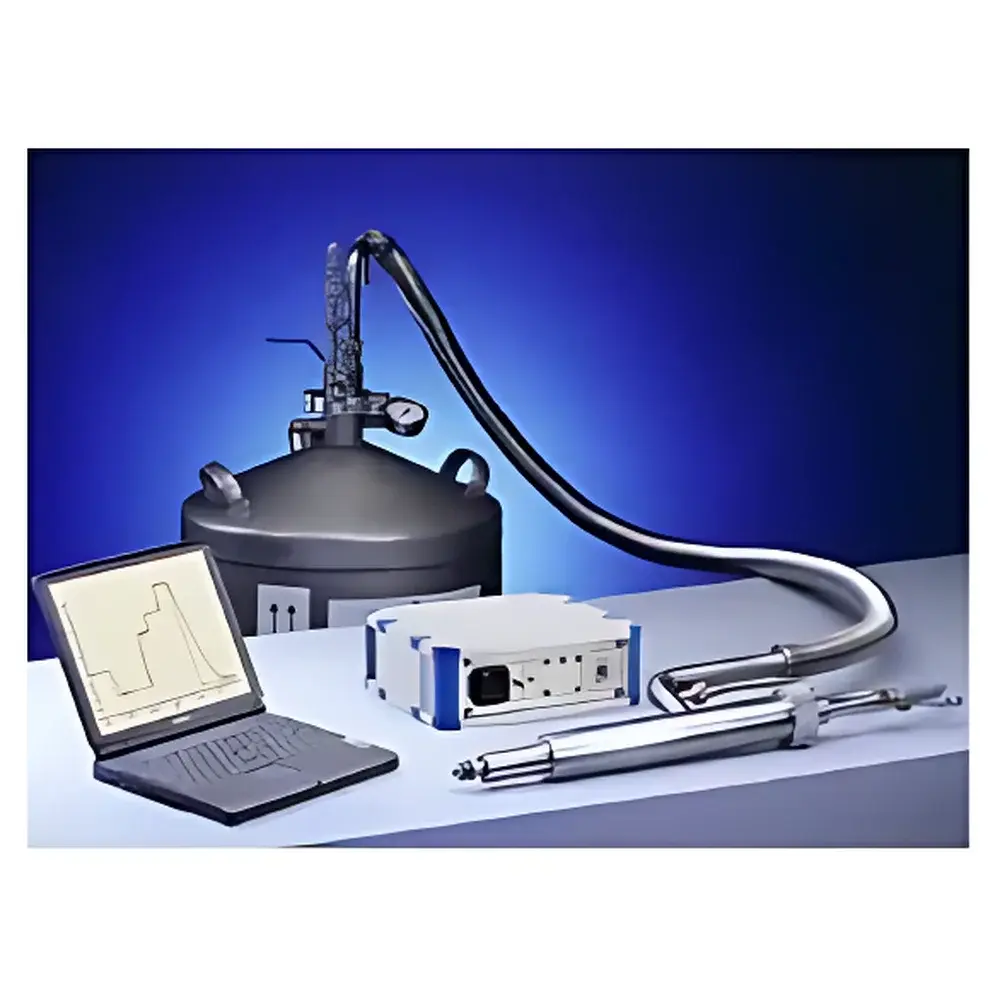
Julabo-Chemtron TG-LKF High-Precision Heating and Cooling Gas Temperature Control System
| Brand | Julabo-Chemtron |
|---|---|
| Origin | Germany |
| Model | TG-LKF |
| Cooling Medium | Evaporated Liquid Nitrogen (LN₂) |
| Minimum Temperature | −180 °C |
| Temperature Control Accuracy | ±0.2 °C (SL5 Controller), up to ±0.1 °C with optimized parameters |
| Heating Power | 630 W |
| Vaporizer Power | 500 W or 1000 W (model-dependent) |
| LN₂ Consumption | 1.1–11 L/h (500 W) or 2.2–22 L/h (1000 W) |
| Flexible Cryogenic Gas Line | V2A stainless steel, 1.8 m, vacuum-insulated |
| Connection Interface | KF NW 50 flange + multiple fitting options (male/female thread, clamp, Swagelok® compression, nut-type) |
Overview
The Julabo-Chemtron TG-LKF High-Precision Heating and Cooling Gas Temperature Control System is an engineered solution for dynamic, high-fidelity thermal conditioning of external experimental setups using evaporated liquid nitrogen (LN₂) as the primary cooling medium. Unlike conventional compressor-based cryogenic systems, the TG-LKF leverages controlled phase-change thermodynamics—precisely regulating LN₂ evaporation rate, gas temperature, and mass flow—to deliver rapid, stable, and programmable cooling down to −180 °C. Its dual-mode architecture integrates resistive heating (630 W) with variable-power vaporizers (500 W or 1000 W), enabling seamless transition between deep cryogenic operation and precise sub-ambient to elevated temperature control (typically −180 °C to +150 °C, dependent on application configuration). The system operates via a closed-loop gas delivery path: LN₂ is drawn from a standard dewar through a KF NW 50虹吸 (siphon) interface, vaporized in a thermostatically regulated heat exchanger, and delivered as dry, particle-free nitrogen gas through a vacuum-jacketed, flexible V2A stainless-steel conduit. This design eliminates condensation risk, minimizes thermal lag, and ensures repeatable thermal boundary conditions critical for materials testing, reaction calorimetry, and low-temperature mechanical characterization.
Key Features
- Ultra-low temperature capability: Continuous, stable output of cryogenic nitrogen gas at −180 °C with <5 min cooldown time from ambient
- Modular architecture: Interchangeable vaporizer modules (500 W / 1000 W), heating elements, and gas delivery assemblies—no need to replace core infrastructure (dewar, vacuum pump, controller)
- High-resolution temperature control: SL5 digital controller with PID tuning, offering ±0.2 °C standard accuracy; enhanced calibration and feedback optimization support ±0.1 °C stability over extended periods
- Intelligent LN₂ economy: Adaptive vaporizer power modulation and real-time mass flow regulation reduce liquid nitrogen consumption by up to 40% versus fixed-flow systems (1.1–11 L/h or 2.2–22 L/h, model-dependent)
- Vacuum-insulated flexible conduit: 1.8 m V2A stainless-steel line with integrated vacuum jacket ensures minimal parasitic heat ingress and mechanical compliance for integration into complex test rigs
- Multi-standard mechanical interface: KF NW 50 flange plus configurable termination options—including male/female NPT, ISO-KF clamp, Swagelok® compression, and nut-type fittings—for direct coupling to sample chambers, tensile stages, or environmental enclosures
Sample Compatibility & Compliance
The TG-LKF is designed for integration into third-party instrumentation requiring externally sourced, precisely regulated cryogenic gas streams. It is routinely deployed in ASTM D648 (heat deflection temperature), ISO 75 (temperature of deflection under load), and ASTM E228 (linear thermal expansion) compliant test environments. Its dry, inert nitrogen output meets ISO 8573-1 Class 2 purity requirements for particulate and moisture content, making it suitable for GMP-aligned material qualification workflows where chamber contamination must be avoided. When paired with validated controllers and audit-trail-enabled software (e.g., Julabo’s PT100-compatible LabView drivers or optional FDA 21 CFR Part 11-compliant logging modules), the system supports GLP/GMP documentation requirements for QC laboratories performing thermal stability assessments per ICH Q1A(R2) or USP . No internal sample contact occurs—the system delivers conditioned gas only; compatibility is governed solely by the thermal and mechanical interface between the TG-LKF outlet and the user’s test apparatus.
Software & Data Management
The TG-LKF operates natively with Julabo’s SL5 digital temperature controller, featuring front-panel programming, real-time setpoint ramping, and alarm-triggered safety shutdown (e.g., dewar level monitoring, overtemperature, flow interruption). Optional RS485/Modbus RTU or Ethernet/IP interfaces enable integration into centralized SCADA or LIMS platforms. Third-party software compatibility includes LabVIEW™ (NI-DAQmx drivers), MATLAB® Instrument Control Toolbox, and Python (PySerial/MinimalModbus libraries) for custom automation sequences—such as synchronized thermal profiling during DMA, DSC, or mechanical fatigue tests. All temperature logs are timestamped and exportable in CSV format; when configured with optional secure logging firmware, event-driven audit trails (user login, parameter change, alarm activation) comply with FDA 21 CFR Part 11 electronic record requirements. No cloud connectivity or proprietary cloud services are embedded—data sovereignty and network isolation are preserved by default.
Applications
- Thermal analysis: Rapid quenching and isothermal hold for DSC, TMA, and DMA sample preconditioning
- Mechanical testing: Low-temperature tensile, torsion, and Charpy impact testing per ASTM E23 and ISO 148
- Materials science: Thermal cycling of composites, polymers, and metal alloys to assess embrittlement thresholds and phase transition behavior
- Electronics reliability: Junction temperature simulation and accelerated life testing of semiconductors and PCB assemblies
- Biopharma: Controlled vitrification of protein crystals, cryopreservation validation, and cold-chain process development
- Chemical process engineering: Exothermic reaction quenching, catalyst deactivation studies, and low-T kinetics investigations
- Environmental simulation: Coupling with climate chambers (e.g., TG-G air-cooling variant for −20 °C ambient conditioning) for multi-stress accelerated aging
FAQ
What is the lowest achievable temperature with the TG-LKF system?
The system delivers continuous, stabilized nitrogen gas flow at −180 °C when operating with liquid nitrogen and the 1000 W vaporizer module.
Can the TG-LKF be used without a liquid nitrogen dewar?
No—it is specifically engineered for LN₂-based cooling; alternative refrigerants or compressor-based operation are not supported.
Is the nitrogen gas output dry and oil-free?
Yes—evaporated LN₂ yields inherently dry, particle-free, hydrocarbon-free nitrogen meeting ISO 8573-1 Class 2 specifications.
How is temperature uniformity maintained across the target sample zone?
Uniformity depends on user-side gas distribution design (e.g., nozzle geometry, chamber volume, flow velocity); the TG-LKF ensures inlet gas stability—spatial gradients must be characterized separately per application.
Does the system require periodic recalibration?
Annual verification against traceable Pt100 standards is recommended; the SL5 controller supports two-point calibration routines with user-accessible offset/gain adjustment.



