
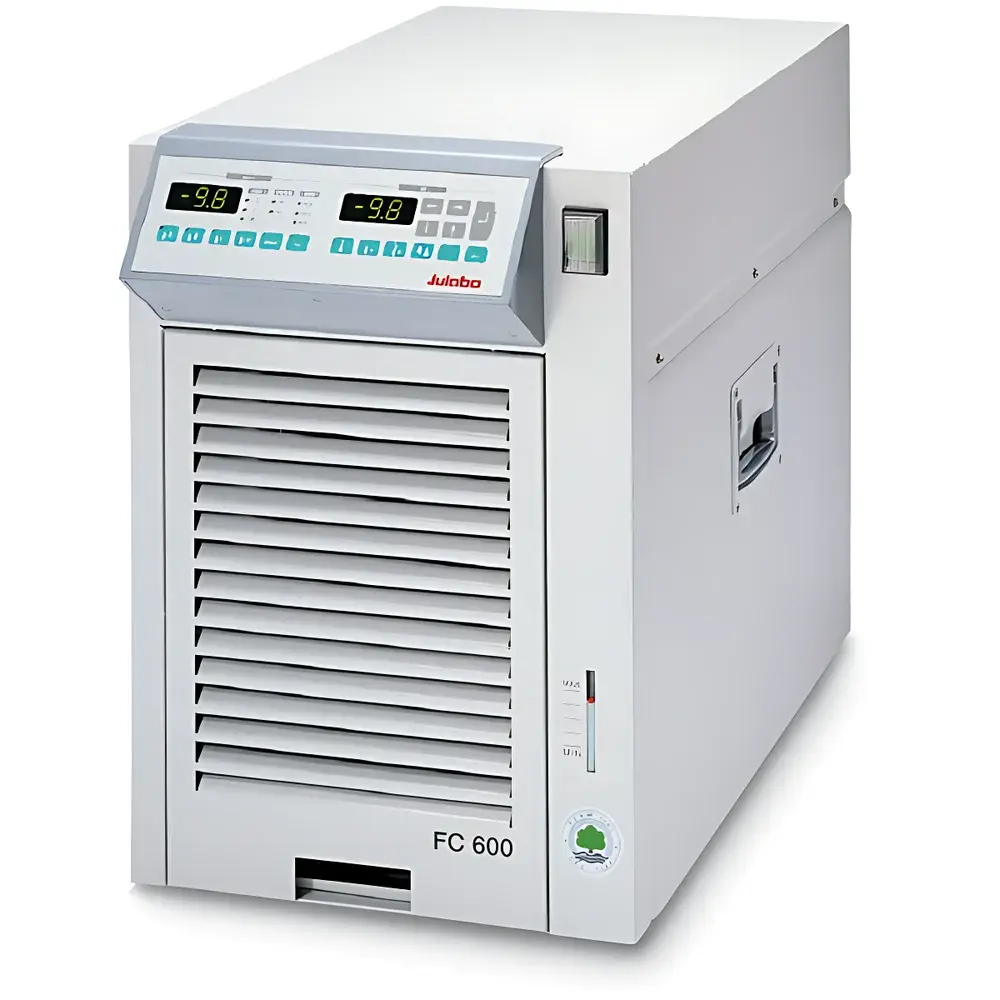
Julabo FCW600 Circulating Chiller
| Brand | Julabo |
|---|---|
| Origin | Germany |
| Model | FCW600 |
| Instrument Type | Integrated Circulating Chiller |
| Cooling Method | Water-Cooled |
| Temperature Range | −20 to +80 °C |
| Temperature Stability | ±0.2 °C |
| Refrigeration Capacity | 600 W at 20 °C |
| Heating Power | 1.2 kW |
| Pump Flow Rate | 20 L/min |
| Pump Pressure | 0.5 bar |
| Reservoir Volume | 6–8 L |
| Operating Mode | Continuous |
| Display Resolution | 0.1 °C |
| External Pt100 Input | Integrated |
| Communication Interface | RS232 (optional), Profibus (optional) |
| Ambient Operating Temperature | 5–40 °C |
| Dimensions (W×L×H) | 35 × 54 × 49 cm |
| Weight | 43 kg |
| Sound Pressure Level (1 m) | 51 dBA |
| Refrigerant | Environmentally Compliant (R-404A or R-507, per EU F-Gas Regulation) |
Overview
The Julabo FCW600 Circulating Chiller is an integrated, water-cooled temperature control system engineered for high-precision thermal management in demanding laboratory environments. Based on vapor-compression refrigeration with a dual-function compressor and electric heating element, the FCW600 delivers simultaneous cooling and heating across a continuous operating range of −20 °C to +80 °C. Its design eliminates reliance on municipal tap water for heat rejection—replacing wasteful once-through cooling with a closed-loop, recirculating coolant circuit. This not only conserves water but also ensures stable thermal performance independent of seasonal inlet water temperature fluctuations. The unit complies with IEC 61000-6-3 (EMC emission standards) and IEC 61000-6-2 (immunity), and its refrigerant selection adheres to EU Regulation No. 517/2014 (F-Gas Regulation), ensuring environmental compliance for global deployment.
Key Features
- High temperature stability of ±0.2 °C across the full operating range, achieved via PID-controlled dual-stage refrigeration and proportional heating
- Integrated dual LED display interface: simultaneously shows setpoint and actual bath temperature, along with configurable high/low temperature alarm thresholds and safety cutoff limits
- Adjustable ΔT (temperature differential) between inlet and outlet ports, enabling precise matching to external process load characteristics
- Variable-speed circulation pump (20 L/min max flow, 0.5 bar pressure) with adjustable output pressure and flow rate—optimized for compatibility with calorimeters, spectrophotometers, rotary evaporators, and laser systems
- Intuitive reservoir design with transparent level indicator, anti-freeze protection logic, low-level alarm, and automatic shutdown on critical fault conditions
- Compact footprint (35 × 54 × 49 cm) and robust steel enclosure with vibration-damped compressor mounting for low-noise operation (51 dBA at 1 m)
- Pre-installed Pt100 sensor input for external temperature feedback—enabling cascade control configurations with third-party instruments or process controllers
Sample Compatibility & Compliance
The FCW600 is compatible with standard aqueous and water-glycol coolant mixtures (up to 30% v/v ethylene or propylene glycol). It interfaces seamlessly with analytical instrumentation requiring stable thermal conditioning—including HPLC column ovens, ICP-MS torch coolers, NMR probe chillers, and vacuum pump condensers. All electrical components meet CE marking requirements under the Low Voltage Directive (2014/35/EU) and EMC Directive (2014/30/EU). For regulated environments, the optional RS232 or Profibus interface supports audit-ready data logging when paired with validated software platforms compliant with FDA 21 CFR Part 11 and ISO/IEC 17025 documentation workflows.
Software & Data Management
While the FCW600 operates autonomously via its front-panel controller, optional digital connectivity enables integration into centralized lab infrastructure. The RS232 port supports ASCII command protocol for remote setpoint adjustment, status polling (temperature, alarm state, pump status), and real-time data streaming at 1 Hz resolution. When used with Julabo’s WinTemp software or third-party SCADA systems (e.g., LabVIEW, Ignition), users can configure automated temperature ramps, generate timestamped CSV logs, and trigger email/SNMP alerts on deviation events. Audit trails—including operator ID, parameter changes, and system faults—are retained locally for GLP/GMP traceability where configured per site-specific validation protocols.
Applications
- Thermal stabilization of high-resolution mass spectrometry sources and collision cells
- Cooling of high-power LED arrays and semiconductor test fixtures requiring tight ΔT control
- Temperature regulation in accelerated stability chambers and photostability testing cabinets
- Condenser cooling for rotary evaporation under reduced pressure (−20 °C to +25 °C typical)
- Supporting cryogenic sample preparation workflows in materials science labs (e.g., controlled-rate freezing of polymers or biomaterials)
- Process cooling for small-scale chemical synthesis reactors with exothermic reaction profiles
FAQ
What coolant types are approved for use with the FCW600?
Deionized water or water-propylene glycol mixtures (≤30% v/v) are recommended. Ethylene glycol is permitted but requires corrosion-inhibitor additives compatible with stainless steel and EPDM wetted parts.
Can the FCW600 be operated in ambient temperatures above 40 °C?
No. Sustained operation above 40 °C ambient compromises condenser efficiency and may trigger thermal overload protection; installation must comply with specified ventilation clearance (≥10 cm rear/side, unrestricted top airflow).
Is the unit suitable for cleanroom environments?
Yes—the sealed refrigeration circuit, low particulate generation, and absence of external water connections make it appropriate for ISO Class 7/8 cleanrooms when installed with HEPA-filtered intake air.
Does the FCW600 support external program controllers like the Julabo PG6?
The FCW600 does not include native analog I/O for direct PG6 integration; however, its RS232 interface allows bidirectional communication with programmable logic controllers (PLCs) or PC-based sequencers using Modbus RTU or Julabo ASCII protocol.
How is calibration verification performed?
Users perform periodic verification using a NIST-traceable reference thermometer immersed in the reservoir; Julabo provides factory calibration certificates (ISO/IEC 17025 accredited) and supports IQ/OQ documentation packages for GxP-regulated installations.



