
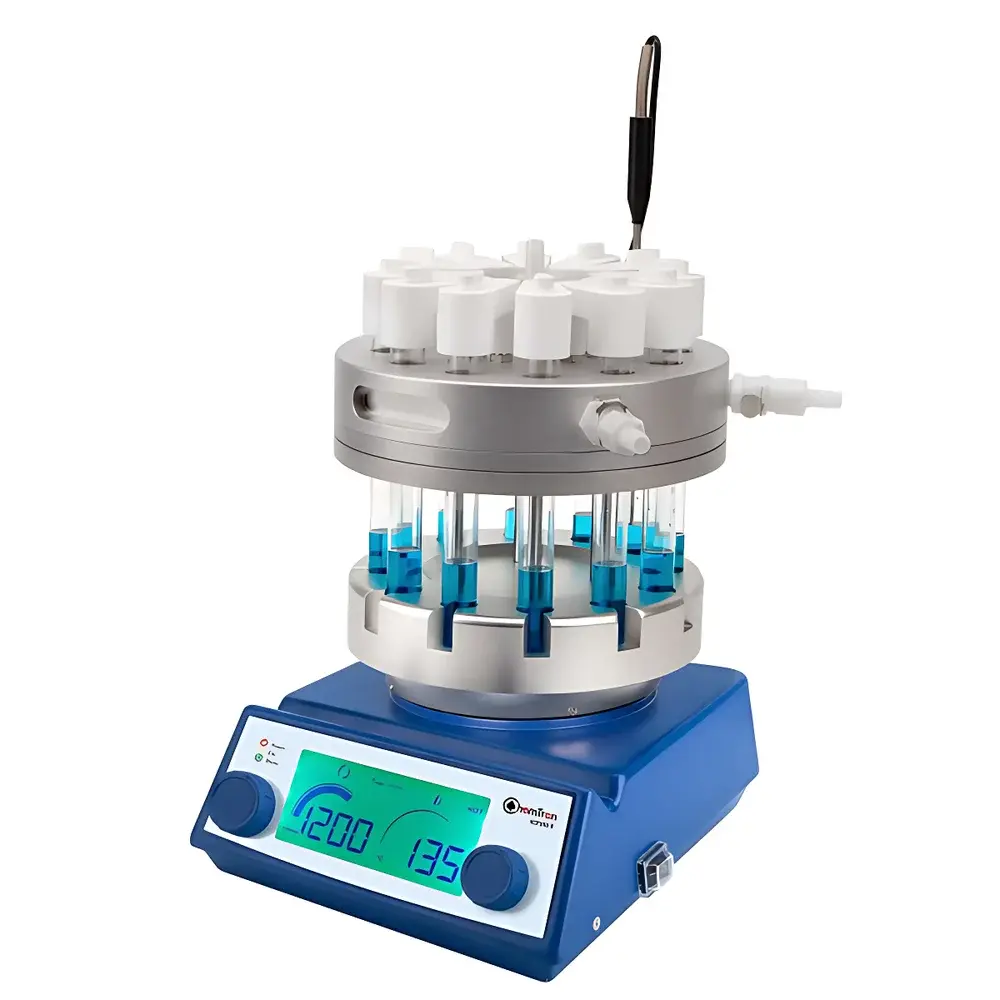
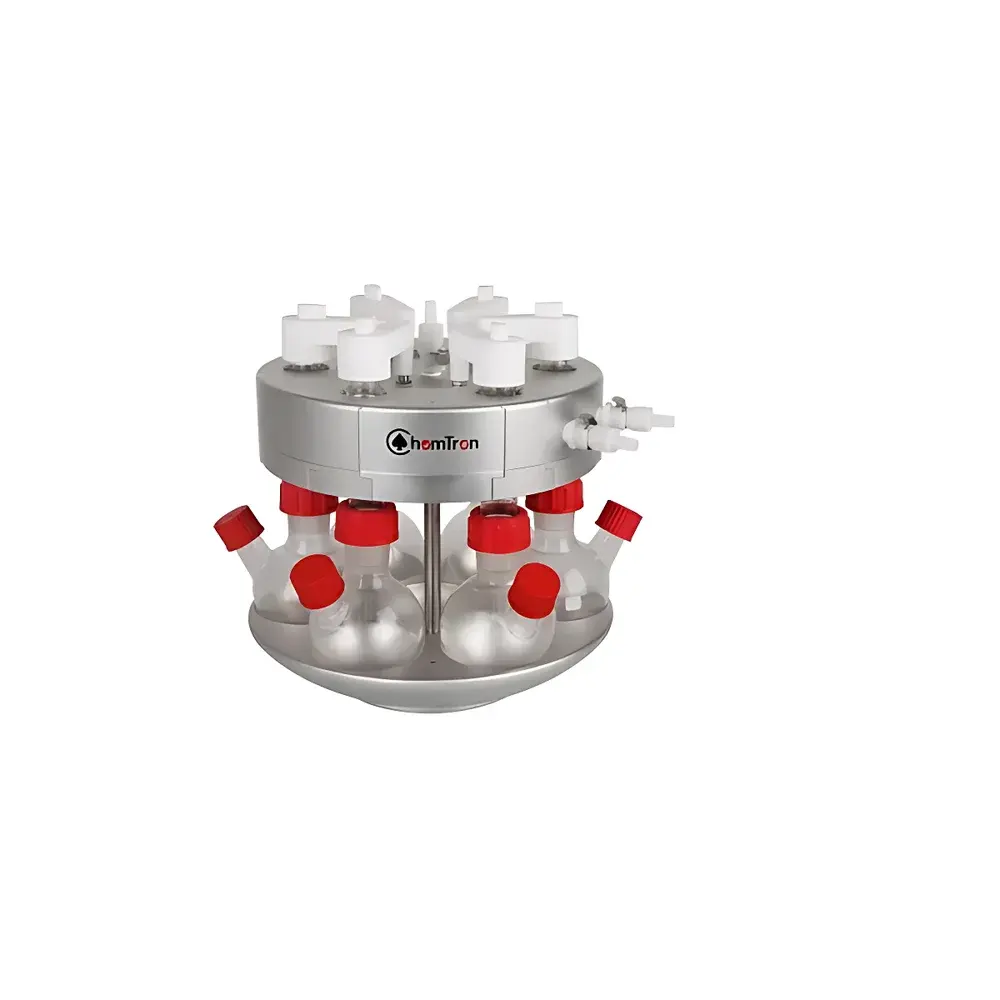
ChemTron PRS-12 12-Position Parallel Synthesis Reactor
| Brand | ChemTron |
|---|---|
| Origin | Germany |
| Model | PRS-12 |
| Temperature Range | RT+5 to 180 °C |
| Temperature Control Accuracy | ±0.5 °C |
| Number of Reaction Positions | 12 |
| Reaction Vessel Capacity | 12 × 20 mL |
| Vacuum Level | ≥20 mbar |
| Stirring Speed | 100–600 rpm |
| Wetted Materials | Borosilicate Glass 3.3 / PTFE |
| Reflux Capability | Yes |
| Inert Atmosphere Compatibility | Yes |
Overview
The ChemTron PRS-12 is a precision-engineered 12-position parallel synthesis reactor designed for high-throughput, reproducible chemical reaction screening under controlled thermal, atmospheric, and mechanical conditions. Based on Couette-type magnetic stirring and uniform conductive heating principles, the system enables simultaneous execution of up to twelve independent reactions in identical environmental parameters—ensuring inter-run comparability critical for kinetic studies, catalyst evaluation, and route scouting. Each position features individual PTFE-sealed gas inlet/outlet valves connected via a centralized manifold, allowing selective inert gas purging (N₂ or Ar) or vacuum application without cross-contamination. The reactor operates within a validated temperature range of RT+5 °C to 180 °C, with real-time monitoring via calibrated PT100 sensors embedded in the aluminum heating base. Its modular architecture integrates seamlessly with standard ChemTron magnetic hotplates, eliminating positional thermal gradients and ensuring consistent energy input across all vessels.
Key Features
- Twelve independently controllable reaction stations, each accommodating a 20 mL borosilicate glass 3.3 tube with PTFE-sealed cap and integrated condenser port
- Centralized inert gas/vacuum manifold with twelve chemically resistant PTFE flow-control valves—enabling sequential or parallel atmosphere control per vessel
- Digital temperature regulation with ±0.5 °C accuracy over full operating range (RT+5 to 180 °C), verified per DIN EN 61000-4-30
- Magnetic stirring speed adjustable from 100 to 600 rpm; torque consistency maintained across all positions via shared heating-stirring plate design
- Integrated timer-based endpoint control: automatic deactivation of heating and stirring after user-defined duration, supporting unattended overnight operation
- Modular ring-shaped frame constructed from anodized aluminum; optimized footprint (≤350 mm diameter) for benchtop use outside fume hoods
- Quick-connect CPC fittings for external cooling water lines; built-in shut-off valves prevent leakage during disconnection
- Dual safety layers: programmable overtemperature cutoff plus independent hardware-limiting thermal fuse (settable up to 220 °C)
Sample Compatibility & Compliance
The PRS-12 accommodates standard 20 mL reaction tubes fabricated from DIN ISO 3585-compliant borosilicate glass 3.3, ensuring resistance to thermal shock and compatibility with aggressive reagents including concentrated acids, halogenated solvents, and organometallics. All wetted seals and valve components are manufactured from virgin PTFE (ASTM D4894), certified non-reactive per USP Class VI and FDA 21 CFR 177.1550. The system supports GLP/GMP-aligned workflows through traceable parameter logging (when paired with optional ChemTron DataBridge software) and meets essential requirements of ISO/IEC 17025 for method validation in contract research laboratories. Vacuum performance (≥20 mbar) complies with ASTM E5050 for low-pressure reaction applications such as solvent removal or moisture-sensitive transformations.
Software & Data Management
While the PRS-12 operates as a standalone instrument with front-panel digital controls, it is fully compatible with ChemTron’s optional DataBridge 3.0 software suite. This Windows-based platform provides time-synchronized logging of temperature setpoints, actual readings, stirring speed, and runtime duration for each position. Export formats include CSV and PDF reports compliant with FDA 21 CFR Part 11 when configured with electronic signatures and audit trail activation. DataBridge also supports automated pass/fail criteria evaluation against predefined acceptance limits—facilitating rapid decision-making during DoE (Design of Experiments) campaigns. No proprietary drivers or cloud dependencies are required; communication occurs via USB 2.0 or RS-485 industrial interface.
Applications
- High-throughput optimization of catalytic systems (e.g., Pd-coupling, asymmetric hydrogenation, C–H activation)
- Reaction condition screening for API intermediate synthesis under ICH Q5A-relevant stress conditions
- Accelerated stability testing of formulated compounds under controlled O₂/H₂O partial pressures
- Library synthesis of heterocycles and peptide mimetics using solid-supported reagents
- Method development for EPA Method 8270D-compliant extraction and derivatization protocols
- Teaching laboratory implementation of green chemistry principles (atom economy, E-factor calculation) via parallel comparative runs
FAQ
Can the PRS-12 be used with reaction volumes other than 20 mL?
Yes—the system is mechanically adaptable to custom tube geometries; however, factory-calibrated temperature uniformity and stirring efficiency are guaranteed only for the standard 20 mL borosilicate configuration. Alternate volumes require empirical validation per ASTM E2500.
Is remote monitoring supported out of the box?
No native Ethernet or Wi-Fi capability is included; remote access requires integration with third-party LabVIEW or Python-based SCADA systems via the RS-485 interface.
Does the unit comply with explosion-proof requirements for solvent-rich environments?
The PRS-12 is rated for general laboratory use (IEC 61010-1, Pollution Degree 2) but is not ATEX or UL Class I Div 1 certified. Operation in flammable vapor environments requires external ventilation or enclosure per NFPA 45.
How is calibration traceability maintained?
Each unit ships with a NIST-traceable calibration certificate for the integrated PT100 sensor array, valid for 12 months under normal usage conditions. Field recalibration kits and accredited service support are available directly from ChemTron GmbH.
What maintenance intervals are recommended?
PTFE valve seats should be inspected every 500 operational hours; heating base surface cleaning with isopropanol is advised after each use. No scheduled lubrication or firmware updates are required—firmware remains static unless upgraded via authorized service technician.



