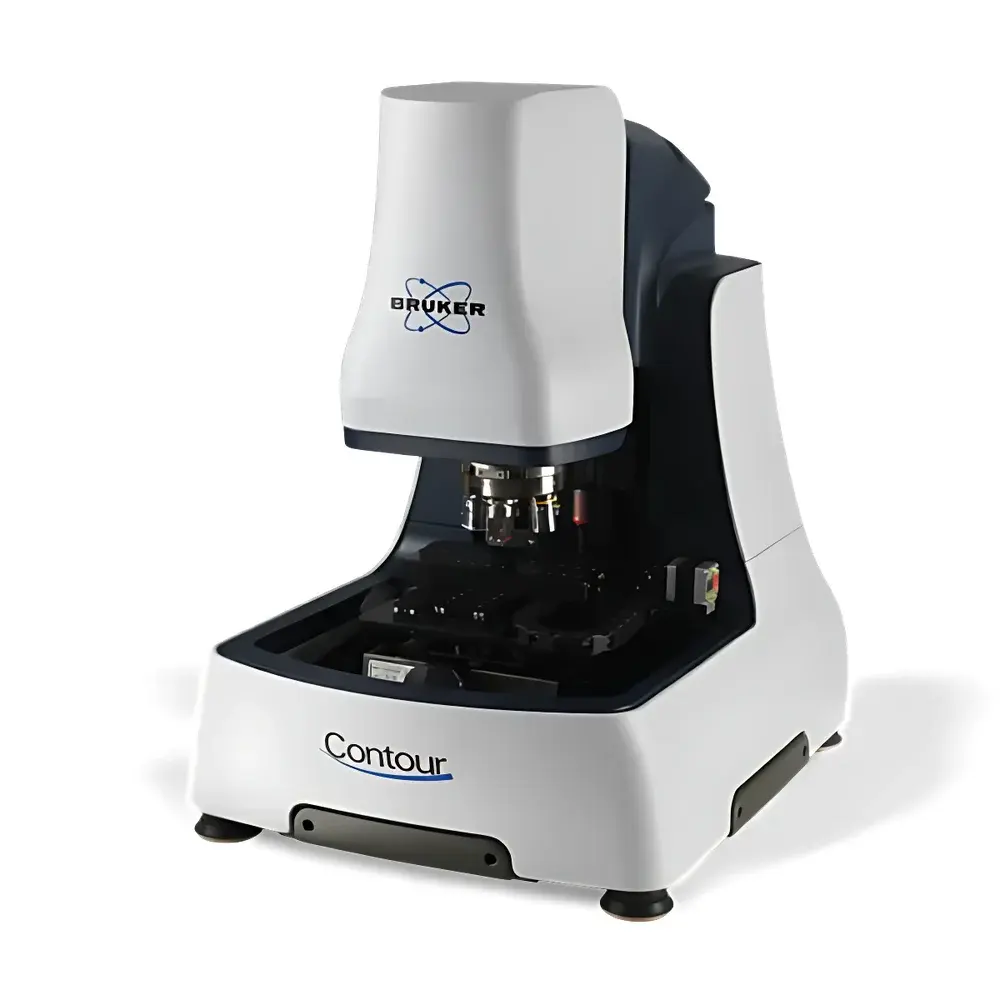
Bruker ContourX-200 White Light Interferometric Profilometer
| Brand | Bruker |
|---|---|
| Origin | USA |
| Model | ContourX-200 |
| Product Type | Non-contact Profilometer / Surface Roughness Analyzer |
| Working Principle | White Light Interferometry (WLI) |
| Camera Resolution | 5 MP |
| Field of View | Standard Large FOV |
| Z-Axis Resolution | Sub-nanometer |
| Compliance Standards | ISO 25178, ISO 4287, ASME B46.1 |
| Software Platform | Vision64® and VisionXpress™ |
| Motion Control | Motorized XY Stage |
| Surface Reflectivity Range | 0.05% – 100% |
| Application Scope | Precision Machined Surfaces, Thin Films, Semiconductors, Ophthalmic Lenses, Medical Devices, MEMS, Tribology |
Overview
The Bruker ContourX-200 is a high-performance, non-contact white light interferometric (WLI) profilometer engineered for quantitative 3D surface topography and roughness metrology in research laboratories and production environments. Leveraging Bruker’s four-decade heritage in proprietary WLI technology, the system delivers sub-nanometer vertical resolution independent of magnification—enabling traceable, high-reproducibility measurements across diverse surface reflectivities (0.05% to 100%). Unlike confocal or focus-variation systems, WLI provides true phase-resolved interference fringes, yielding absolute height data without ambiguity or step-height artifacts. The ContourX-200 integrates a 5-megapixel scientific camera with a large standard field of view (FOV), combined with a precision motorized XY stage, to support rapid, automated scanning of macro- to micro-scale features—from full wafers and optical lenses to MEMS structures and coated medical implants.
Key Features
- Sub-nanometer Z-axis resolution and repeatability, validated per ISO 25178-601 and NIST-traceable calibration protocols
- Optical design optimized for magnification-invariant measurement accuracy—eliminating scaling errors across objective lenses (5× to 100×)
- Motorized XY stage with closed-loop positioning and programmable scan patterns for repeatable multi-site analysis
- Robust anti-vibration optical baseplate and thermally stable mechanical architecture for operation in non-dedicated lab environments
- Dual-software platform: Vision64® for advanced metrology scripting, statistical process control (SPC), and GLP/GMP-compliant reporting; VisionXpress™ for intuitive, workflow-driven measurement with one-click ISO/ASME-compliant analyses
- Integrated feature recognition engine enabling automatic region-of-interest (ROI) selection and alignment across heterogeneous samples
Sample Compatibility & Compliance
The ContourX-200 accommodates a broad range of sample geometries and optical properties—including highly reflective mirrors, low-reflectance polymers, transparent thin films on silicon, and structured surfaces with steep slopes (>70°). Its adaptive illumination and real-time fringe contrast optimization ensure robust data acquisition without manual gain adjustment. All surface texture parameters (Sa, Sq, Sz, Sdr, etc.) are computed in accordance with ISO 25178-2:2021 and ASME B46.1-2022. Custom report templates support FDA 21 CFR Part 11–compliant electronic signatures and audit trails when deployed in regulated manufacturing (e.g., Class II/III medical device production). System validation documentation—including IQ/OQ/PQ protocols—is available upon request to meet ISO/IEC 17025 and GxP requirements.
Software & Data Management
Vision64® serves as the core metrology engine, offering over 1,000 configurable analysis parameters—including power spectral density (PSD), bearing ratio curves (Abbott-Firestone), motif analysis, and critical dimension (CD) profiling. Batch processing, script automation (via Python API), and database-linked result archiving enable seamless integration into enterprise quality management systems (QMS). VisionXpress™ provides guided workflows for routine tasks—such as wafer flatness mapping or lens surface defect grading—with pre-loaded filters (Gaussian, Spline, Robust Gaussian) and ISO-standard roughness modules. Raw interferogram data is stored in open-format HDF5 files, ensuring long-term accessibility and third-party tool interoperability (e.g., MATLAB, Python SciPy).
Applications
- Semiconductor: Wafer bow, film thickness uniformity, CMP endpoint verification, and trench/profile metrology
- Ophthalmics: Surface form error and micro-roughness assessment of intraocular lenses (IOLs) and contact lenses
- Medical Devices: Verification of surface finish on orthopedic implants, stent struts, and microfluidic channel geometry
- MEMS/NEMS: Dynamic characterization of actuator displacement, release etch uniformity, and packaging-induced stress relief
- Precision Optics: Measurement of scratch/dig, coating homogeneity, and aspheric deviation
- Tribology & Coatings: Quantitative wear track volume, coating adhesion interface topography, and porosity mapping
FAQ
What surface reflectivity range does the ContourX-200 support?
The system reliably measures surfaces with reflectivity from 0.05% (e.g., black anodized aluminum) to 100% (e.g., fused silica mirrors) without hardware modification.
Does the ContourX-200 comply with ISO 25178 for areal surface texture analysis?
Yes—full compliance is achieved through certified algorithms for parameter calculation, calibrated reference standards, and documented uncertainty budgets aligned with ISO 25178-601.
Can Vision64® generate reports suitable for FDA-regulated environments?
Yes—when configured with audit trail logging, user access controls, and electronic signature modules, Vision64® supports 21 CFR Part 11 compliance for QSR and MDR submissions.
Is motorized XY stage positioning repeatable enough for multi-site SPC monitoring?
The stage achieves ±0.5 µm bidirectional repeatability over its full travel range, verified per ISO 9283, making it suitable for long-term process capability studies.
How does WLI differ from confocal microscopy for surface metrology?
WLI provides absolute height measurement via interference fringe localization, whereas confocal relies on intensity-based focus detection—introducing systematic bias on sloped or discontinuous surfaces.