
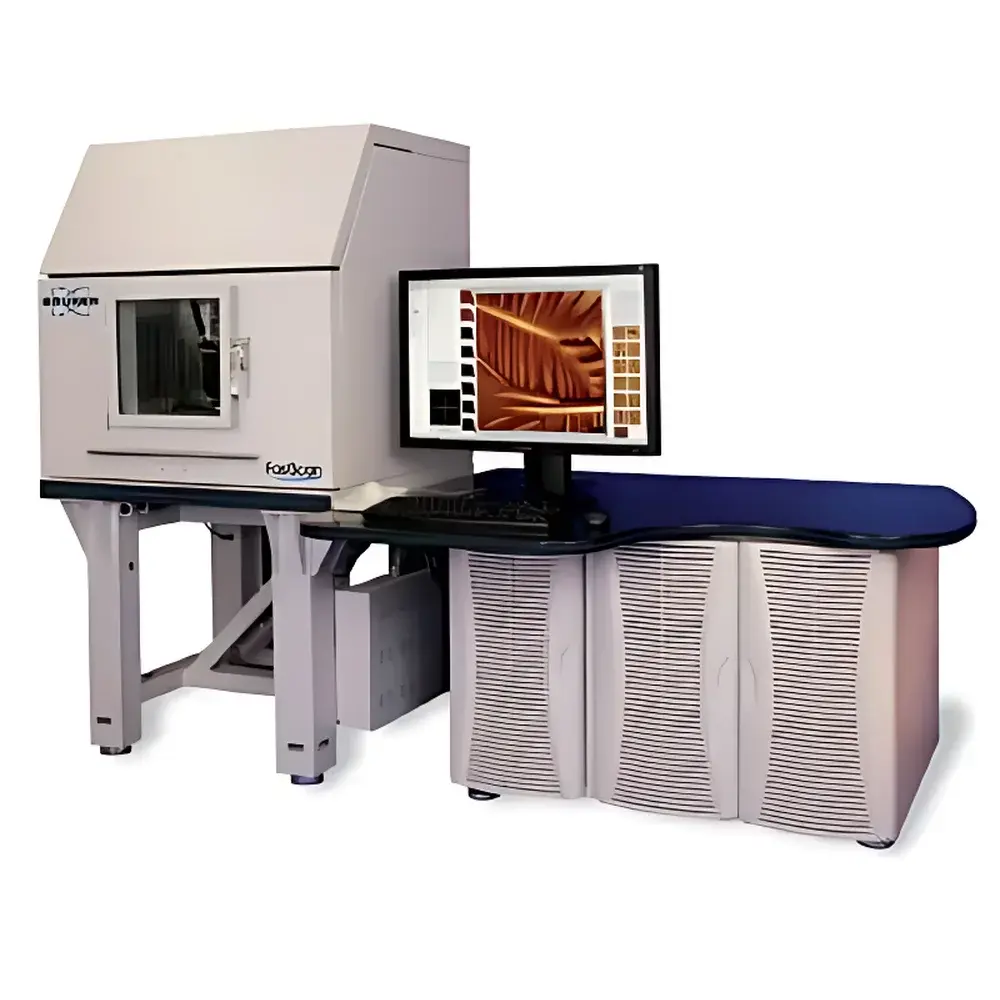
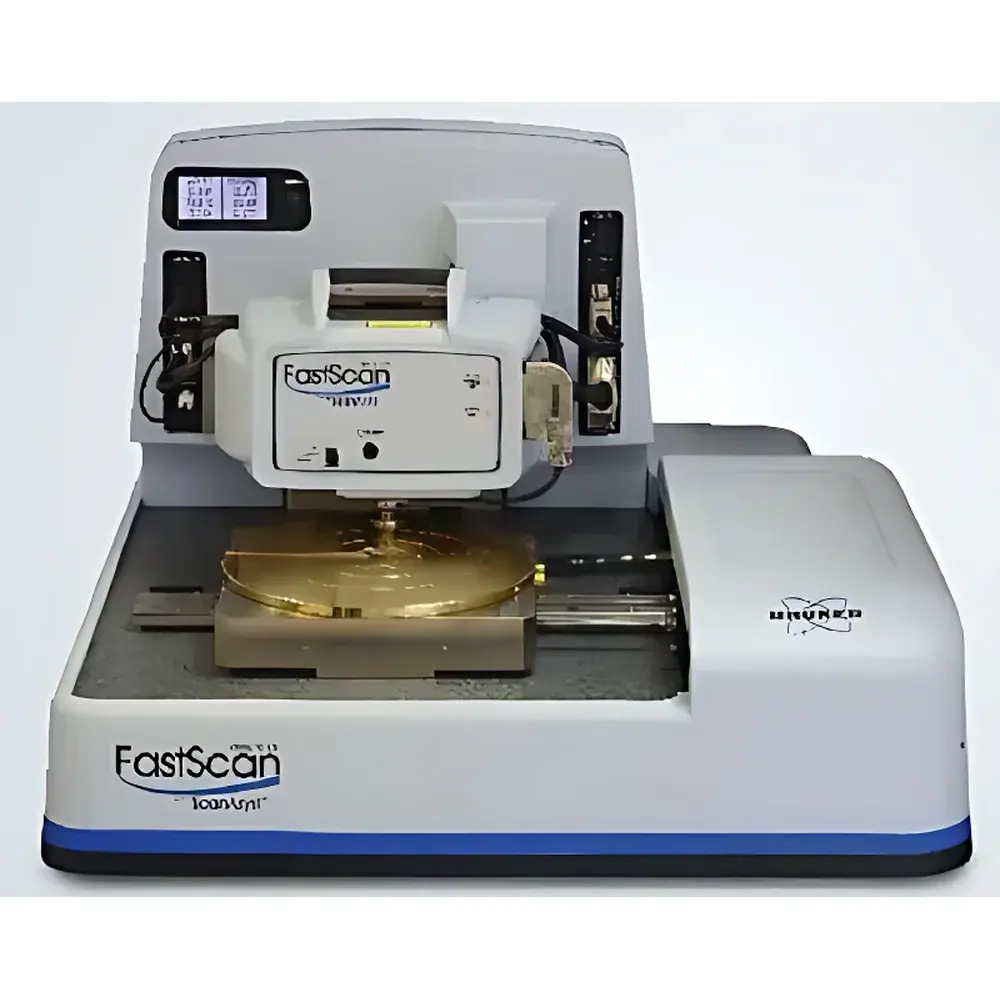
Bruker Dimension FastScan Atomic Force Microscope
| Brand | Bruker |
|---|---|
| Origin | USA |
| Manufacturer Type | Authorized Distributor |
| Origin Category | Imported Instrument |
| Model | Dimension FastScan |
| Instrument Type | Materials-Focused AFM |
| Position Detection Noise | X-Y ≤ 0.15 nm RMS, Z = 35 pm RMS |
| Typical Imaging Bandwidth | Up to 625 Hz |
| Sample Diameter | 210 mm (vacuum chuck), Max Thickness: ≤ 15 mm |
| Stage Travel Range | 180 mm × 150 mm |
Overview
The Bruker Dimension FastScan Atomic Force Microscope (AFM) represents a paradigm shift in high-speed nanoscale imaging—engineered for precision, reproducibility, and operational efficiency without compromising resolution or measurement fidelity. Unlike conventional AFMs constrained by thermal drift, mechanical bandwidth limitations, and open-loop positioning artifacts, the Dimension FastScan integrates Bruker’s proprietary closed-loop, low-drift piezoelectric scanner architecture with a high-bandwidth NanoScope® controller and optimized cantilever dynamics. Its core innovation lies in the decoupling of scan speed from signal-to-noise degradation: it achieves real-time, sub-ångström Z-noise performance (<40 pm RMS) even at frame rates exceeding 125 Hz in ambient air and liquid environments. This is enabled by a thermally compensated position sensor, ultra-stiff XYZ scanner design, and proprietary tip-scanning geometry—eliminating sample-stage inertia while preserving nanometer-scale positional accuracy across the full 180 mm × 150 mm observable area. The system operates on the fundamental principle of dynamic force detection via optical beam deflection, supporting all major AFM modalities—including TappingMode™, ScanAsyst®, PeakForce QNM™, and PeakForce TUNA™—with quantitative force control at kHz-level feedback bandwidths.
Key Features
- Real-time imaging up to 625 Hz frame rate—enabling second-per-frame acquisition in air or liquid without resolution loss
- Closed-loop XYZ scanner with <40 pm Z-direction noise RMS and <0.15 nm XY noise RMS—validated under ISO 25178-6 metrology guidelines
- Thermally stabilized, low-drift scanner architecture: <200 pm/min thermal drift rate—critical for long-duration time-lapse and multi-point measurements
- 210 mm vacuum-chuck sample stage accommodating wafers, thin films, biological substrates, and heterogeneous materials up to 15 mm thick
- Automated laser alignment and photodetector optimization—reducing setup time by >70% versus manual calibration workflows
- Intelligent probe approach algorithm (SmartScan™) minimizing crash risk and enabling reliable operation by non-specialist users
- Full compatibility with Bruker’s complete suite of functional probes—including conductive, magnetic, heated, and electrochemical variants
Sample Compatibility & Compliance
The Dimension FastScan supports diverse sample classes—from rigid semiconductor wafers and 2D materials to soft hydrogels, live cells, and electrochemical interfaces—without mode switching or hardware reconfiguration. Its large-stage design accommodates standard 8-inch wafers and custom multi-sample holders, while the open-tip architecture permits in situ integration with environmental control modules (e.g., humidity chambers, electrochemical cells, and cryogenic stages). All scanning modes comply with ASTM E2533–21 (Standard Guide for AFM Measurements) and ISO/IEC 17025–2017 requirements for measurement uncertainty quantification. Data integrity meets FDA 21 CFR Part 11 compliance when used with Bruker’s NanoScope Analysis software configured for audit-trail-enabled operation—supporting GLP/GMP-regulated quality control and failure analysis workflows in pharmaceutical and medical device manufacturing.
Software & Data Management
Bruker’s NanoScope Analysis v2.0 software provides an intuitive, workflow-driven interface with pre-configured application templates (e.g., “Polymer Nanomechanics,” “Battery SEI Layer Mapping,” “Protein Folding Kinetics”). Raw force-distance curves, topography, adhesion, deformation, and modulus channels are acquired synchronously at full frame rate and stored in vendor-neutral HDF5 format. Batch processing pipelines support automated feature extraction, statistical roughness analysis (Sa, Sq, Sz per ISO 25178), and machine-learning-assisted classification of nanoscale domains. Export modules integrate natively with MATLAB, Python (via Bruker’s official SDK), and commercial statistical platforms (JMP, OriginPro). All metadata—including environmental conditions, probe calibration parameters, and user-defined annotations—is embedded in each dataset to ensure full traceability and reproducibility per FAIR data principles.
Applications
- Nanoscale Dynamics: Time-resolved imaging of polymer phase separation, lipid bilayer remodeling, or electrode surface evolution during battery cycling—capturing structural transitions at sub-second temporal resolution
- Materials Characterization: Quantitative nanomechanical mapping (elastic modulus, adhesion, deformation) across composite interfaces, thin-film stacks, and additive-manufactured microstructures
- Life Sciences: High-fidelity imaging of membrane proteins, extracellular vesicles, and hydrated biofilms in physiological buffer—without drying artifacts or radiation damage
- Failure Analysis & QC: Rapid screening of wafer defects, coating uniformity, and particulate contamination across full-die areas—reducing inspection cycle time by >90% versus traditional SEM-based methods
- Electrochemical AFM: In operando observation of solid-electrolyte interphase (SEI) growth, dendrite nucleation, and catalyst restructuring under potentiostatic control
FAQ
What is the maximum usable scan speed without resolution degradation?
At 20 Hz TappingMode™ and 6 Hz ScanAsyst®, the system delivers resolution equivalent to conventional 1 Hz acquisitions. Frame rates up to 125 Hz maintain sub-nanometer lateral resolution on standard calibration gratings (e.g., NIST SRM 2461).
Is the Dimension FastScan compatible with vacuum or controlled-atmosphere environments?
Yes—the instrument platform supports optional environmental enclosures for inert gas, low-humidity, or variable-pressure operation. Vacuum compatibility requires separate chamber integration (not included as standard).
How does the closed-loop scanner improve measurement reliability compared to open-loop systems?
It eliminates hysteresis and creep-induced positional error, enabling traceable, repeatable Z-positioning within ±10 pm over 10 µm range—essential for quantitative force spectroscopy and multi-site comparative studies.
Can the system perform simultaneous multimodal imaging (e.g., topography + conductivity + modulus)?
Yes—PeakForce QNM™ acquires topography, deformation, adhesion, and dissipation channels concurrently at full frame rate; PeakForce TUNA™ adds nanoscale current mapping synchronized to mechanical data.
What regulatory standards does the software support for regulated industries?
NanoScope Analysis supports 21 CFR Part 11-compliant electronic signatures, audit trails, and role-based access control when deployed on validated Windows Server environments—meeting requirements for pharmaceutical stability testing and medical device biocompatibility assessment.



