
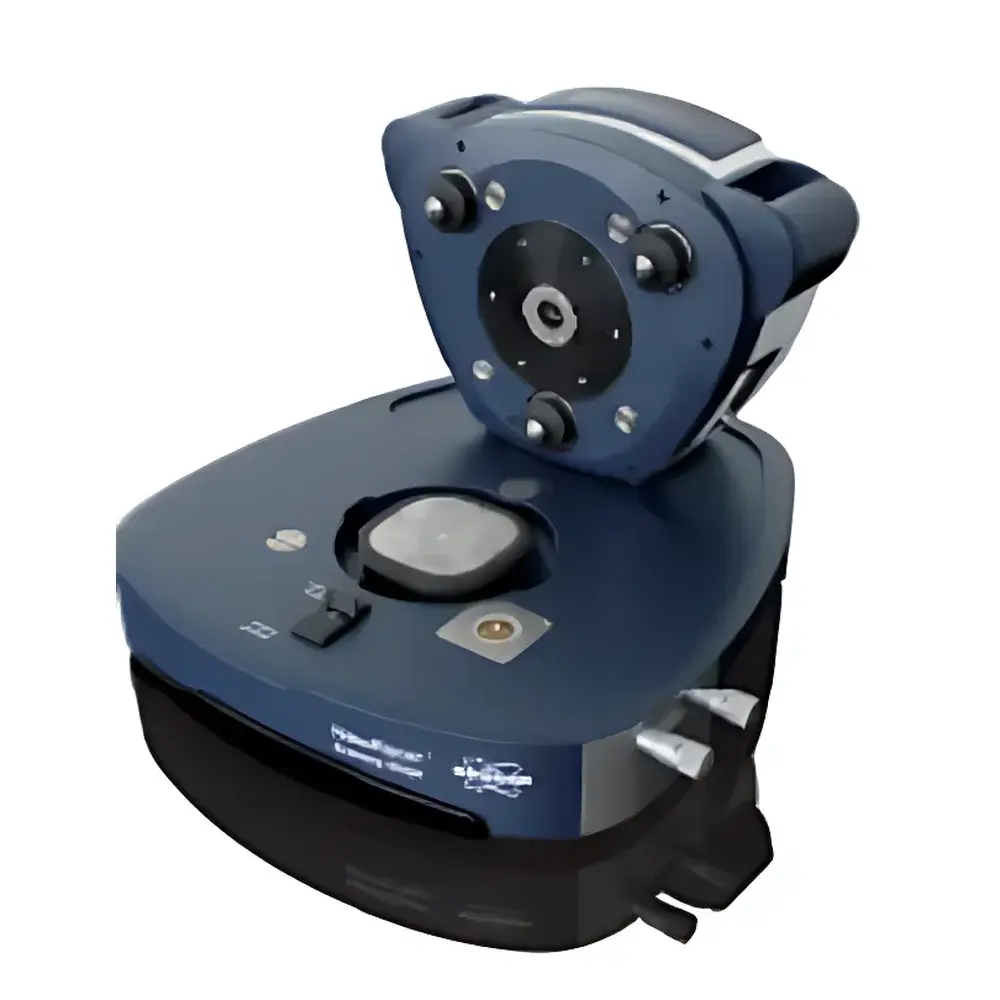
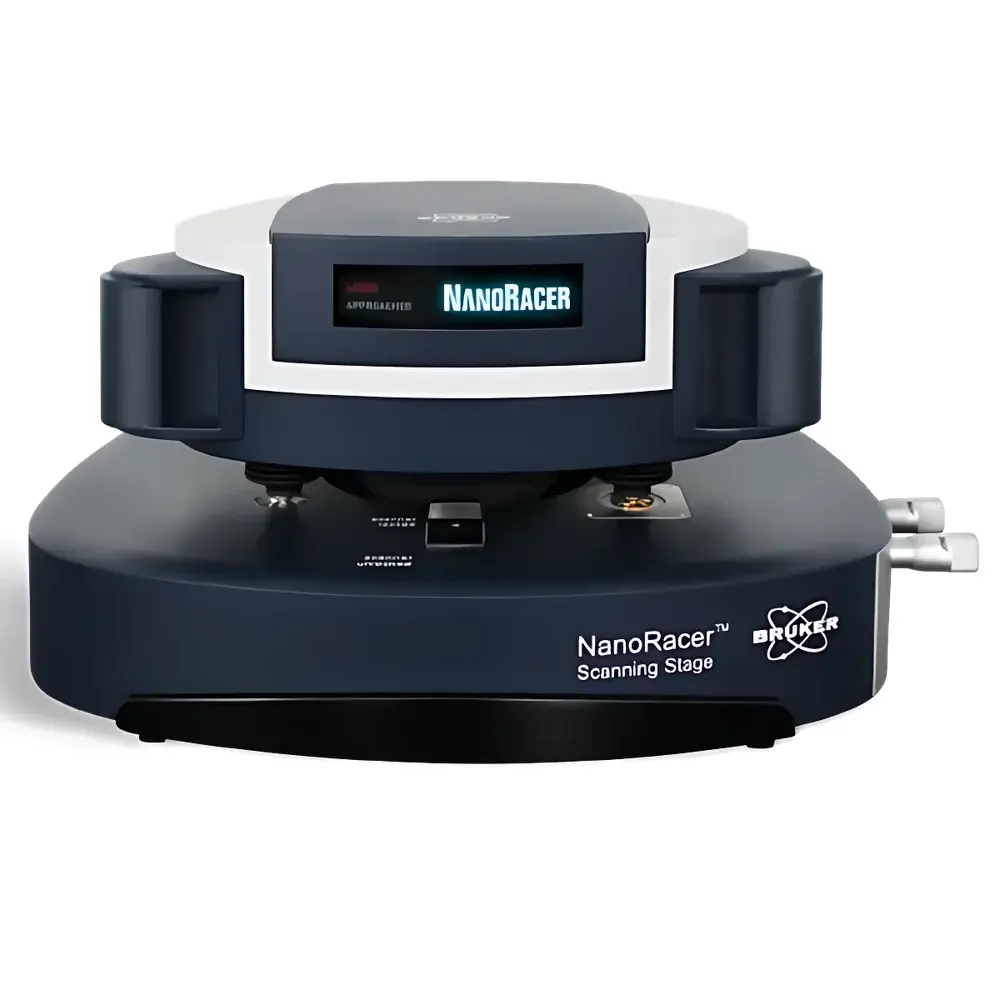
Bruker NanoRacer High-Speed Atomic Force Microscope
| Brand | Bruker |
|---|---|
| Origin | Germany |
| Manufacturer Type | Authorized Distributor |
| Origin Category | Imported |
| Model | NanoRacer |
| Instrument Type | Biological Atomic Force Microscope |
| XY Position Detection Noise | <0.09 nm RMS |
| Z Position Detection Noise | <0.04 nm RMS |
| Typical Sample Diameter | 4 mm |
| Software Version | V7 |
Overview
The Bruker NanoRacer is a high-speed atomic force microscope (AFM) engineered for real-time, nanoscale dynamic imaging of soft biological specimens under physiological conditions. Unlike conventional AFMs limited by mechanical resonance constraints and thermal drift, the NanoRacer employs a proprietary high-bandwidth digital control architecture combined with low-noise, fully closed-loop piezoelectric scanners across all three axes (X, Y, and Z). Its operational principle relies on photothermal excitation of ultralight cantilevers using infrared laser illumination—eliminating acoustic coupling and minimizing energy transfer to delicate samples. This enables stable, quantitative force mapping at frame rates up to 50 Hz in liquid environments, making it uniquely suited for observing conformational dynamics of single biomolecules—including DNA, membrane proteins, and cytoskeletal filaments—in near-native states.
Key Features
- Ultra-low noise position detection: <0.09 nm RMS in XY and <0.04 nm RMS in Z, achieved via optimized interferometric sensing and active thermal stabilization.
- Infrared photothermal cantilever excitation: Enables clean, non-contact drive with minimal perturbation—critical for fragile hydrated samples and long-term time-lapse experiments.
- Advanced feedback algorithms: Real-time adaptive PID tuning and predictive scanning control reduce tip-sample interaction variability and suppress force drift during extended acquisitions (>30 min).
- High-fidelity closed-loop scanning: All-axis closed-loop operation ensures sub-nanometer spatial fidelity without post-scan correction, eliminating hysteresis and creep artifacts common in open-loop systems.
- Dedicated high-speed power amplification: Custom-designed wideband amplifiers deliver precise, distortion-free actuation signals up to 1 MHz bandwidth, supporting rapid raster and vector scanning modes.
- Biological optimization: Designed for compatibility with standard fluid cells, temperature-controlled stages, and electrochemical accessories—fully integrated into Bruker’s BioScope Resolve platform ecosystem.
Sample Compatibility & Compliance
The NanoRacer accommodates standard biological substrates including mica functionalized with poly-L-lysine (PLO), HOPG, SiO₂ wafers, and polymer-coated coverslips. Typical sample dimensions are ≤4 mm in diameter, compatible with commercial liquid cells and environmental chambers. The system meets ISO/IEC 17025 calibration traceability requirements for displacement metrology and complies with key regulatory frameworks governing life science instrumentation, including FDA 21 CFR Part 11 for electronic records and signatures when used with audit-trail-enabled V7 software configurations. Data integrity is reinforced through GLP/GMP-aligned acquisition logs, user authentication, and version-controlled parameter templates.
Software & Data Management
Controlled exclusively via Bruker’s V7 software suite, the NanoRacer integrates modular acquisition, real-time processing, and metadata-rich data storage in a unified interface. V7 supports automated experiment sequencing, multi-channel synchronized recording (topography, deflection, amplitude, phase), and on-the-fly Fourier analysis for dynamic mode characterization. All raw data are saved in Bruker’s proprietary .spm format with embedded calibration parameters, instrument configuration snapshots, and user-defined experimental notes. Export options include TIFF, HDF5, and MATLAB-compatible binary formats. For regulated environments, optional V7 Audit Trail and Electronic Signature modules provide full compliance with 21 CFR Part 11 and EU Annex 11 requirements.
Applications
- Real-time visualization of single-molecule DNA mechanics—including stretching, bending, and protein-binding kinetics—in aqueous buffer at 50 fps.
- In situ monitoring of lipid bilayer formation, pore insertion, and peptide-induced membrane remodeling.
- Time-resolved structural transitions in amyloid fibrils and intrinsically disordered proteins.
- Quantitative nanomechanical mapping of live cells—elasticity, adhesion, and viscoelastic relaxation—with sub-second temporal resolution.
- Correlative studies combining high-speed AFM with fluorescence microscopy (via compatible inverted optical platforms) for multimodal structural–functional correlation.
FAQ
What is the maximum achievable imaging speed in liquid?
Up to 50 frames per second (fps) for 512 × 512 pixel scans on standard biological samples such as DNA immobilized on mica-PLO substrates.
Is the NanoRacer compatible with electrochemical AFM (EC-AFM) configurations?
Yes—when equipped with Bruker’s EC Cell Kit and appropriate potentiostat integration, the NanoRacer supports simultaneous high-speed topographic and electrochemical current mapping.
Does the system support automated tip approach and engagement in liquid?
Yes—V7 software includes intelligent auto-approach routines that adapt to surface topography and cantilever sensitivity, reducing manual intervention and improving reproducibility.
Can third-party cantilevers be used?
The NanoRacer accepts standard rectangular and V-shaped silicon nitride or silicon cantilevers with nominal spring constants from 0.01 to 0.5 N/m; photothermal excitation is optimized for specific cantilever geometries but remains broadly compatible.
Is remote operation supported?
V7 software permits secure remote access via encrypted VPN connections, enabling collaborative experiments and off-site instrument monitoring while maintaining full acquisition fidelity and audit trail integrity.





