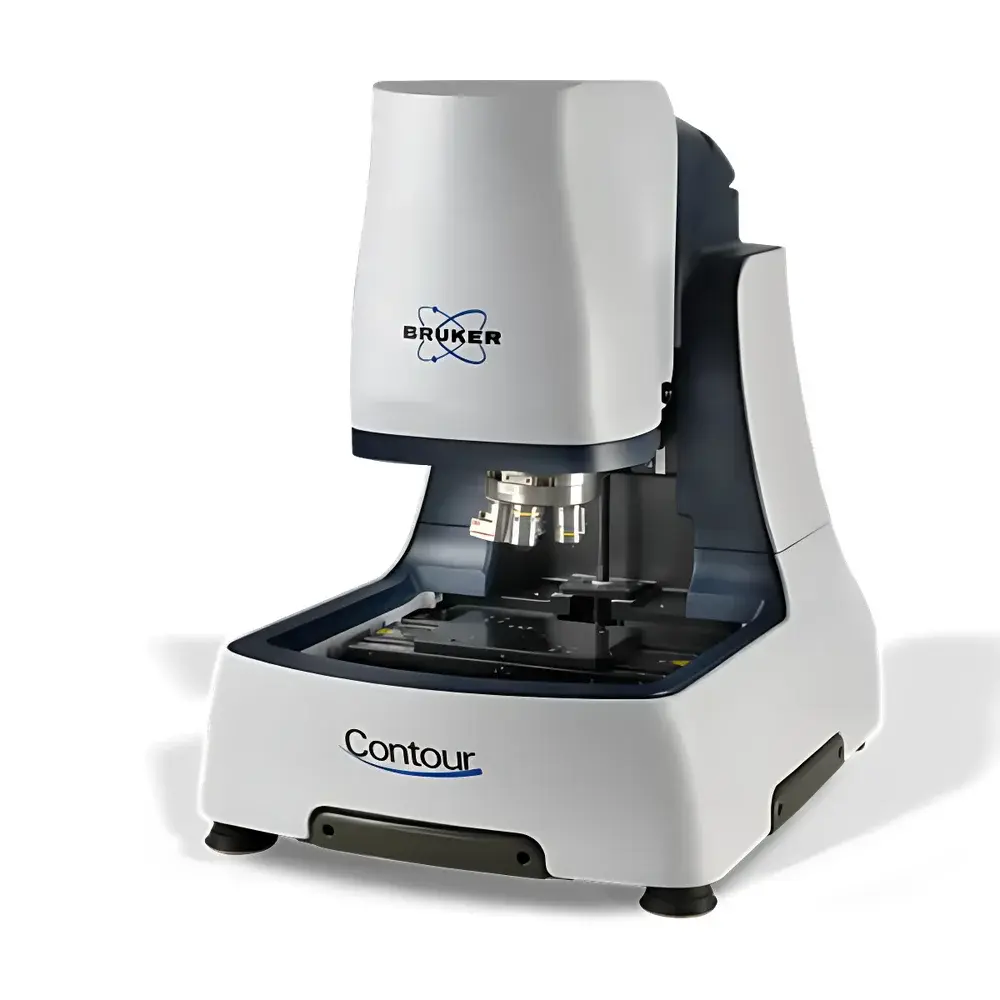
Bruker ContourX-500 White Light Interferometric 3D Optical Profilometer
| Brand | Bruker |
|---|---|
| Origin | USA |
| Model | ContourX-500 |
| Product Type | Non-contact Profilometer / Surface Roughness Analyzer |
| Working Principle | White Light Interferometry (WLI) |
| Compliance Standards | ISO 25178, ASME B46.1, ISO 4287 |
| Automation Features | Motorized XY Stage with Encoders, Programmable Auto-Tilt Optical Head, Auto-Brightness Control, Pneumatic Vibration Isolation Base |
| Software Platform | VisionXpress™ and Vision64® |
Overview
The Bruker ContourX-500 is a high-precision, benchtop white light interferometric (WLI) 3D optical profilometer engineered for non-contact surface topography measurement across research, development, and industrial quality control environments. Leveraging the physical principle of broadband interference—where coherence envelope analysis of reflected white light enables sub-nanometer vertical resolution—the ContourX-500 delivers traceable, quantitative 3D surface characterization without mechanical contact or sample damage. Its core architecture integrates Bruker’s proprietary auto-tilt optical head, which dynamically aligns the interference objective to the local surface normal across programmable angular ranges (±6° typical), eliminating cosine error and minimizing step-height tracking artifacts. This capability ensures metrological integrity on structured, inclined, or anisotropic surfaces—including MEMS cantilevers, wafer-level packaging features, ophthalmic lens aspheres, and precision-machined molds—without manual repositioning or operator-dependent alignment.
Key Features
- Sub-nanometer Z-axis resolution (<0.1 nm typical) with traceable calibration against NIST-traceable step standards
- Auto-tilt optical head with closed-loop angular positioning and real-time surface normal compensation
- Motorized XY translation stage with high-resolution linear encoders (≤100 nm repeatability)
- Pneumatically isolated base platform optimized for vibration immunity in shared lab or production-floor environments
- Multi-objective turret with automated magnification switching (5× to 100×) and parfocal alignment
- Universal Scanning Intelligence (USI) mode—adapts scan parameters (scan speed, integration time, focus search logic) in real time based on local surface reflectivity and slope
- Fully programmable measurement sequences supporting unattended batch processing and integration into automated test workflows
Sample Compatibility & Compliance
The ContourX-500 accommodates samples up to 200 mm × 200 mm (with optional extended stage) and thicknesses up to 75 mm, including wafers, optical components, medical implants, injection-molded plastics, and coated substrates. Its non-contact operation preserves fragile, soft, or temperature-sensitive surfaces—critical for semiconductor process monitoring, thin-film metrology, and biomedical device R&D. The system supports full compliance with international surface texture standards: ISO 25178 series (areal surface texture parameters), ISO 4287 (profile-based roughness), and ASME B46.1. All measurement data includes embedded metadata (instrument ID, calibration timestamp, environmental conditions) to support GLP/GMP audit trails. Optional FDA 21 CFR Part 11–compliant software modules provide electronic signatures, user access controls, and immutable audit logs for regulated manufacturing environments.
Software & Data Management
ContourX-500 operates exclusively via Bruker’s dual-tier software suite: VisionXpress™ for rapid setup and routine QA/QC, and Vision64® for advanced research-grade analysis. Both platforms feature intuitive drag-and-drop workflow builders, parameterized script templates (Python API available), and over 1,200 built-in filters and algorithms—including power spectral density (PSD), bearing ratio (Abbott-Firestone curve), motif analysis, and grain segmentation. Raw interferograms, height maps, intensity images, and cross-section profiles are stored in open-format HDF5 containers with embedded metadata. Export options include CSV, STEP AP210 (for CAD integration), and standardized XML reports compliant with ISO/IEC 17025 documentation requirements. Network deployment enables centralized license management and remote instrument monitoring via secure HTTPS interface.
Applications
- Semiconductor: Critical dimension verification, CMP uniformity mapping, trench depth profiling, and lithographic resist characterization
- MEMS & Micro-optics: Actuator displacement quantification, mirror flatness assessment, and grating pitch validation
- Ophthalmics: Aspheric lens surface deviation, anti-reflective coating uniformity, and haptic surface texture analysis
- Precision Manufacturing: Tool wear monitoring, EDM surface integrity evaluation, and injection mold cavity fidelity inspection
- Academic Research: Tribology studies, biomaterial surface patterning, and nanocomposite interface morphology correlation
FAQ
What vertical resolution can be achieved with the ContourX-500 under standard laboratory conditions?
Typical Z-axis repeatability is ≤0.1 nm RMS over 1 µm vertical range; absolute accuracy is ±0.5% of measured step height, verified using NIST-traceable SiO₂-on-Si step standards.
Does the system support automated pass/fail decision-making for inline QC?
Yes—VisionXpress™ allows definition of tolerance bands per parameter (e.g., Sa, Sq, Sdr) with configurable alarms, exportable pass/fail flags, and PLC-triggered start/stop via digital I/O.
Can the ContourX-500 measure transparent or highly reflective surfaces?
Yes—USI scanning adapts exposure and focus logic dynamically; optional polarization filters and neutral density modules further extend dynamic range for challenging optics and metal mirrors.
Is hardware calibration traceable to national standards?
All Z-axis calibrations use Bruker-certified step-height artifacts calibrated by NIST-accredited labs; XY stage linearity is verified with laser interferometer traceability.
How does the auto-tilt function improve measurement robustness on angled surfaces?
By maintaining orthogonal incidence between the objective and local surface normal throughout the scan, it eliminates tilt-induced phase bias and preserves lateral spatial fidelity—even on slopes >15°.