
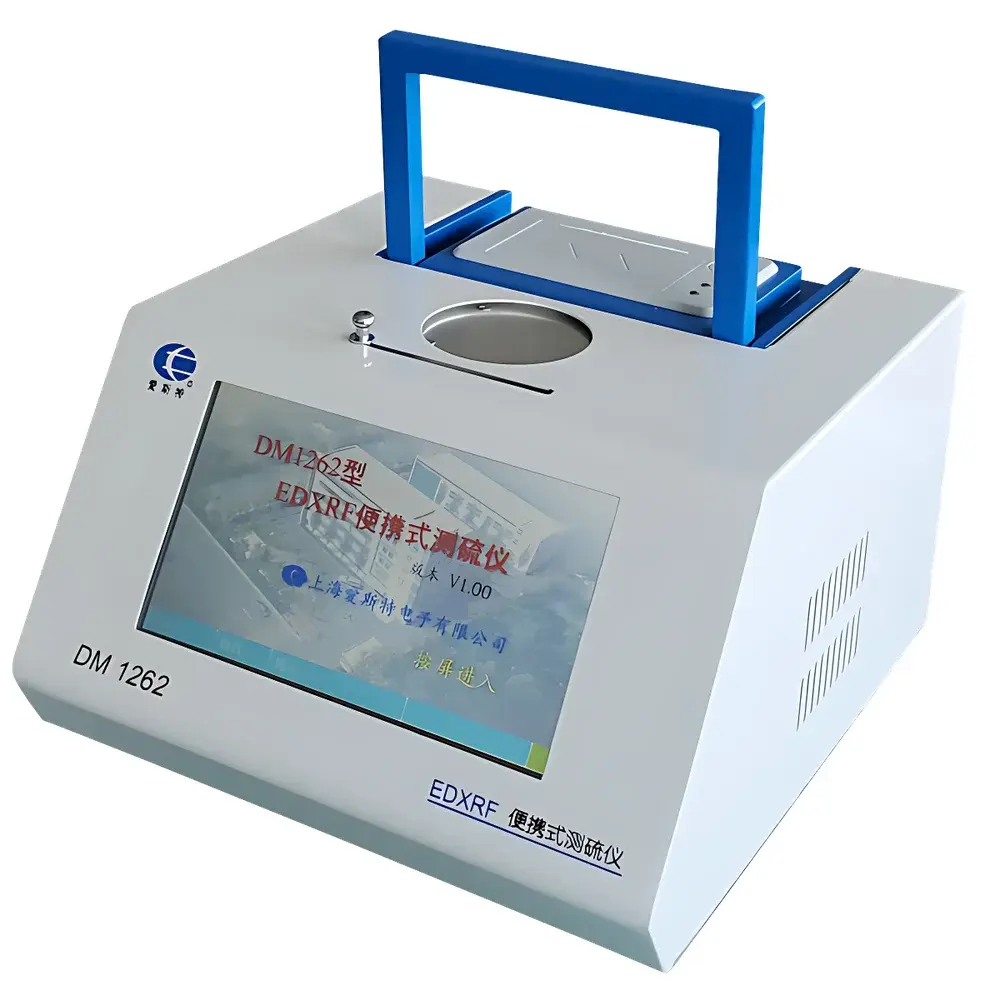
ASTRO DM1262 Portable EDXRF Sulfur Analyzer
| Brand | ASTRO / ST |
|---|---|
| Origin | Shanghai, China |
| Model | DM1262 |
| Detection Method | Total Sulfur (S) by Energy-Dispersive X-ray Fluorescence (EDXRF) |
| Detection Limit (300 s, air atmosphere) | 2.6 ppm |
| Weight (incl. battery & thermal printer) | 5.6 kg |
| Measurement Range | 3×DL to 9.99 wt% S |
| Linearity Coefficient (r) | >0.999 across low/mid/high calibration ranges |
| Repeatability (r) & Reproducibility (R) | Compliant with GB/T 17040–2019, GB 17411, and ASTM D4294 |
| Operating Temperature | −10 °C to +40 °C |
| Relative Humidity | ≤95% at 35 °C |
| Power Supply | 11.1 V / 20.8 Ah Li-ion battery (≥5 h continuous operation) |
| Dimensions | 242 mm (W) × 258 mm (D) × 142 mm (H) |
| X-ray Tube | ≤10 kV, ≤1 mA, ≤10 W |
| Detector | Low-background ultra-thin Be-window proportional counter with secondary filtration |
| Pulse Processing | FPGA- and DSP-based digital multi-channel analyzer (MCA) with reduced dead time |
| Software | Embedded touchscreen OS with automatic C/H ratio correction, matrix effect compensation, and multi-range calibration curve switching |
| Regulatory Compliance | Meets radiation safety exemption criteria per CNPC and IAEA guidelines |
Overview
The ASTRO DM1262 Portable EDXRF Sulfur Analyzer is a field-deployable, regulatory-compliant instrument engineered for rapid, non-destructive quantification of total sulfur (S) in liquid petroleum products—including gasoline, diesel, marine fuel oil, residual fuel oil, lubricants, and refinery intermediates. It employs Energy-Dispersive X-ray Fluorescence (EDXRF) spectroscopy: a physically based, reference-standard-free analytical technique that excites sulfur Kα characteristic X-rays (2.307 keV) using a compact, low-power X-ray tube, then resolves and integrates the emitted fluorescence signal via a high-efficiency ultra-thin beryllium-window proportional counter. Unlike combustion-based methods (e.g., UV fluorescence or microcoulometry), EDXRF requires no sample digestion, carrier gas, vacuum environment, or chemical reagents—eliminating consumables, hazardous waste, and operator exposure risk. The DM1262 is specifically designed to meet the performance requirements of GB/T 17040–2019 (Petroleum Products—Determination of Sulfur Content—Energy-Dispersive X-ray Fluorescence Spectrometry), GB 17411 (Marine Fuel Oil Specifications), and ASTM D4294 (Standard Test Method for Sulfur in Petroleum and Petroleum Products by Energy-Dispersive X-ray Fluorescence Spectrometry). Its detection limit of 2.6 ppm (300 s, ambient air) satisfies the PLOQ (Practical Quantitation Limit) of 16 ppm mandated by GB/T 17040–2019 for low-sulfur fuels.
Key Features
- Field-optimized portability: Weighs only 5.6 kg including integrated Li-ion battery and thermal printer—enabling handheld operation, vehicle-mount deployment, or benchtop use without external power or auxiliary systems.
- Enhanced sensitivity architecture: Features a low-background, ultra-thin Be-window proportional counter coupled with dynamically selected secondary filters and an adjustable X-ray source (voltage, current, and target material)—optimizing signal-to-noise ratio across wide concentration ranges (2.6 ppm to 9.99 wt%).
- Digital pulse processing: Utilizes an FPGA- and DSP-based digital multichannel analyzer (MCA) with <1.5% dead time, enabling higher count throughput and improved precision at short measurement times (as low as 60 s for routine screening).
- Intelligent matrix compensation: Implements real-time C/H ratio correction and empirical matrix-effect algorithms calibrated against certified reference materials—ensuring accuracy across diverse hydrocarbon matrices (e.g., paraffinic vs. aromatic diesel, cracked distillates, residual oils).
- Three-tier calibration framework: Supports independent low-, mid-, and high-range working curves (0–1000 ppm, 0.1–1 wt%, 1–4.6 wt%), each validated to r > 0.999; automatic curve selection based on preliminary scan intensity.
- Radiation safety compliance: Fully shielded design meets national exemption criteria for portable X-ray devices (CNPC Standard Q/SH 1020 1271–2018); no licensing required for routine operation.
- Robust embedded platform: 7-inch capacitive touchscreen interface with industrial-grade firmware; supports data logging (≥10,000 spectra), timestamped audit trails, and USB/Bluetooth export to laboratory information management systems (LIMS).
Sample Compatibility & Compliance
The DM1262 accepts standard 30–40 mm diameter liquid samples in sealed polypropylene or Mylar-backed cups (minimum volume: 2 mL). It is validated for direct analysis of transparent to moderately turbid hydrocarbons without dilution, filtration, or homogenization—provided viscosity remains below 15 cSt at 40 °C. Certified reference materials (CRMs) traceable to NIST SRM 2722, ISO 8217 Annex B, and GBW(E) 060123 are used for calibration verification. The instrument complies with the measurement uncertainty, repeatability (r), and reproducibility (R) criteria defined in GB/T 17040–2019 (r ≤ 0.12 ppm for <10 ppm; R ≤ 0.25 ppm), GB 17411–2015 (marine fuel ≤ 0.10 wt% S), and ASTM D4294–22 (precision statements per concentration tier). All firmware and calibration files include version-controlled metadata compliant with GLP documentation practices.
Software & Data Management
The embedded operating system provides ISO/IEC 17025-aligned data integrity controls: full audit trail (user ID, timestamp, parameter changes, result modifications), electronic signature support, and password-protected method locking. Spectral acquisition, peak deconvolution (Gaussian-Lorentzian fitting), and net intensity integration are performed in real time. Calibration models are stored with CRM traceability records, uncertainty budgets, and linearity validation reports. Data export supports CSV, XML, and PDF formats compatible with LIMS (e.g., LabWare, Thermo Fisher SampleManager) and statistical process control (SPC) platforms. Firmware updates are delivered via encrypted USB stick with SHA-256 hash verification—no internet connectivity required.
Applications
- On-site quality assurance at fuel terminals, bunkering ports, and distribution depots—verifying compliance with Euro 5/6, IMO 2020 (0.50 wt% global cap), and US EPA Tier 3 sulfur limits.
- In-process monitoring in refineries: rapid feedback on hydrotreater effluent, fractionator cuts, and additive-blended streams.
- Regulatory inspection: mobile enforcement units performing roadside diesel testing or port state control (PSC) audits of marine fuels.
- Contract laboratory support: supplemental analysis for ASTM D4294 interlaboratory studies and proficiency testing schemes.
- Research applications: sulfur speciation screening in biofuels, synthetic crude, and heavy oil upgrading streams where oxidation state interference is minimal.
FAQ
Does the DM1262 require helium purge or vacuum for sulfur analysis?
No. It operates in ambient air using optimized detector geometry and low-energy X-ray excitation—eliminating gas supply infrastructure.
Can it measure sulfur in highly viscous or solid samples (e.g., asphalt, coke)?
It is validated for liquids only. Solid or semi-solid matrices require homogenization into thin films or solvent dilution per ASTM D4294 Annex A3 protocols.
How is calibration traceability maintained?
Each instrument ships with a calibration certificate referencing CRMs certified to ISO/IEC 17025-accredited labs; users perform periodic verification using in-house check standards with documented uncertainty budgets.
Is the firmware compliant with FDA 21 CFR Part 11?
While not marketed for pharmaceutical use, its audit trail, electronic signature, and method-locking features align with core Part 11 principles; full validation documentation is available upon request for regulated environments.
What maintenance is required beyond routine cleaning?
Annual verification of X-ray output stability and detector resolution using reference foils; no user-serviceable parts—field service supported globally via ASTRO’s authorized partner network.




