
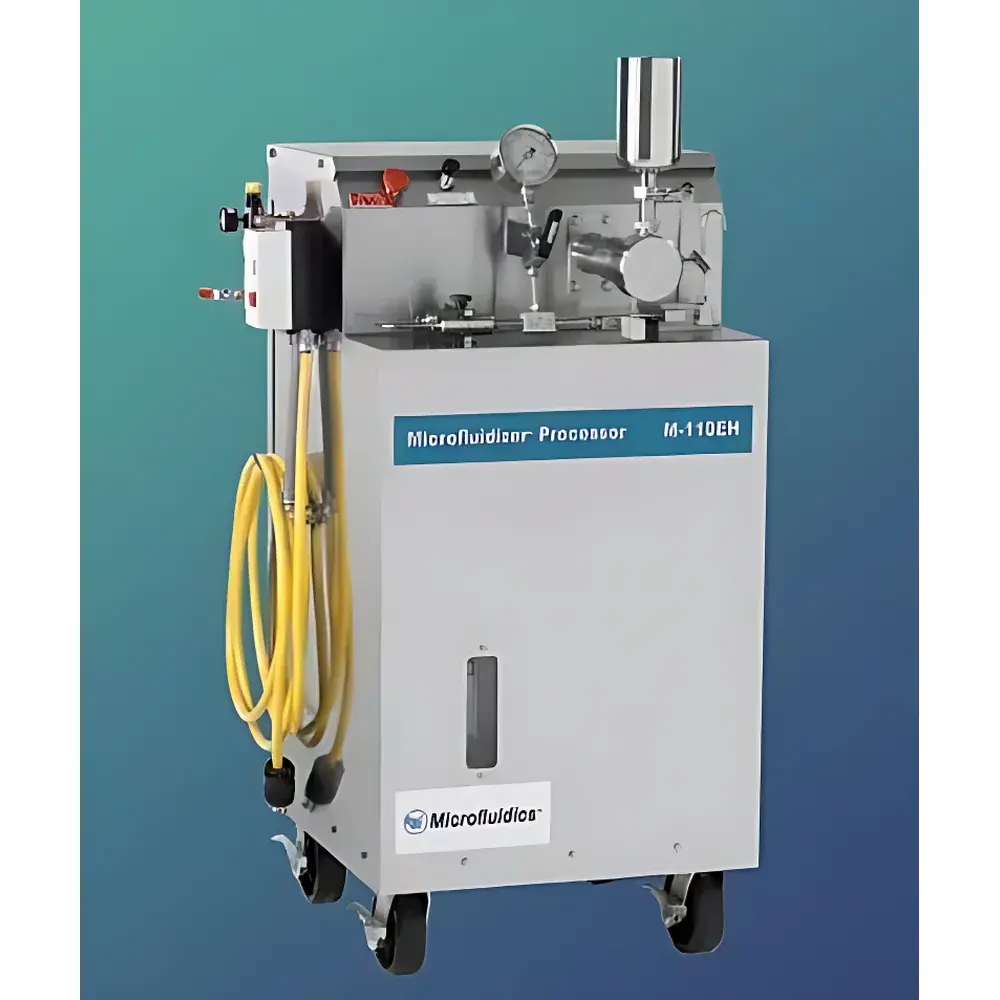
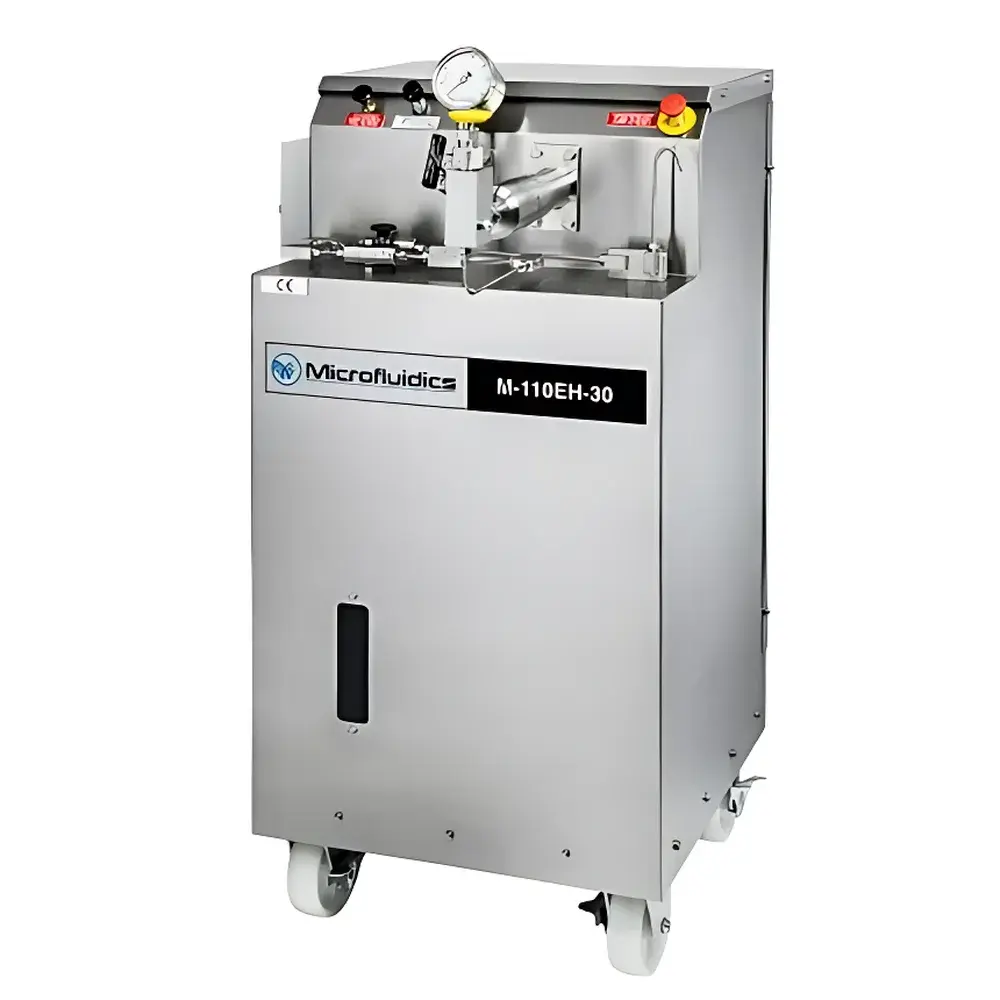
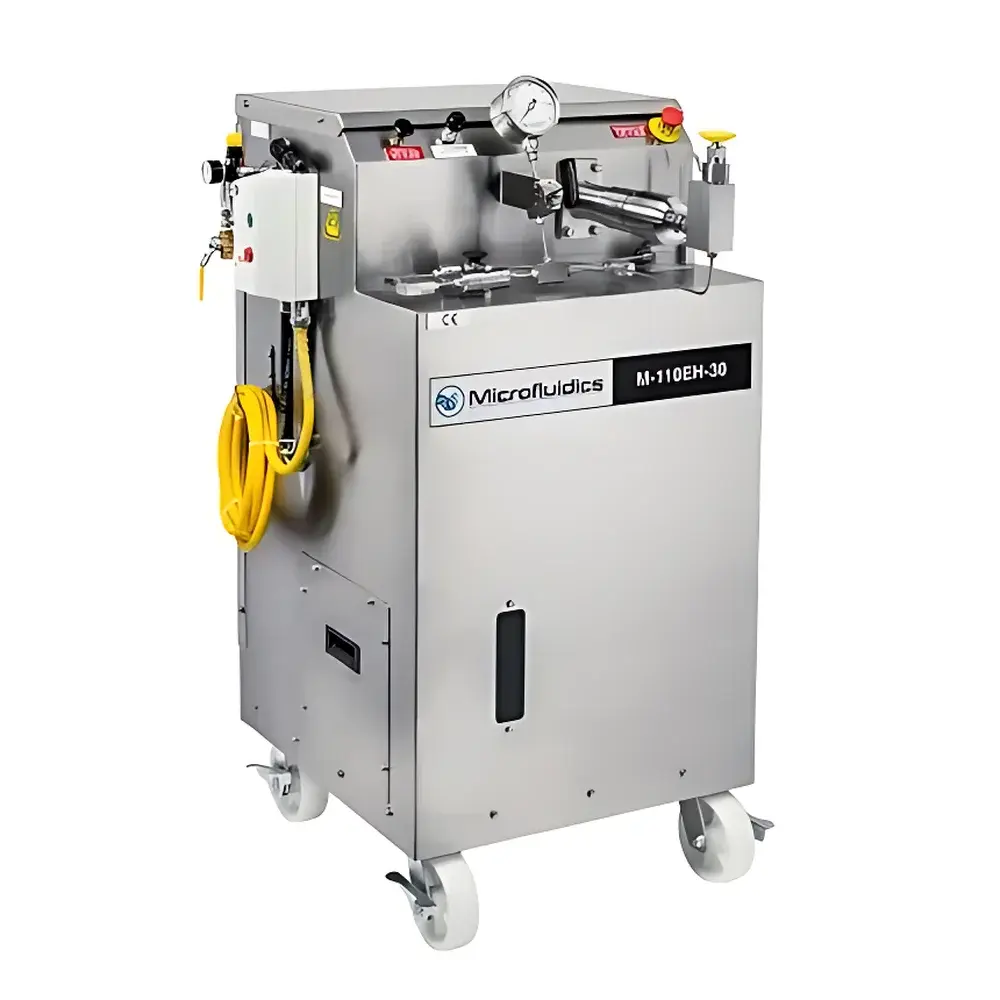
Microfluidics M-110EH30 High-Pressure Microfluidizer Homogenizer
| Brand | Microfluidics |
|---|---|
| Origin | USA |
| Model | M-110EH30 |
| Instrument Type | High-Pressure Homogenizer |
| Max Pressure | 30,000 psi (2070 bar) |
| Max Flow Rate | 450 mL/min |
| Sample Volume Range | 100–30,000 mL |
| Inlet Temperature Range | up to 75 °C |
| Motor Power | 5 HP (3.7 kW) |
| System Fluid Volume | 100 mL |
| Air Supply Requirement | 50 psi, 1 SCFM, dew point 0–35 °F |
| Minimum Sample Volume | 120 mL |
| Dimensions (W×D×H) | 84 × 87 × 148 cm |
| Weight | 205 kg |
| Compliance | CE certified |
Overview
The Microfluidics M-110EH30 High-Pressure Microfluidizer Homogenizer is an engineered solution for scalable, reproducible nano- and micro-scale particle size reduction, cell disruption, and emulsion/nanocarrier formulation. Unlike conventional valve-based homogenizers, the M-110EH30 employs a fixed-geometry, diamond-coated interaction chamber where fluid streams collide at supersonic velocities under precisely controlled high pressure—enabling consistent shear, cavitation, and impact forces. This microfluidic principle ensures deterministic energy input per unit volume, eliminating variability from wear-prone moving parts or adjustable valves. Designed for seamless transition from laboratory R&D to pilot-scale process development and small-batch GMP manufacturing, the system delivers high-fidelity linear scale-up due to its invariant flow geometry and thermally stabilized operation.
Key Features
- Diamond-coated interaction chamber (U.S. Patent No. US6923392B2) — provides exceptional wear resistance, chemical inertness, and dimensional stability across thousands of operating hours, ensuring long-term reproducibility.
- Stable maximum operating pressure of 30,000 psi (2070 bar), maintained via dual-stage hydraulic intensification with zirconia-coated plunger assemblies for corrosion resistance and low thermal drift.
- Integrated real-time temperature control system — actively monitors and regulates sample inlet/outlet temperatures (range: ambient to 75 °C) to prevent thermal degradation during high-energy processing.
- Clean-in-place (CIP) and steam-in-place (SIP) compatibility — enables full-system sterilization without disassembly, meeting requirements for aseptic processing of pharmaceutical nanosuspensions and liposomal formulations.
- Low minimum sample volume requirement (120 mL) and compact fluid path volume (100 mL) — minimizes material waste during early-stage formulation screening.
- CE-certified architecture with safety interlocks, pressure relief valves, and redundant pressure monitoring — compliant with IEC 61000-6-2/6-4 and ISO 13849-1 functional safety standards.
Sample Compatibility & Compliance
The M-110EH30 processes a broad spectrum of sensitive biologics and complex formulations including liposomes (e.g., doxorubicin, amphotericin B), nanoemulsions (propofol, dexmedetomidine), polymeric nanoparticles (albumin-bound paclitaxel), nanocrystalline suspensions (paliperidone, budesonide), and biological macromolecules requiring gentle yet efficient lysis (e.g., bacterial, yeast, and mammalian cells). Its all-wetted-path construction—utilizing 316L stainless steel, Hastelloy C-276, and diamond—ensures compatibility with aggressive solvents, acidic/basic buffers, and high-salinity media. The system supports GLP/GMP documentation workflows and meets critical regulatory expectations for traceability, including audit trails for pressure, temperature, flow, and runtime parameters—fully aligned with FDA 21 CFR Part 11 data integrity requirements when paired with validated software modules.
Software & Data Management
The M-110EH30 operates via a dedicated touchscreen HMI with embedded programmable logic controller (PLC) logic. All process parameters—including pressure setpoint, cycle count, dwell time, inlet temperature, and real-time pressure/temperature logging—are stored locally with timestamped records exportable in CSV format. Optional Ethernet/IP or Modbus TCP interfaces enable integration into centralized MES or SCADA environments. For regulated environments, optional IQ/OQ documentation packages and 21 CFR Part 11-compliant electronic signature modules are available, supporting validation against ASTM E2500, ISO 13485, and USP <1058> analytical instrument qualification guidelines.
Applications
This homogenizer serves as a core platform in advanced drug delivery development, particularly for parenteral nanomedicines requiring narrow polydispersity index (PDI < 0.1) and batch-to-batch consistency. It has been deployed in commercial manufacturing of FDA-approved lipid nanoparticle (LNP) formulations, injectable nanoemulsions, and sterile nanosuspensions. Beyond pharma, it supports materials science applications such as exfoliation of graphene oxide, dispersion of carbon nanotubes, stabilization of pigment dispersions, and preparation of uniform ceramic nanopowders. Its ability to achieve >95% cell lysis efficiency in a single pass—without protease release or nucleic acid shearing—also makes it ideal for intracellular protein extraction and organelle isolation protocols.
FAQ
What distinguishes the M-110EH30 from conventional high-pressure homogenizers?
It uses a fixed-geometry microchannel interaction chamber instead of an adjustable valve, delivering repeatable energy input and eliminating operator-dependent variability.
Can the M-110EH30 be used for aseptic processing?
Yes—its SIP/CIP capability, fully drainable fluid path, and Class 100-compatible surface finish support terminal sterilization and aseptic filling line integration.
Is linear scale-up from lab to production validated?
Yes—over 200 installations globally demonstrate correlation between lab-scale (M-110EH30) and production-scale (Microfluidics F-Series) results, supported by published case studies on liposomal and nanoemulsion products.
What maintenance intervals are recommended?
Plunger seals require replacement every ~1,500 operating hours; the diamond interaction chamber typically exceeds 5,000 hours before refurbishment—validated via post-run particle size distribution trending.
Does the system support GMP-compliant data archiving?
When configured with optional software add-ons, it provides electronic signatures, user access controls, and immutable audit trails meeting 21 CFR Part 11 requirements.



