
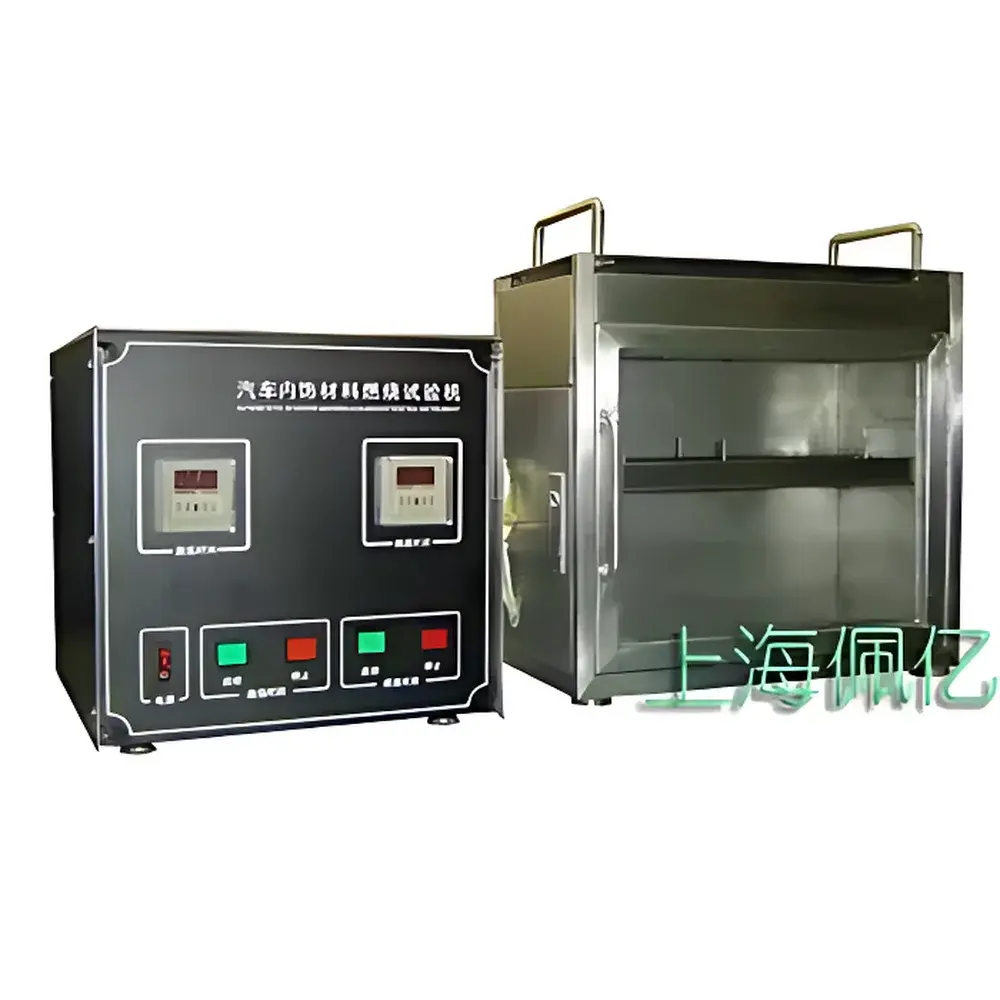
Peiyi PY-NS05 Automotive Interior Materials Horizontal Burning Tester
| Brand | Peiyi |
|---|---|
| Origin | Shanghai, China |
| Model | PY-NS05 |
| Chamber Dimensions (L×W×H) | 385 × 204 × 360 mm |
| Top Ventilation Slot Width | 13 mm |
| Bottom Ventilation Holes | 10 × Ø19 mm |
| Stand Height | 10 mm (4 pcs) |
| Ignition Flame Height Adjustment Range | 20–100 mm (standard: 38 mm) |
| Burner Nozzle Inner Diameter | Ø9.5 mm |
| Nozzle-to-Specimen Distance | 19 mm |
| Burner Tube Length | 100 mm with Air Adjustment Orifice |
| Flame Application Time Setting Range | 0–99 min 99 s (typically 15 s) |
| Burn Duration Measurement Range | 0–99 min 99 s |
| Comb Length | 110 mm (8 smooth rounded teeth per 25 mm) |
| Thermometer Range | 0–150 °C, Resolution: 1 °C |
| Steel Ruler | 400 mm, Graduation: 1 mm |
| Power Supply | 220 V / 50 Hz |
| Overall Dimensions (L×W×H) | 835 × 315 × 400 mm |
| Fuel | Butane or Liquefied Petroleum Gas (LPG) — user-supplied |
Overview
The Peiyi PY-NS05 Horizontal Burning Tester is a precision-engineered instrument designed for evaluating the flame propagation behavior of automotive interior materials under standardized horizontal orientation conditions. It operates on the principle of controlled surface ignition and linear flame spread measurement—specifically aligned with the horizontal burning test methodology defined in GB 8410–2006, ISO 3795:2022, ASTM D5132–22, DIN 75200:2017, JIS D1201:2019, FMVSS 302, SAE J369, and ECE-R118. The device positions a conditioned specimen horizontally on a U-shaped support frame, subjects its free end to a calibrated 38 mm Bunsen-type flame for a precisely timed duration (typically 15 seconds), and records critical combustion parameters—including flame extinction time, post-ignition burn distance, and corresponding burn rate (mm/min). This test method quantifies material resistance to flame spread under low-energy ignition conditions typical of vehicle cabin environments, providing essential data for regulatory compliance and material qualification.
Key Features
- Stainless steel construction for both main combustion chamber and control enclosure—ensuring corrosion resistance, structural integrity, and long-term dimensional stability under repeated thermal cycling.
- Automated test sequence execution: integrated programmable logic controller (PLC) enables fully autonomous operation—including gas valve actuation, spark ignition initiation, flame timing synchronization, and test termination upon completion or flame extinction.
- Precision-adjustable burner assembly featuring a 9.5 mm inner diameter nozzle, fixed 19 mm vertical offset from specimen base, and fine-tuned air-fuel mixing via dedicated orifice—guaranteeing repeatable flame geometry and thermal output across all testing cycles.
- Calibrated instrumentation suite: NIST-traceable thermometer (0–150 °C, ±1 °C accuracy), stainless steel ruler (400 mm, 1 mm graduations), and standardized metal comb (110 mm length, 8 evenly spaced smooth teeth per 25 mm) for specimen surface preparation per ISO 3795 Annex A.
- Dual ventilation architecture: top-mounted 13 mm wide exhaust slot combined with ten evenly distributed Ø19 mm bottom inlet ports ensures laminar airflow patterns that replicate standardized draft-free test conditions as mandated by all referenced standards.
Sample Compatibility & Compliance
The PY-NS05 accommodates flat, rigid, or semi-rigid polymeric sheets, foams, composites, textiles, and laminates used in automotive dashboards, door trims, headliners, seat covers, and floor coverings. Specimens are cut to 356 mm × 100 mm dimensions (per GB 8410 and ISO 3795) and conditioned at 23 ± 2 °C and 50 ± 5 % RH for minimum 24 hours prior to testing. All mechanical and operational parameters—including burner alignment tolerances, flame height verification procedures, and environmental airflow specifications—are validated against the metrological requirements outlined in ISO/IEC 17025:2017 for testing laboratories. The system supports full audit trails required for GLP-compliant reporting and meets traceability requirements for accreditation bodies including CNAS, A2LA, and UKAS.
Software & Data Management
While the PY-NS05 utilizes embedded PLC-based control without proprietary software, it delivers digital timestamped outputs for flame application duration, observed burn time, and measured burn distance—exportable via RS-232 interface to external laboratory information management systems (LIMS). All timing functions are synchronized to internal quartz crystal oscillator (±0.1 s/day drift), satisfying timing accuracy requirements specified in ASTM E176 and ISO/IEC 17025 Clause 6.4.2. Test logs include operator ID, ambient temperature/humidity readings (when interfaced with optional external sensors), specimen identification codes, and pass/fail determinations based on maximum allowable burn rate thresholds (e.g., ≤100 mm/min per FMVSS 302). Data retention complies with FDA 21 CFR Part 11 principles when integrated into validated LIMS environments.
Applications
- Pre-certification screening of OEM-specified interior trim materials against global automotive safety mandates.
- Quality assurance testing in Tier-1 and Tier-2 supplier production lines for polymer extrusions, nonwovens, and coated fabrics.
- Regulatory submission support for type approval dossiers submitted to NHTSA, EU Whole Vehicle Type Approval (WVTA) authorities, and China’s MIIT CNCA certification process.
- Comparative flame retardancy benchmarking during R&D of halogen-free flame-retarded polyolefins, intumescent coatings, and nanocomposite substrates.
- Root cause analysis of batch failures related to inconsistent flame retardant dispersion or thermal degradation onset temperatures.
FAQ
What flame fuel types are compatible with the PY-NS05?
Butane or liquefied petroleum gas (LPG) is required; propane is not recommended due to differing stoichiometric combustion characteristics and flame velocity profiles.
Is calibration certification included with shipment?
A factory-verified calibration report covering burner alignment, flame height repeatability (±2 mm), and timer accuracy (±0.2 s over 15 s interval) is provided with each unit.
Can the PY-NS05 be integrated into an existing fume hood system?
Yes—the unit is designed for direct installation beneath standard laboratory fume hoods with ≥0.5 m/s face velocity; top ventilation slot connects seamlessly to ducted exhaust manifolds.
Does the system meet ISO/IEC 17025 traceability requirements?
All critical dimensional and timing components are verified using equipment calibrated to national standards (e.g., NIM, PTB); full metrological chain documentation is available upon request.
What maintenance intervals are recommended for long-term reliability?
Burner nozzle inspection and cleaning every 50 test cycles; electromagnetic valve functional verification quarterly; stainless steel chamber wipe-down after each use to prevent soot accumulation.



