
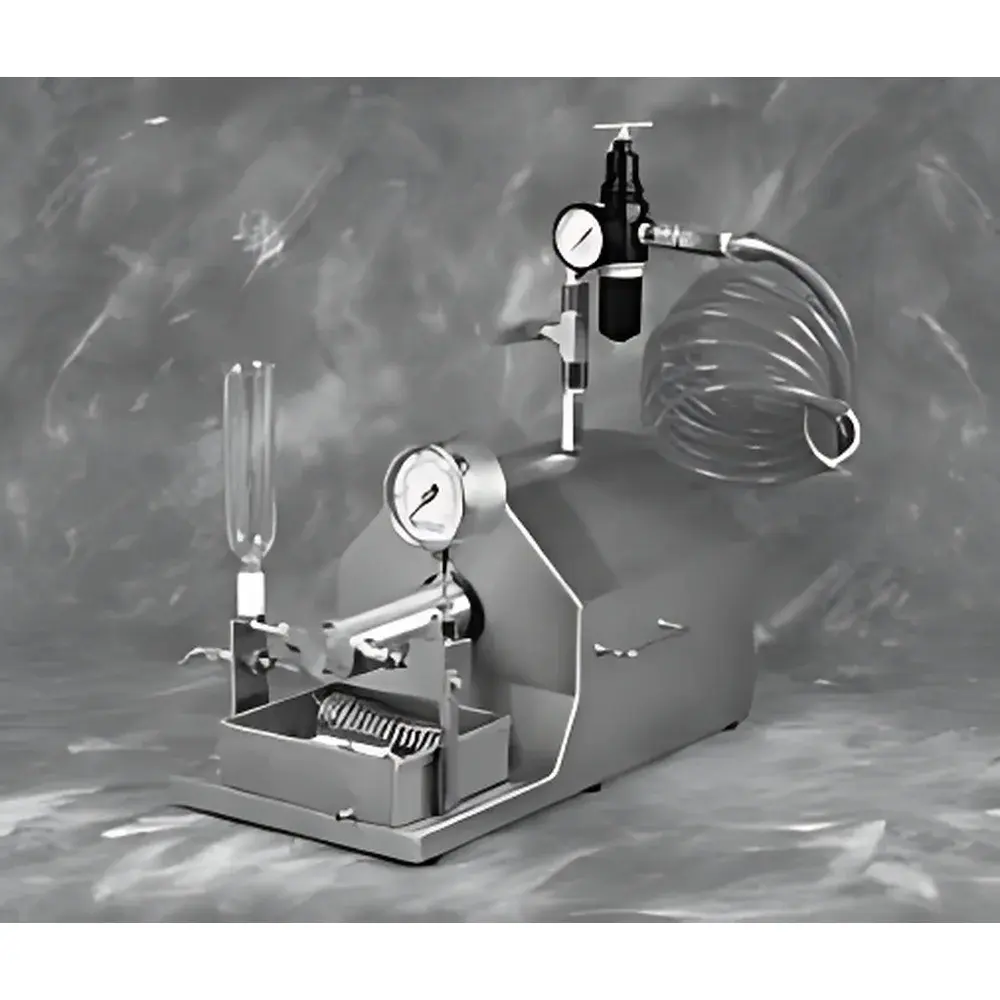
Microfluidics M-110L High-Pressure Microfluidizer Nanoscale Homogenizer
| Origin | USA |
|---|---|
| Manufacturer Type | Authorized Distributor |
| Origin Category | Imported |
| Model | M-110L |
| Pricing | Upon Request |
Overview
The Microfluidics M-110L High-Pressure Microfluidizer is a benchtop, pneumatically driven nanoscale homogenization system engineered for precision fluid processing in research and development laboratories. Unlike conventional rotor-stator or valve-based homogenizers, the M-110L employs a patented fixed-geometry interaction chamber—where two high-velocity microfluidic streams collide at precisely controlled angles under ultra-high pressure (up to 18,000 psi). This impingement-based energy transfer mechanism enables consistent, shear-intensive yet low-thermal-load processing, resulting in narrow particle size distributions (PSD) with median diameters routinely below 100 nm. Designed for reproducible scalability, the M-110L serves as a critical bridge between discovery-phase formulation and cGMP-compliant process development—particularly where colloidal stability, biological activity preservation, and regulatory traceability are paramount.
Key Features
- Fixed-geometry ceramic interaction chamber with zero moving parts—ensuring mechanical stability, minimal wear, and batch-to-batch consistency across thousands of operating hours.
- Adjustable pressure range from 3,000 to 18,000 psi, enabling tunable energy input for diverse material classes including liposomes, polymeric nanoparticles, protein complexes, and Gram-negative bacterial cells.
- Minimal sample requirement of only 14 mL, delivering ≥12 mL of processed output—ideal for precious biologics, early-stage APIs, and limited-synthesis nanomaterials.
- Single-pass cell disruption efficiency exceeding 95% for E. coli, yeast, and mammalian cells, with preserved intracellular integrity and negligible metal ion leaching or protease activation.
- Flexible operation modes: single-pass, recirculation, and continuous feed—supporting both exploratory screening and extended stability studies.
- Compact footprint (60 × 39 × 68 cm) and lightweight design (26.4 kg) for integration into biosafety cabinets, cold rooms (–25 °C), or temperature-controlled labs (up to 75 °C inlet).
Sample Compatibility & Compliance
The M-110L processes aqueous, organic, and mixed-phase systems—including oil-in-water emulsions, polymer dispersions, lipid nanoparticle (LNP) suspensions, viral vector formulations, and cell lysates—without cross-contamination or residual carryover. Its all-ceramic wetted path (zirconia or silicon carbide chambers) complies with USP Class VI biocompatibility standards and resists corrosion from aggressive solvents or pH extremes. The system supports GLP/GMP-aligned workflows through optional pressure logging, flow rate monitoring, and time-stamped operational records. While not inherently 21 CFR Part 11 compliant, it integrates with validated LIMS or ELN platforms for audit-trail generation during method qualification per ICH Q5A and ASTM E2877-22 guidelines.
Software & Data Management
The M-110L operates via manual pneumatic control; no embedded software or digital interface is included. However, its deterministic mechanical architecture ensures full repeatability without firmware dependencies. Users document parameters—including inlet pressure, number of passes, temperature, and chamber type—in standardized lab notebooks or electronic records. For automated data capture, third-party pressure transducers and flow meters (e.g., Brooks Instrument SLA Series) can be integrated upstream/downstream, feeding into LabArchives or Benchling via analog 4–20 mA outputs. All operational logs remain fully exportable for regulatory submission packages.
Applications
- Nanomedicine: Production of uniform LNPs for mRNA delivery, nanoemulsions for topical corticosteroids, and nanocrystalline suspensions meeting USP & Ph. Eur. particle size requirements.
- Vaccinology & Biologics: Gentle yet efficient lysis of CHO or HEK293 cells while retaining antigen conformation and minimizing host-cell protein contamination.
- Materials Science: Exfoliation of 2D materials (e.g., graphene oxide), dispersion of quantum dots in polymer matrices, and stabilization of metal-organic frameworks (MOFs) in aqueous media.
- Food & Cosmetics: Development of transparent nanoemulsions for nutraceutical delivery and long-term stable pigment dispersions without surfactant overuse.
- Scale-up Validation: Linear correlation between M-110L lab-scale results and pilot-scale Microfluidizer® models (e.g., M-725, M-120XP) has been demonstrated in >120 published case studies across FDA-reviewed IND submissions.
FAQ
What chamber types are compatible with the M-110L?
The M-110L accepts standard Microfluidics F20Y, F80Y, and P110Y interaction chambers—each optimized for specific viscosity ranges and target particle sizes. Chamber selection directly influences shear rate profile and thermal dissipation characteristics.
Can the M-110L process heat-sensitive proteins?
Yes. With inlet temperature control (–25 °C to 75 °C) and minimal adiabatic heating due to short residence time (<10 ms), the system maintains native conformation of monoclonal antibodies, enzymes, and viral capsids during processing.
Is validation support available for GMP environments?
Microfluidics provides IQ/OQ documentation templates and chamber calibration certificates traceable to NIST standards. Full PQ support requires site-specific protocol development aligned with ISO 13485 or Annex 11 requirements.
How does the M-110L compare to ultrasonication or rotor-stator homogenizers?
Unlike cavitation-driven methods, the M-110L delivers deterministic, pressure-controlled energy input—eliminating hotspots, free radical generation, and probe erosion. It achieves narrower PSDs, higher batch uniformity, and superior scalability than empirical alternatives.
What compressed air specifications are required?
Supply must deliver 80 psi at 28–57 SCFM, powered by a 7.5–15 hp compressor with desiccant drying and particulate filtration to prevent chamber fouling or seal degradation.



