
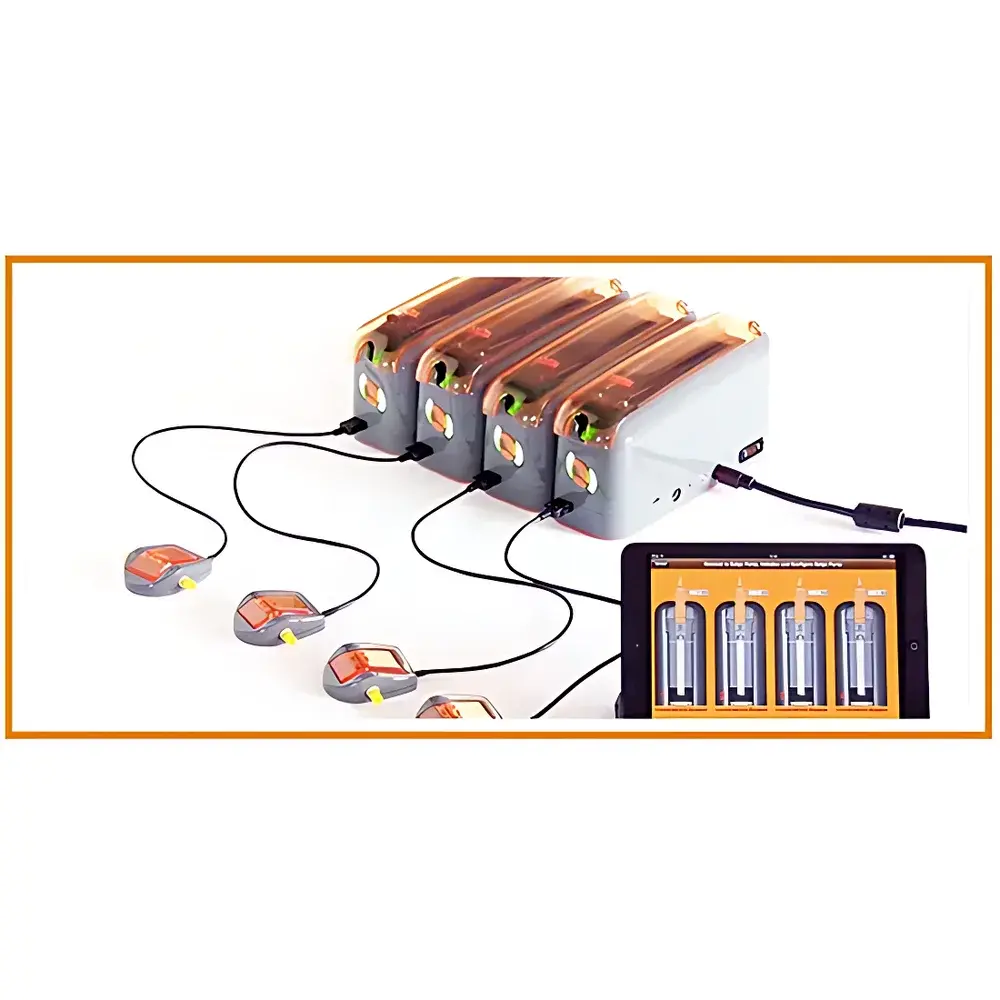
Cellix ExiGo Pump High-Precision Microfluidic Syringe Pump
| Brand | Cellix |
|---|---|
| Origin | Ireland |
| Model | ExiGo Pump |
| Instrument Type | Microfluidic Syringe Pump |
| Flow Rate Range | 10 nL/min – 13 mL/min (depending on syringe type) |
| Accuracy | ±20 nL/min (250 µL glass syringe) / ±40 nL/min (5 mL plastic syringe) |
| Flow Stability | ±0.25% of full scale (250 µL syringe) |
| Stepper Resolution | 0.008 µm |
| Microsteps per Revolution | 250,000 |
| Dynamic Response Time | ≤50 ms (0 → 10,000 nL/min) |
| Max Operating Pressure | 2 bar (30 psi) |
| Dead Volume | 1–25 µL |
| Sensor Integration | Plug-and-play flow sensor with PID feedback capability |
| Control Interfaces | Wi-Fi (iPad mini SmartFlow app) & USB (LabVIEW) |
| Dimensions (Pump) | 225 × 69 × 122 mm |
| Weight (Pump) | ~1.3 kg |
| Power Input | 110/220 V, 50/60 Hz, 60 W |
| Syringe Compatibility | 100 µL – 5 mL (glass & plastic) |
Overview
The Cellix ExiGo Pump is a high-precision microfluidic syringe pump engineered for applications demanding nanoliter-scale flow control, ultra-low pulsatility, and real-time closed-loop regulation. Built upon a proprietary pulse-elimination architecture and integrated flow sensing, the ExiGo operates on a closed-loop control principle—combining high-resolution stepper motor actuation (250,000 microsteps/rev), sub-micrometer positional resolution (0.008 µm), and active PID feedback from an inline flow sensor. This architecture enables true continuous, non-pulsatile delivery across its full operational range—from 10 nL/min to 13 mL/min—making it suitable for quantitative microfluidic workflows where temporal fidelity, volumetric reproducibility, and shear-sensitive sample integrity are critical. Unlike open-loop syringe pumps relying solely on displacement estimation, the ExiGo validates and corrects flow in real time, ensuring compliance with rigorous experimental requirements in academic, pharmaceutical, and diagnostic microfluidics.
Key Features
- Closed-loop flow control with integrated flow sensor enabling real-time PID feedback and dynamic correction
- Ultra-low pulsatility: validated non-pulsatile output down to 10 nL/min using 250 µL glass syringes
- Bidirectional push/pull operation for precise aspiration and dispensing in multi-step protocols
- Multi-mode programmability: constant, ramp, step, and sinusoidal flow profiles via SmartFlow or LabVIEW
- Modular scalability: up to four ExiGo or UniGo pumps (pressure-driven) can be synchronized within a single microfluidic setup
- Compact footprint (225 × 69 × 122 mm) and lightweight design (~1.3 kg) optimized for benchtop integration and cleanroom compatibility
- Dual-control ecosystem: native iPad mini SmartFlow app (Wi-Fi) and LabVIEW driver (USB) supporting automated assay scripting and audit-ready data logging
Sample Compatibility & Compliance
The ExiGo Pump supports standard Luer-lock syringes ranging from 100 µL to 5 mL—including borosilicate glass and medical-grade polypropylene variants—ensuring compatibility with aqueous, organic, and low-viscosity biological media (e.g., cell suspensions, hydrogels < 50 cP). Its maximum operating pressure of 2 bar (30 psi) accommodates typical microchannel resistances without compromising seal integrity or flow linearity. The system complies with IEC 61000-6-3 (EMC emissions) and IEC 61010-1 (safety for laboratory equipment). When deployed in regulated environments, the LabVIEW interface supports timestamped, user-annotated data export and optional integration with electronic lab notebooks (ELNs) aligned with GLP/GMP documentation practices. Though not FDA 21 CFR Part 11–certified out-of-the-box, its deterministic control logic and immutable event logging (start/stop, mode change, error flags) provide foundational traceability for internal validation.
Software & Data Management
Control is delivered through two interoperable platforms: the SmartFlow application (iOS, iPad mini) and the LabVIEW-based PC software. SmartFlow provides intuitive touch-based configuration—ideal for rapid prototyping—with visual flow waveform preview, real-time sensor readouts, and wireless synchronization of up to four pumps. The LabVIEW driver offers deeper integration capabilities: programmable sequence loops, external trigger inputs (TTL), analog output for peripheral device coordination, and structured binary or CSV data export with metadata (timestamp, syringe ID, setpoint, actual flow, error status). All communication events—including parameter changes and sensor alerts—are logged locally with millisecond resolution, supporting retrospective analysis and protocol verification. No cloud dependency or vendor-hosted infrastructure is required; all data remains on-device or on-user-controlled networks.
Applications
- Droplet generation and sorting in monodisperse emulsion or particle synthesis
- Shear-controlled cell culture studies—e.g., endothelial activation under defined laminar or oscillatory flow
- Multi-reagent gradient generation for microscale chemical kinetics or dose-response assays
- Nanofluidic delivery in single-cell electroporation or CRISPR RNP transfection workflows
- Calibration and validation of micro-PIV systems requiring known, stable velocity boundary conditions
- Integration with pressure-driven UniGo pumps to combine precise volumetric control (ExiGo) with high-throughput perfusion (UniGo) in organ-on-chip platforms
FAQ
What syringe types and sizes are supported?
The ExiGo accepts standard Luer-lock syringes from 100 µL to 5 mL, including both glass (e.g., Hamilton, SGE) and autoclavable plastic variants. Calibration is performed per syringe type and volume during initial setup.
Is the flow sensor mandatory for operation?
No—the pump functions in open-loop mode without the sensor—but closed-loop PID control and real-time flow verification require the plug-and-play flow sensor module.
Can multiple ExiGo units be synchronized with different flow profiles?
Yes. SmartFlow and LabVIEW support independent parameter assignment and time-aligned execution across up to four pumps, enabling complex multi-inlet mixing or sequential delivery protocols.
What is the minimum dead volume introduced by the flow sensor?
The integrated sensor adds 1–25 µL of system dead volume depending on selected configuration, with low-volume variants optimized for <100 nL applications.
Does the ExiGo support regulatory-compliant data archiving?
While not pre-certified for 21 CFR Part 11, its deterministic logging architecture—combined with user-managed file storage, checksummed exports, and full metadata capture—provides the technical foundation for internal validation under GxP frameworks.



