
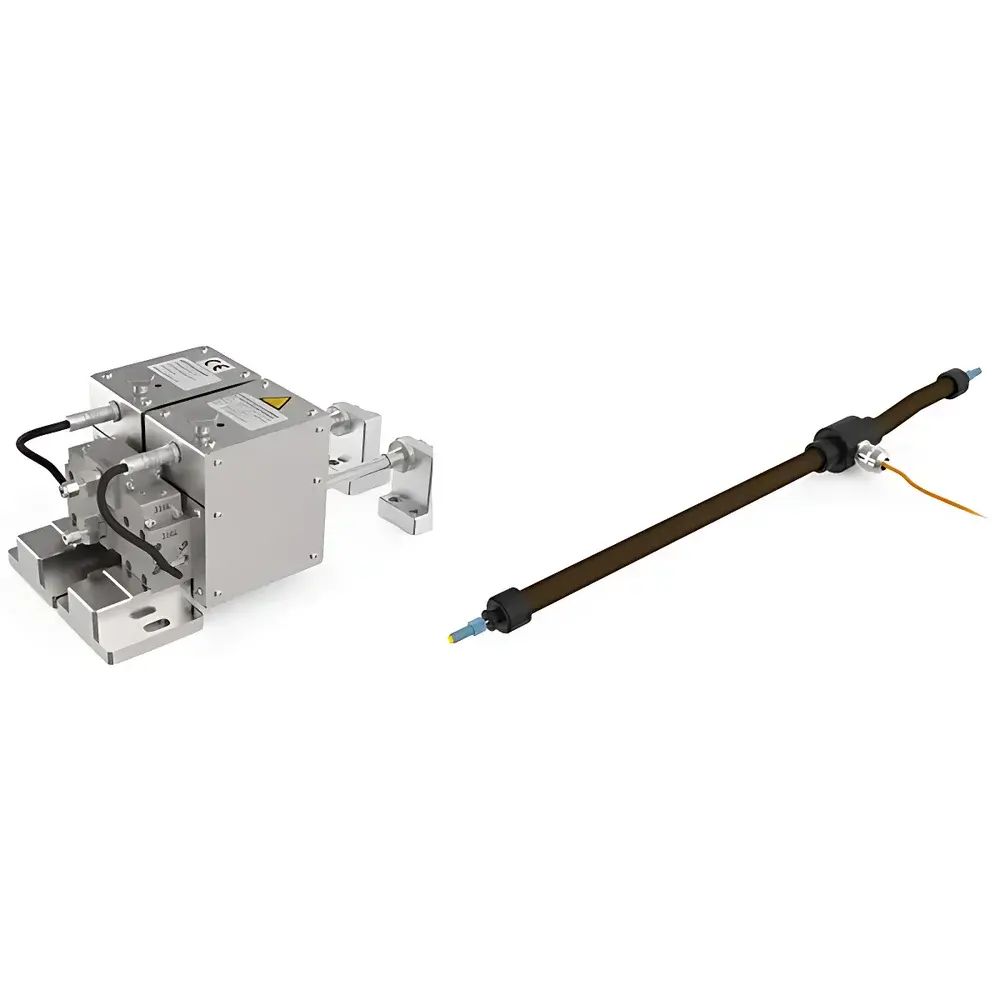
CETONI Qmix TC-Heated Syringe and Heating Sleeve
| Brand | CETONI |
|---|---|
| Origin | Germany |
| Model | Qmix TC-Heated Syringe & Heating Sleeve |
| Max. Heating Temperature | 200 °C |
| Heating Power | Syringe: 150 W, Sleeve: 70 W |
| Supply Voltage | 24 V DC |
| Construction Material | Stainless Steel (Syringe), Custom Polymer/Alloy Composite (Sleeve) |
| Compatible With | CETONI Qmix modular fluid control platform |
| Compliance | CE-marked, RoHS-compliant, Designed for Lab-Scale Process Integration |
Overview
The CETONI Qmix TC-Heated Syringe and Heating Sleeve is an integrated temperature-controlled fluid handling module engineered for precise thermal management of low-volume liquid streams in microfluidic and lab-on-a-chip applications. Based on resistive Joule heating and closed-loop PID temperature regulation, the system delivers stable, uniform thermal conditioning directly at the point of fluid dispensing—eliminating conductive losses common in external bath or oven-based heating. Unlike passive thermal enclosures, this active heating solution maintains setpoint accuracy within ±1.5 °C (typical, under steady-state flow conditions) across the entire syringe barrel and capillary path, enabling reproducible reaction kinetics, viscosity-sensitive delivery, and thermally triggered phase transitions in real time. Designed exclusively for integration with the CETONI Qmix modular fluid control platform, the unit operates under synchronized command from the QmixControl software suite and interfaces via CAN bus to ensure deterministic timing between flow rate, pressure, and thermal actuation.
Key Features
- Direct-contact resistive heating architecture with embedded Pt1000 temperature sensors for real-time feedback at both syringe barrel and sleeve capillary zones
- Independent thermal control channels: syringe (150 W max) and heating sleeve (70 W max), each configurable via QmixControl with ramp/soak profiles
- Stainless steel syringe body (316L grade) rated for pressures up to 100 bar, compatible with aggressive solvents and high-viscosity media
- Modular sleeve design featuring replaceable fused-silica or PEEK capillaries (ID: 100–500 µm), enabling rapid reconfiguration for different chemistries or particle-laden suspensions
- 24 V DC low-voltage operation ensures intrinsic safety in Class I, Division 2 laboratory environments and simplifies integration into automated workstations
- Thermal insulation optimized to minimize axial gradient—validated by IR thermography showing <5 °C deviation over 30 mm active heating length
Sample Compatibility & Compliance
The heated syringe and sleeve support a broad range of process fluids—including aqueous buffers, organic solvents (e.g., DMF, THF), polymer melts (up to 200 °C), and nanoparticle dispersions—without degradation of sealing integrity or thermal drift. All wetted materials comply with USP Class VI and FDA 21 CFR 177.2600 for repeated contact with pharmaceutical intermediates. The system meets IEC 61000-6-2 (immunity) and IEC 61000-6-4 (emission) standards, carries CE marking per Directive 2014/30/EU (EMC) and 2014/35/EU (LVD), and supports audit-ready electronic records when paired with QmixControl’s 21 CFR Part 11-compliant mode (with user authentication, event logging, and immutable data export).
Software & Data Management
Temperature setpoints, ramp rates, dwell times, and interlock conditions are defined and executed through CETONI’s QmixControl software—a native Windows application supporting scripting (Python API), batch protocol sequencing, and synchronized multi-axis control (flow, pressure, temperature, valve switching). All thermal events are timestamped and logged alongside pump parameters at 100 Hz resolution. Raw data exports as CSV or HDF5; metadata adheres to ISA-88/ISA-95 conventions for LIMS and MES interoperability. Optional QmixCloud enables remote monitoring, firmware OTA updates, and predictive maintenance alerts based on thermal cycle history.
Applications
- Microscale catalytic reactions requiring precise thermal initiation (e.g., Suzuki coupling, enzymatic synthesis)
- In-line preheating of viscous biopolymers (hyaluronic acid, alginate) prior to extrusion-based bioprinting
- Enhanced oil recovery (EOR) simulation: controlled heating of surfactant/polymer floods during core flooding experiments
- Thermoresponsive hydrogel dispensing with on-the-fly gelation onset control
- Calibration of infrared thermography systems using traceable, spatially resolved fluid-phase temperature references
- Accelerated stability testing of injectables under dynamic thermal stress profiles
FAQ
Is the heating sleeve compatible with non-CETONI syringes?
No—mechanical, electrical, and communication interfaces are proprietary to the Qmix ecosystem. Interchangeability is limited to CETONI-certified syringes with integrated TC sensor contacts.
Can the system maintain temperature during high-flow-rate dispensing?
Yes, dynamic compensation algorithms adjust power output in real time to counter convective cooling; performance is validated up to 10 mL/min with ≤2 °C deviation from setpoint.
What is the minimum recommended capillary inner diameter for the heating sleeve?
100 µm—below this, risk of localized overheating and fluid decomposition increases significantly due to reduced thermal mass and boundary layer effects.
Does the system support external temperature probes for validation?
Yes—QmixControl accepts analog input from calibrated external PT100 or thermocouple probes via optional QmixIO modules, enabling independent verification per ISO/IEC 17025 calibration workflows.
How is thermal calibration performed and documented?
Factory calibration uses NIST-traceable dry-block calibrators; end users may perform field verification using CETONI’s QmixTC-CalKit (PN: QTC-CAL-200), with full certificate generation compliant with GLP requirements.




