
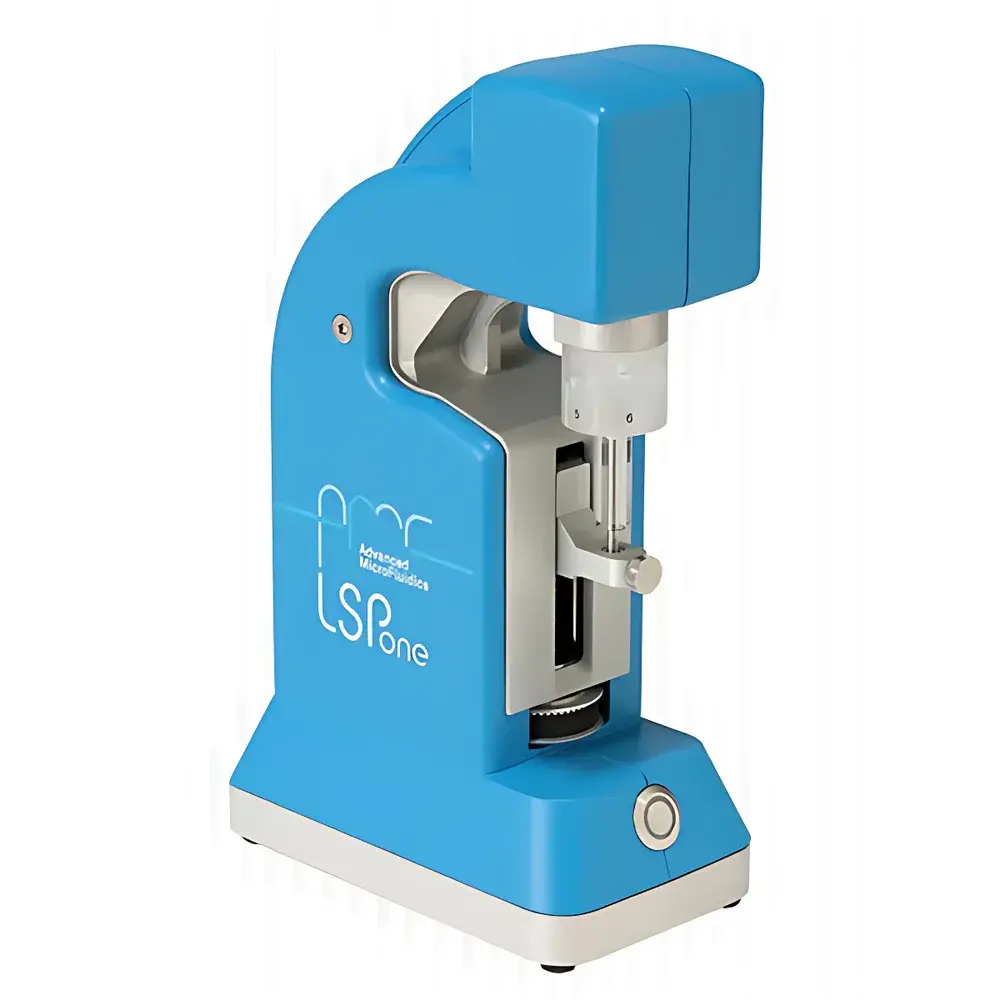
AMF LSPone Microfluidic Syringe Pump
| Brand | Advanced MicroFluidics (Switzerland) |
|---|---|
| Origin | Switzerland |
| Model | LSPone |
| Instrument Type | Precision Microfluidic Syringe Pump |
| Flow Rate Range | 0.25 nL/min to 30 mL/min |
| Flow Stability | Near-pulseless operation with high repeatability |
| Valve Dead Volume | As low as 1.5 µL |
| Operating Temperature | 5–40 °C |
| Operating Humidity | 20–80% RH (non-condensing) |
| Max System Pressure | 5 bar |
| Pump Drive | Linear encoder-equipped stepper motor with stall detection |
| Resolution | 3000 steps (standard) / 24,000 steps (high-res option) |
| Communication Interfaces | USB Mini-B, RS232, RS485, I²C (customizable) |
| Power Supply | 18–24 VDC, ≤2.2 A |
| Dimensions | 245 × 143 × 85 mm |
| Weight | 2.2 kg |
| Compliance | CE, CB |
| Software Support | Windows 7+, macOS, SDK for C/C++, Python, MATLAB, LabVIEW |
Overview
The AMF LSPone Microfluidic Syringe Pump is an engineered solution for precision fluid delivery in demanding microfluidic research environments. Designed and manufactured in Switzerland by Advanced MicroFluidics, the LSPone leverages closed-loop stepper motor control with integrated linear position encoding to achieve near-pulseless flow profiles across an exceptionally wide dynamic range—from sub-nanoliter-per-minute dosing to milliliter-per-minute throughput. Its core architecture follows the Couette-flow principle of controlled displacement, where volumetric accuracy is determined by syringe geometry, piston displacement resolution, and real-time feedback on mechanical slippage or stalling. This makes the LSPone particularly suited for applications requiring long-term stability, minimal shear-induced sample degradation, and strict temporal fidelity—such as organ-on-a-chip perfusion, single-cell stimulation, and time-resolved fluorescence labeling protocols.
Key Features
- Near-zero dead volume valve integration: Standard configurations include zero-dead-volume multi-port switching valves (e.g., VD2-6, VFD1-10), with internal volumes as low as 3.5 µL and system-level dead volume reduced to just 1.5 µL—significantly below conventional solenoid or rotary valves (typically ≥50 µL).
- Inverted syringe mounting orientation: Eliminates air entrapment during priming and startup, ensuring bubble-free initiation critical for optical assays and low-volume cell culture media exchange.
- High-resolution piston actuation: 30,000 microsteps per full stroke (30 mm), optionally upgradable to 24,000-step mode with enhanced positional fidelity; combined with linear encoder feedback for stall detection and compensation.
- Material compatibility: Fluid-wetted components constructed from chemically inert PTFE, PCTFE, and borosilicate glass—validated for use with aqueous buffers, organic solvents, and biologics under ISO 10993-compliant handling conditions.
- Modular communication architecture: Native support for serial protocols (RS232/RS485), USB Mini-B, and I²C bus—enabling deterministic timing control in synchronized multi-pump setups or integration into custom DAQ systems.
Sample Compatibility & Compliance
The LSPone accommodates a broad range of commercially available syringes (25 µL to 1000 µL), including those fabricated from PTFE, UHMW-PE, and glass, enabling compatibility with aggressive solvents (e.g., DMSO, acetonitrile), viscous hydrogels (up to 100 mPa·s), and shear-sensitive suspensions (e.g., primary neurons, organoid aggregates). All wetted materials comply with USP Class VI and EU Pharmacopoeia Chapter 3.1 standards for extractables and leachables. The device meets CE marking requirements under Directive 2014/30/EU (EMC) and 2014/35/EU (LVD), and carries CB Scheme certification for global market access. While not inherently 21 CFR Part 11 compliant, audit-ready data logging and user-accessible firmware update logs can be implemented via third-party software extensions aligned with GLP/GMP workflows.
Software & Data Management
Two complementary software layers are provided: LSPone Quick—a GUI-based application for real-time parameter adjustment, flow profile visualization, and sequence playback—and the LSPone SDK, which delivers native API bindings for C/C++, Python, MATLAB, and LabVIEW. The SDK supports asynchronous command queuing, hardware-triggered start/stop events, and timestamp-synchronized data acquisition at up to 100 Hz. All communication packets include CRC-16 error checking; firmware updates are signed and verified prior to installation. Exported datasets adhere to HDF5 format with embedded metadata (syringe ID, calibration coefficients, environmental logs), facilitating FAIR (Findable, Accessible, Interoperable, Reusable) data practices in academic and industrial labs.
Applications
- Organ-on-a-chip systems: Continuous, pulsatile, or gradient perfusion of endothelialized microchannels with physiological shear stress profiles (0.1–20 dyn/cm²).
- Single-cell analysis platforms: Nanoliter-scale reagent injection during microfluidic trapping and electrophysiological recording.
- Automated assay development: Multi-step liquid handling for high-content screening, including sequential addition of dyes, inhibitors, and substrates without cross-contamination.
- Microreactor feeding: Precise stoichiometric control in continuous-flow synthesis of nanoparticles or polymers.
- Cell encapsulation workflows: Co-injection of alginate/cell suspensions with CaCl₂ crosslinker at matched flow ratios to ensure uniform bead size distribution.
FAQ
What syringe sizes and materials are supported?
The LSPone accepts standard Luer-lock syringes from 25 µL to 1000 µL, including PTFE, UHMW-PE, and borosilicate glass variants. Custom syringe adapters are available upon request.
Is remote triggering possible for synchronization with imaging systems?
Yes—hardware TTL triggers (input/output) are provided on the rear panel, supporting external start/stop and pulse-width modulation for frame-locked fluid delivery.
How is calibration traceability maintained?
Each unit ships with a factory calibration certificate referencing NIST-traceable flow standards. End users may perform recalibration using gravimetric or fluorometric methods; calibration parameters are stored in non-volatile memory with version-stamped timestamps.
Can multiple LSPone units be daisy-chained for coordinated operation?
RS485 interface enables multi-drop serial topology (up to 32 devices per bus); dedicated synchronization firmware ensures sub-millisecond inter-unit timing alignment.
Does the system support pressure monitoring or overpressure protection?
While the LSPone does not integrate inline pressure sensors, its closed-loop motor control detects abnormal load increases indicative of occlusion. Optional external pressure transducers (0–10 bar range) can be interfaced via analog input channels on compatible DAQ modules.



