
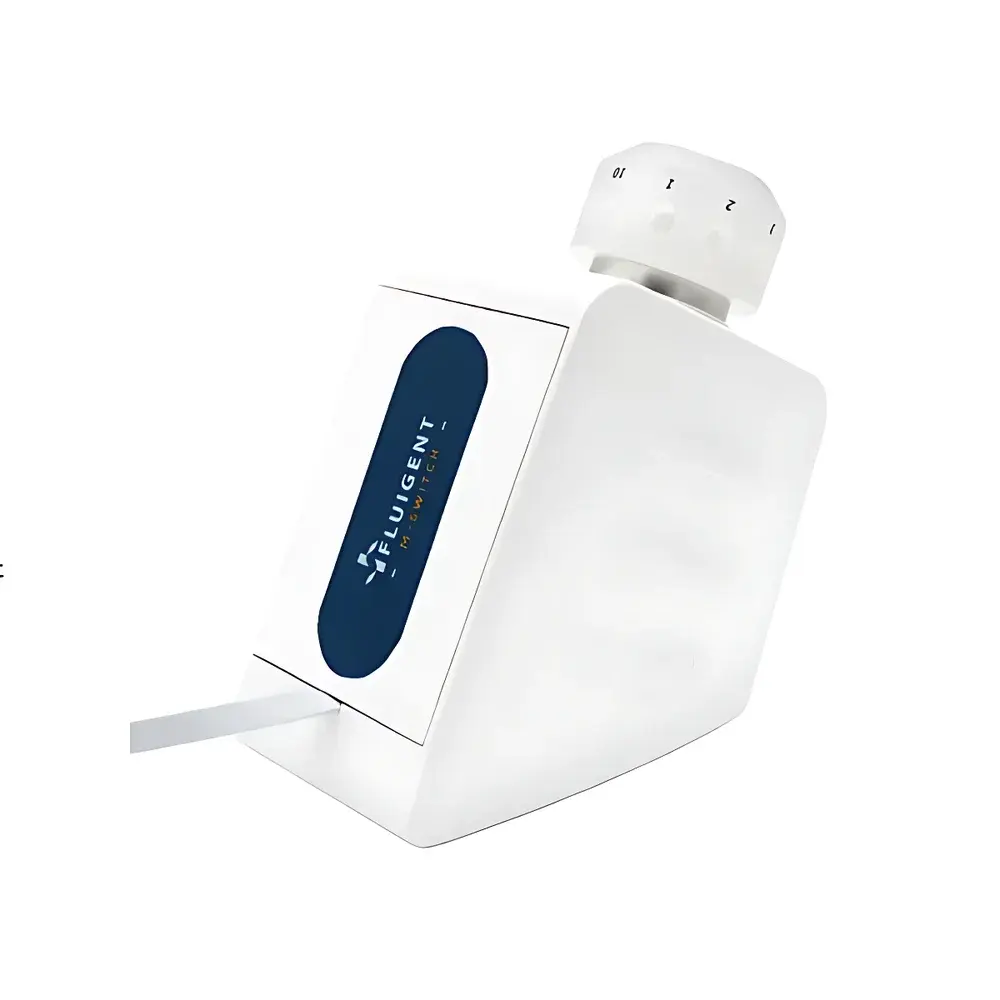
Fluigent M-Switch 10-Position High-Precision Microfluidic Switching Valve
| Brand | Fluigent (France) |
|---|---|
| Origin | France |
| Model | M-Switch |
| Port Configuration | 10 peripheral ports + 1 central common port |
| Control Interface | USB/RS-232 |
| Compatible Software | Fluigent OXYGEN™ v4.0+ |
| Actuation Type | Pneumatically actuated, solenoid-driven rotary valve |
| Max Operating Pressure | 8 bar (116 psi) |
| Fluid Compatibility | Aqueous, organic solvents, oils (chemically resistant PEEK and stainless steel wetted materials) |
| Repeatability | < 0.5% CV for sequential switching cycles |
| Typical Switching Time | ≤ 120 ms per position change |
| Temperature Range | 5–40 °C |
| Compliance | CE-marked, RoHS-compliant, ISO 9001-manufactured |
Overview
The Fluigent M-Switch is a high-precision, pneumatically actuated 10-position rotary microfluidic switching valve engineered for deterministic, low-dead-volume fluid routing in automated microscale experimental workflows. Based on a robust coaxial rotor-stator architecture with precision-machined PEEK and 316 stainless steel flow paths, the M-Switch operates on the principle of positive displacement port alignment—where a single central common port connects sequentially to any one of ten independently addressable peripheral inlets or outlets. This design eliminates internal leakage, minimizes carryover (< 10 nL residual volume per switch), and ensures repeatable flow path integrity across thousands of switching cycles. Unlike motorized or stepper-based alternatives, the M-Switch employs fast-response solenoid valves to control pressurized air actuation, enabling sub-120 ms position transitions without mechanical backlash or positional drift. It is purpose-built for integration into closed-loop microfluidic systems requiring strict temporal control over reagent delivery, sample injection, buffer exchange, or multi-step assay sequencing—particularly in applications where contamination avoidance, timing fidelity, and chemical compatibility are non-negotiable.
Key Features
- 10-position rotary configuration with 1 central common port and 10 peripheral ports—supporting bidirectional flow routing (inlet-to-outlet or outlet-to-inlet)
- Pneumatic actuation delivers rapid, silent, and wear-free switching with no moving parts in direct contact with fluids
- Chemically inert wetted materials: PEEK rotor/stator body and 316 stainless steel sealing surfaces ensure compatibility with aqueous buffers, ethanol, isopropanol, DMSO, and mineral oils
- Integrated pressure monitoring port (optional) enables real-time verification of line priming and occlusion detection
- Factory-calibrated position repeatability (< 0.5% coefficient of variation over 10⁴ cycles) verified under ISO/IEC 17025-accredited test protocols
- USB and RS-232 interfaces support deterministic command execution with hardware-level TTL trigger synchronization for time-critical experiments
Sample Compatibility & Compliance
The M-Switch is validated for use with biological samples including primary cells, organoids, and fluorescently labeled biomolecules (e.g., FITC-dextran, Alexa Fluor conjugates), as well as small-molecule pharmaceuticals and nanoparticle suspensions (diameters ≥ 20 nm). Its low-shear, laminar-flow geometry preserves cell viability and prevents aggregation during transit. The device conforms to CE marking requirements under Directive 2014/30/EU (EMC) and 2014/35/EU (LVD), complies with RoHS 2011/65/EU restrictions on hazardous substances, and is manufactured in an ISO 9001:2015-certified facility. While not classified as medical device or IVD equipment, its design supports GLP-aligned workflows when paired with audit-trail-enabled software such as OXYGEN™ with FDA 21 CFR Part 11-compliant user access controls (available via enterprise license).
Software & Data Management
The M-Switch is fully integrated with Fluigent’s OXYGEN™ software platform (v4.0 or later), which provides graphical sequence programming, real-time valve position logging, and synchronized triggering with compatible Fluigent pressure controllers (e.g., Flow-EZ, MFCS-EZ). Users define multi-step protocols—including timed dwell periods, conditional branching based on sensor inputs (e.g., pressure thresholds), and looped sequences—with millisecond-level timestamp resolution exported in CSV or HDF5 format. All command executions are logged with operator ID, timestamp, and checksum-verified command strings, satisfying traceability requirements for method validation and regulatory submissions. API support (Python, MATLAB, LabVIEW) enables custom automation within larger instrument control frameworks, including those compliant with ASTM E2500-07 (Good Automated Manufacturing Practice).
Applications
- Automated multi-reagent delivery in droplet-based single-cell RNA-seq library preparation
- Time-resolved fluorescence imaging assays requiring precise buffer/ligand exchange at defined intervals
- High-throughput drug screening platforms integrating on-chip cell culture, stimulation, and readout
- Calibration and standardization of microfluidic flow sensors using NIST-traceable reference fluids
- Multi-step surface functionalization of microstructured PDMS or glass chips (e.g., silanization → blocking → antibody incubation)
- On-demand solvent switching in microscale synthesis reactors with inline UV-Vis or Raman monitoring
FAQ
Can the M-Switch be used with viscous fluids such as glycerol-water mixtures?
Yes—within specified pressure limits (max 8 bar). Viscosities up to 100 mPa·s are supported; for higher viscosities, pre-heating or pressure compensation may be required.
Is sterilization possible without compromising performance?
Autoclaving is not recommended. However, the valve is compatible with 70% ethanol flushes, 0.5% sodium hypochlorite (bleach) rinses, and gas-phase hydrogen peroxide sterilization (≤ 600 ppm, 1 hr exposure).
Does the M-Switch support analog feedback or closed-loop position sensing?
No—the valve operates open-loop but includes digital position confirmation via optical encoder output (optional add-on module available upon request).
How is dead volume minimized during switching transitions?
Through optimized rotor groove geometry and dynamic pressure balancing between adjacent ports—validated by tracer dye studies showing < 8 nL carryover between sequential fluid switches.
Can multiple M-Switch units be daisy-chained or synchronized?
Yes—via OXYGEN™’s multi-device orchestration engine, supporting up to 8 M-Switch units with sub-millisecond inter-device timing alignment using shared hardware triggers.



