
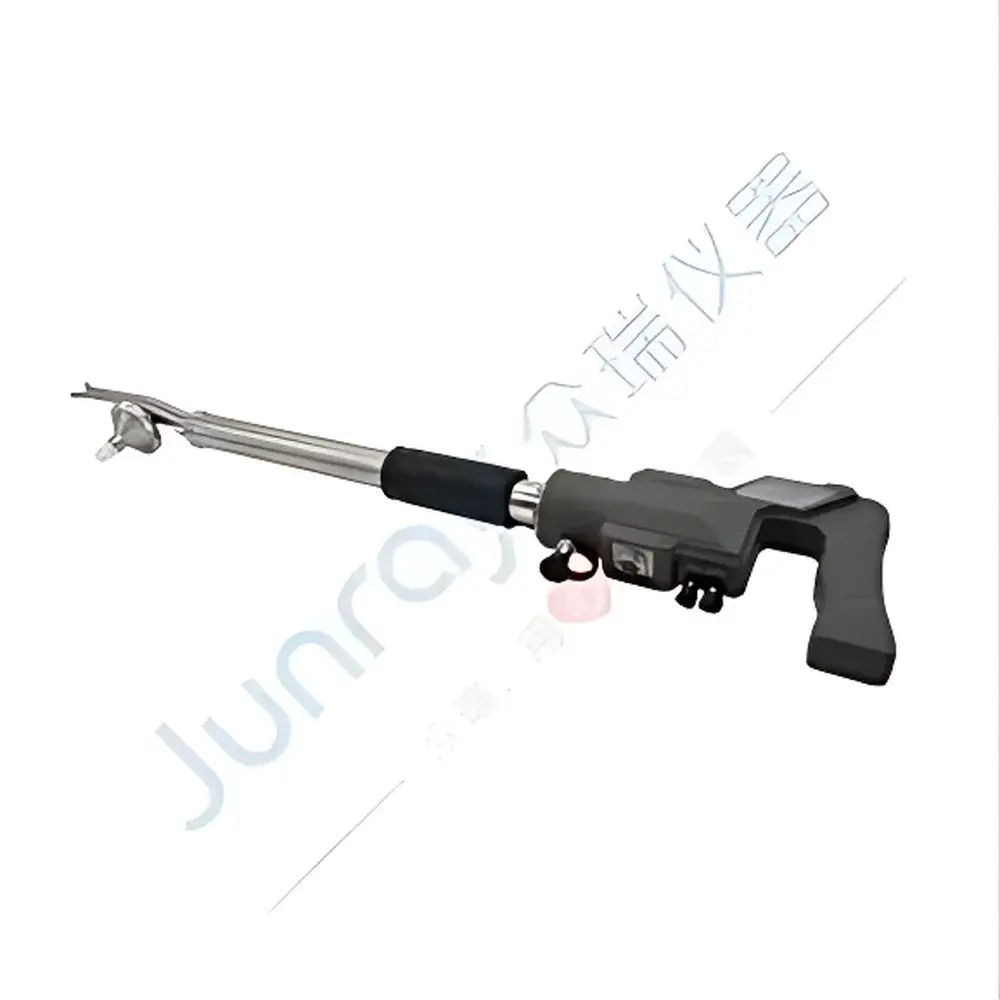
Junray ZR-D12B Oil Fume Sampling Probe
| Brand | Junray |
|---|---|
| Origin | Shandong, China |
| Manufacturer Type | Original Equipment Manufacturer (OEM) |
| Country of Origin | China |
| Model | ZR-D12B |
| Portability | Portable |
| Detection Principle | Gravimetric Filtration |
| Applicable Field | Food Service Industry |
| Compliance Standard | DB11/T 1485–2017 |
Overview
The Junray ZR-D12B Oil Fume Sampling Probe is a field-deployable, gravimetric sampling device engineered for the quantitative collection and subsequent mass-based determination of particulate-phase oil fume emissions from commercial cooking operations. Designed in strict accordance with DB11/T 1485–2017 (“Determination of Oil Fume Particulate Matter in Catering Emissions – Manual Gravimetric Method”), the probe implements a standardized isokinetic sampling protocol to ensure representative capture of airborne cooking aerosols across variable exhaust duct velocities. Its operational principle relies on controlled volumetric aspiration through a pre-weighed, inert filter medium—either polypropylene (PP) or polytetrafluoroethylene (PTFE)—followed by post-sampling laboratory gravimetry. The resulting mass difference, normalized to total sampled gas volume (corrected to standard temperature and pressure), yields the mass concentration of oil fume particulates (mg/m³). Unlike optical or electrochemical sensors, this method provides traceable, reference-grade data suitable for regulatory reporting and compliance verification.
Key Features
- Integrated multi-parameter probe architecture combining sampling tube, S-type Pitot tube, and Pt100 platinum resistance thermometer in a single stainless-steel assembly—enabling concurrent measurement of flue gas velocity, static/total pressure differential, and stack temperature during sampling.
- Modular filtration module comprising two stacked, pre-conditioned filters housed within a precision-machined polypropylene filter holder and protective mesh support; ensures minimal particle bounce and high retention efficiency for submicron cooking aerosols (typical aerodynamic diameter: 0.1–2.5 µm).
- Isokinetic sampling nozzle with calibrated geometry and interchangeable tip sizes to match duct flow profiles and maintain sampling velocity equivalence within ±10% of actual gas velocity—critical for minimizing size-selective bias.
- Filter cartridge designed for pre- and post-sampling handling under controlled laboratory conditions (ISO 17025-accredited weighing environment: 20 ± 1°C, 40–60% RH, Class 1000 cleanroom); supports both PP and PTFE membrane options per application requirements.
- Robust 316 stainless-steel construction with electropolished interior surfaces minimizes adsorption artifacts and facilitates cleaning between sampling campaigns—essential for high-reproducibility sequential measurements.
Sample Compatibility & Compliance
The ZR-D12B is validated for use in exhaust stacks and hoods of commercial kitchens, including wok stations, deep-fryers, griddles, and steam tables. It accommodates flue gas temperatures up to 200°C and velocities ranging from 2 to 30 m/s. All materials contacting the sample stream are inert and non-reactive toward organic condensables typical of cooking emissions (e.g., triglycerides, fatty acids, aldehydes). The probe conforms to the procedural and metrological requirements of DB11/T 1485–2017, including filter preconditioning protocols, desiccation timelines, and balance calibration traceability to national mass standards. While not certified to ISO/IEC 17025 itself, its design enables full integration into GLP-compliant environmental monitoring workflows and supports audit-ready documentation for municipal environmental protection bureaus and third-party inspection agencies.
Software & Data Management
The ZR-D12B operates as a hardware component within Junray’s broader ecosystem of stationary and portable emission monitoring systems (e.g., ZR-3260 series particulate samplers). When paired with compatible controllers, it feeds real-time analog signals (differential pressure, thermistor resistance) to embedded firmware that calculates isokinetic flow rate, standard cubic meter volume, and dynamic sampling correction factors. Raw sensor outputs and user-entered metadata (filter IDs, sampling duration, ambient barometric pressure) are logged in CSV-compatible format compliant with EPA Method 5 and ISO 12141 data structuring conventions. Exported datasets support traceability chains required under GB/T 38395–2019 (Environmental Monitoring Data Quality Management Technical Specification) and align with basic 21 CFR Part 11 readiness when deployed with timestamped, password-protected controller units.
Applications
- Regulatory compliance monitoring for municipal environmental enforcement agencies verifying adherence to local catering emission limits (e.g., Beijing DB11/1485–2017, Shanghai DB31/844–2021).
- Source apportionment studies in urban air quality research, where oil fume particulates serve as tracers for residential/commercial combustion contributions to PM₂.₅.
- Performance evaluation of油烟净化设备 (oil fume purifiers), including electrostatic precipitators and UV-catalytic oxidation units, via upstream/downstream paired sampling.
- Occupational hygiene assessments in kitchen staff exposure monitoring programs—supporting OEL derivation and ventilation system validation.
- Educational laboratory training in environmental engineering curricula covering gravimetric sampling theory, isokinetic principles, and stack testing methodology.
FAQ
What filter types are compatible with the ZR-D12B probe?
The probe accepts standard 47-mm circular membranes: hydrophobic PTFE (pore size 0.45 µm or 1.0 µm) and hydrophilic polypropylene (pore size 0.45 µm), both certified for low extractables and high particulate retention.
Can the ZR-D12B be used for continuous monitoring?
No—it is designed exclusively for discrete, time-integrated grab sampling per DB11/T 1485–2017; continuous measurement requires complementary optical or beta-attenuation instrumentation.
Does the probe include calibration certificates?
The S-type Pitot tube and Pt100 sensor are supplied with individual factory calibration reports (traceable to CNAS-accredited labs); field recalibration is recommended annually or after mechanical impact.
Is the ZR-D12B suitable for outdoor rooftop ducts?
Yes—its IP54-rated housing and stainless-steel thermal mass enable stable operation in ambient temperatures from −20°C to 50°C, provided the sampling port is properly sealed and insulated against rain ingress.
How is isokinetic sampling verified during field use?
By adjusting the sampling pump flow rate until the measured velocity pressure ratio (ΔPs/ΔPt) matches the theoretical isokinetic ratio derived from nozzle geometry and duct velocity profile—verified using the integrated Pitot-static signal pair.
Related Products







