
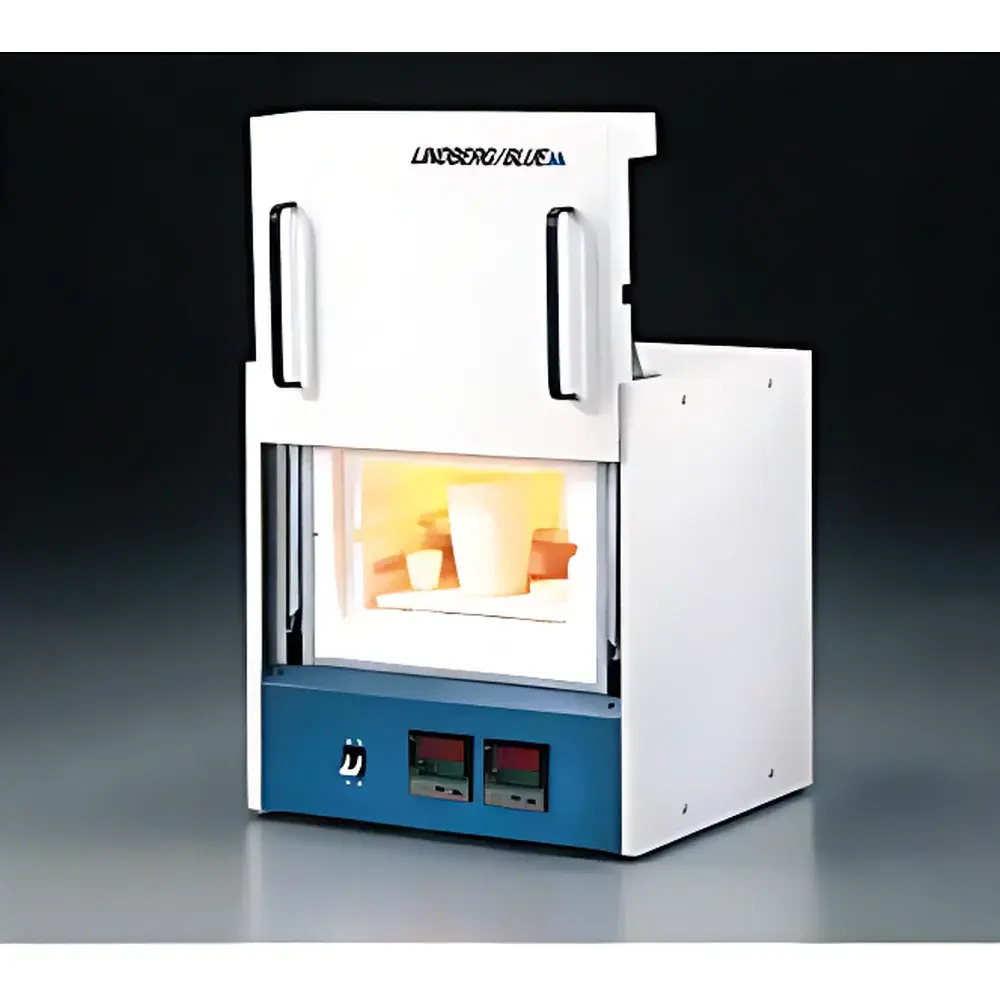
Thermo Fisher Lindberg/Blue M BF51731C-1 1200°C Box Furnace
| Brand | Thermo Fisher |
|---|---|
| Origin | USA |
| Manufacturer | Thermo Fisher Scientific |
| Product Type | Box Furnace |
| Maximum Temperature | 1200°C |
| Temperature Control Accuracy | ±2–4°C |
| Rated Power | 5800 W |
| Heating Rate (to Max Temp) | 6–12°C/min |
| Heating Method | Resistance Wire |
| Internal Dimensions | 177.8 × 279.4 × 330.2 mm |
| Door Configuration | Vertically Lifting |
| Gas Inlet/Outlet | Rear 0.375″ inlet, Top 1″ exhaust port |
| Thermal Insulation | Moldatherm™ ceramic fiber insulation |
| Heating Element | Patented LGO™ (Low-Glow Oxide) wire |
| Thermocouple Type | Platinel II |
| Safety Features | Automatic power cutoff upon door opening, adjustable overtemperature protection |
| Control System | Integrated digital controller with dual LED display (setpoint & actual temperature), selectable °C/°F units |
| Standard Accessories | One removable combination shelf, Moldatherm™ furnace floor plate |
Overview
The Thermo Fisher Lindberg/Blue M BF51731C-1 is a precision-engineered 1200°C box furnace designed for demanding laboratory and pilot-scale thermal processing applications. Built on the legacy of Lindberg/Blue M’s high-reliability furnace architecture, this model integrates patented LGO™ (Low-Glow Oxide) resistance heating elements and Moldatherm™ high-efficiency ceramic fiber insulation to deliver uniform temperature distribution, rapid thermal response, and minimized external surface temperatures—critical for safe operation in shared lab environments. The furnace operates within a programmable range of 100–1200°C and employs Platinel II thermocouples for long-term calibration stability under repeated thermal cycling. Its vertically lifting door design minimizes heat loss during loading/unloading and ensures consistent chamber geometry during operation. Engineered for reproducibility and compliance readiness, the BF51731C-1 supports controlled atmosphere workflows via dedicated inert gas inlet (0.375″ NPT rear port) and exhaust (1″ top port), with automatic leak compensation at the door seal interface.
Key Features
- Patented LGO™ heating elements: Low-emissivity oxide-coated resistance wires providing extended service life, reduced radiant energy loss, and improved thermal efficiency compared to standard Kanthal or NiCr alloys.
- Moldatherm™ insulation system: Multi-layered, low-conductivity ceramic fiber module engineered to maintain internal uniformity while limiting external casing temperature to <60°C at maximum operating setpoint—reducing ambient heat load and improving lab safety.
- Dual-display digital controller: Simultaneously shows setpoint and real-time chamber temperature with ±2–4°C accuracy across the full range; supports user-selectable °C/°F units and intuitive keypad navigation.
- Integrated safety architecture: Automatic heater de-energization upon door actuation; independently adjustable overtemperature cut-off (OTC) with audible alarm; front-panel emergency stop switch.
- Modular shelving system: Includes one removable combination shelf compatible with the 16.4 L chamber volume; optional additional shelves available for vertical sample staging without compromising airflow or thermal homogeneity.
- Gas management interface: Rear-mounted 0.375″ NPT gas inlet and top-mounted 1″ exhaust port enable stable purge or dynamic inert atmosphere control; door gasket design incorporates passive pressure equalization to minimize leakage during transient conditions.
Sample Compatibility & Compliance
The BF51731C-1 accommodates a broad range of sample forms—including crucibles (alumina, quartz, silicon carbide), ceramic boats, metal trays, and custom fixtures—within its 177.8 × 279.4 × 330.2 mm working chamber. The Moldatherm™ furnace floor plate protects the chamber base from thermal shock and particulate accumulation, extending maintenance intervals. From a regulatory standpoint, the furnace’s digital control architecture supports audit-ready operation: all temperature setpoints, ramp rates, dwell times, and OTC thresholds are stored in non-volatile memory. While not pre-certified for FDA 21 CFR Part 11, the controller’s deterministic behavior, password-protected parameter access, and absence of cloud connectivity make it suitable for GLP/GMP-aligned workflows where local data integrity and operator accountability are enforced through procedural controls. It complies with UL 61010-1 and CSA C22.2 No. 61010-1 for electrical safety in laboratory equipment.
Software & Data Management
This model features a standalone digital controller with no embedded software stack or network interface—ensuring deterministic thermal execution without firmware dependencies or cybersecurity exposure. All operational parameters (including up to 16-segment ramp-hold programs in optional variants) are configured directly via front-panel keys and retained in EEPROM. Temperature logging requires external recording: the controller provides a calibrated analog output (0–10 V DC proportional to temperature) and a digital RS-232 port (available on upgraded variants such as BF51732PC-1) for integration with validated data acquisition systems. For laboratories requiring electronic records per 21 CFR Part 11, third-party DAQ hardware with audit-trail-capable software (e.g., LabVIEW with NI DIAdem or DeltaV DCS interfaces) may be deployed to capture time-stamped temperature traces, event markers (door open/close, OTC activation), and user IDs.
Applications
The BF51731C-1 serves critical roles in materials science, metallurgy, ceramics R&D, and quality control laboratories. Typical use cases include ashing organic matrices in environmental and food testing (per ASTM D3174, ISO 1171), calcining catalyst precursors, sintering advanced ceramics, heat-treating small metal components, and performing thermal gravimetric pre-conditioning prior to TGA analysis. Its precise ramp-rate control (6–12°C/min to 1200°C) enables repeatable simulation of industrial firing profiles, while the inert gas capability supports oxidation-sensitive processes such as annealing of thin-film substrates or reduction of metal oxides. Universities utilize it for undergraduate and graduate coursework in solid-state chemistry and physical metallurgy due to its robust construction, intuitive interface, and compatibility with standard lab crucible formats.
FAQ
What is the difference between LGO™ and conventional resistance heating elements?
LGO™ elements feature a proprietary oxide coating that lowers emissivity and surface temperature under load, reducing radiant heat loss and extending element life—particularly beneficial during prolonged holds above 1000°C.
Can this furnace be used under vacuum or positive pressure?
No. The BF51731C-1 is rated for ambient-pressure inert gas purging only; it is not structurally rated for vacuum or pressurized operation.
Is Platinel II thermocouple calibration traceable to NIST?
Platinel II sensors are manufactured to ASTM E230 specifications; end-user calibration using NIST-traceable reference standards is recommended annually or per internal QA protocols.
Does the controller support profile downloading or remote programming?
Not natively—the base BF51731C-1 uses manual keypad entry. Programmable variants (e.g., BF51732 series) support USB or RS-232 upload of multi-segment profiles, but require external configuration tools.
What maintenance is required to sustain temperature uniformity?
Annual inspection of door gasket integrity, visual check of element sagging or hot-spot discoloration, and verification of thermocouple drift using a secondary reference probe are recommended best practices.



