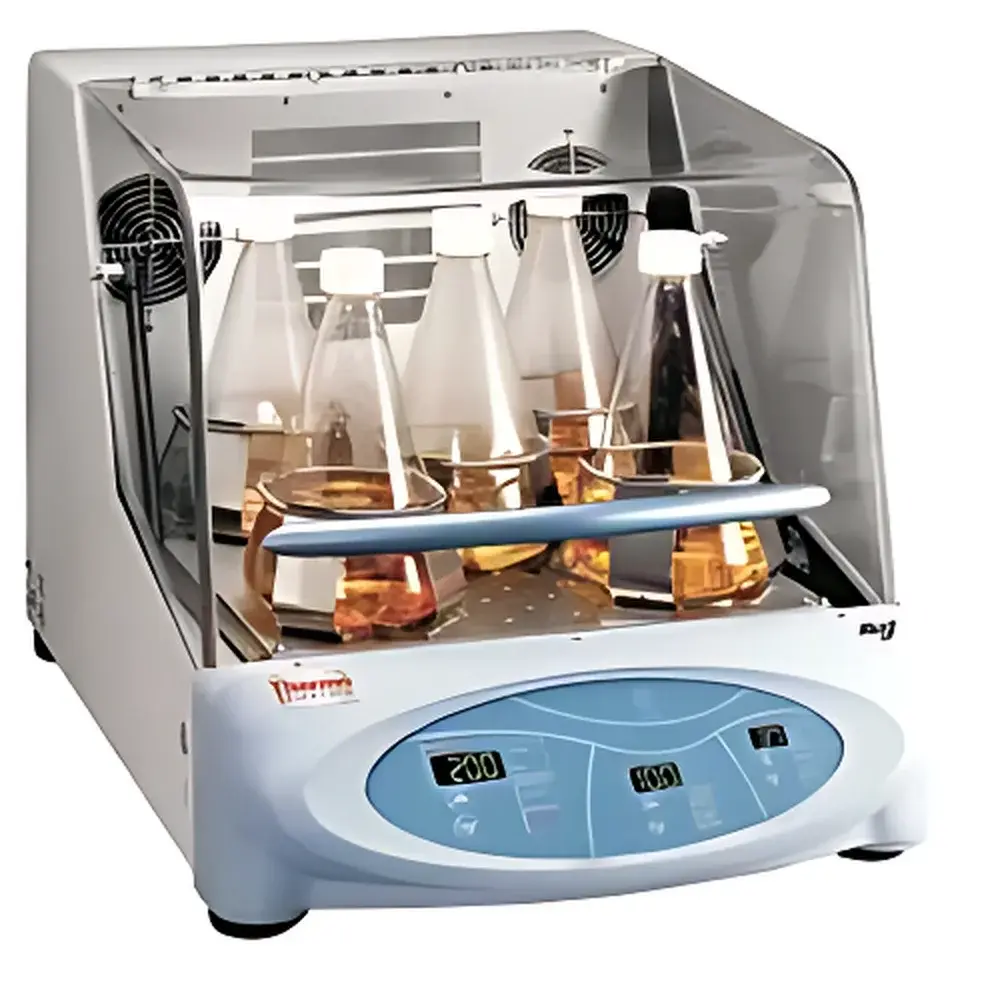
Thermo Scientific™ MaxQ™ 4000 Benchtop Orbital Shaker
| Brand | Thermo Fisher |
|---|---|
| Origin | USA |
| Manufacturer Type | Original Equipment Manufacturer (OEM) |
| Product Category | Imported Instrument |
| Model Variants | SHKE4000-1CE / SHKE4000-6CE / SHKE4000-8CE |
| Instrument Type | Orbital Shaker |
| Platform Size | 45.7 × 45.7 cm (18 × 18 in) |
| Orbit Diameter | 19 mm (0.75 in) |
| Speed Range (Analog) | 40–400 rpm |
| Speed Range (Digital) | 15–500 rpm |
| Temperature Control Range | Ambient to 60°C (Heating Only) or 4–60°C (Refrigerated Models) |
| Temp Accuracy | ±0.1°C at 37°C |
| Temp Uniformity | ±0.5°C across platform |
| Safety Features | Lid Interlock, Over-Temp Protection, Imbalance Detection, Speed Deviation Alert (±10%), Soft Start/Stop |
| Motor Type | Brushless DC Motor |
| Dimensions (W×D×H) | 81.3 × 57.2 × 55.9 cm (32 × 22.5 × 22 in) for standard models |
| Weight | 75.8 kg (167 lb) |
Overview
The Thermo Scientific™ MaxQ™ 4000 Benchtop Orbital Shaker is an engineered solution for precise, reproducible orbital agitation in life science laboratories. Utilizing a three-eccentric drive mechanism, it delivers uniform circular motion with a consistent 19 mm orbit diameter—optimized for suspension culture homogenization, solubilization kinetics, protein expression induction, and biochemical assay preparation. Unlike reciprocating or vortex shakers, orbital motion minimizes shear stress on sensitive biological samples while ensuring thorough mixing across heterogeneous suspensions. Designed as a compact yet high-capacity benchtop platform, the MaxQ 4000 accommodates up to six 2 L Erlenmeyer flasks simultaneously—enabling scalable process development without requiring floor-standing infrastructure. Its thermally insulated chamber and PID-controlled heating system support temperature-critical workflows such as bacterial growth at 37°C or enzymatic reactions requiring strict thermal stability.
Key Features
- Robust brushless DC motor architecture ensures maintenance-free operation over extended duty cycles, eliminating carbon brush wear and commutator arcing common in traditional AC motors.
- Large 45.7 × 45.7 cm (18 × 18 in) stainless steel platform provides ample surface area for multi-vessel configurations—including stackable flask racks, microplate carriers, and custom fixtures.
- Dual-control interface options: analog version features intuitive rotary speed dials and LED temperature display; digital variant integrates triple independent LED readouts for simultaneous monitoring of speed (rpm), setpoint temperature (°C), and elapsed/timer duration.
- Intelligent safety subsystems include lid-activated mechanical interlock, redundant over-temperature protection (primary PID controller + independent backup thermostat), real-time imbalance detection with automatic shutdown, and ±10% speed deviation alarm with audible/visual notification.
- Scratch-resistant transparent polycarbonate lid enables non-invasive sample observation without thermal perturbation—critical during long-duration incubations or time-course experiments.
- Soft-start/soft-stop functionality mitigates mechanical shock during acceleration/deceleration, preventing splashing, foam collapse, or condensation-induced wetting of flask exteriors.
Sample Compatibility & Compliance
The MaxQ 4000 supports broad sample container compatibility—from 15 mL conical tubes and 96-well plates to 2 L baffled flasks—via interchangeable platforms (sold separately): universal flat platforms for custom clamping, or application-specific platforms pre-fitted with spring-loaded flask holders. All variants comply with IEC 61010-1:2010 for laboratory electrical equipment safety. Refrigerated models (e.g., SHKE4000-6CE) meet ISO 13485 design control requirements for medical device manufacturing environments. The system’s temperature control architecture supports GLP-compliant validation protocols, including documented calibration traceability using handheld digital tachometers and NIST-traceable RTD probes. While not inherently 21 CFR Part 11 compliant, audit trails and electronic record integrity can be achieved when integrated with validated LIMS or ELN systems.
Software & Data Management
The MaxQ 4000 operates as a standalone instrument with no embedded firmware-based data logging. However, its analog and digital control modules are designed for seamless integration into regulated workflows. Digital models output TTL-level status signals (e.g., “run,” “alarm,” “lid open”) via rear-panel DB9 connectors—enabling external SCADA or PLC interfacing for centralized lab automation. For quality-critical applications, users may deploy third-party validation packages that capture operator inputs, environmental parameters, and runtime events in CSV or XML format. All temperature and speed settings are retained after power cycling, supporting continuity in multi-shift operations. Calibration records—including user-performed tachometer verification and thermal mapping reports—are structured to align with FDA guidance on computerized system validation (CSV).
Applications
- Microbial cultivation: E. coli, yeast, and mammalian cell line expansion under controlled temperature and orbital agitation.
- Molecular biology workflows: plasmid miniprep lysate mixing, restriction digest incubation, and gel staining/destaining steps requiring gentle but uniform agitation.
- Biopharmaceutical process development: solubility screening of monoclonal antibody formulations, buffer exchange optimization, and aggregation studies under accelerated conditions.
- Environmental and clinical microbiology: enrichment cultures for pathogen isolation, antibiotic susceptibility testing media preparation, and biofilm dispersion assays.
- Academic research: kinetic analysis of enzyme-substrate interactions, ligand-binding equilibrium studies, and small-molecule crystallization trials.
FAQ
What is the maximum flask capacity supported by the MaxQ 4000 platform?
The standard platform accommodates up to six 2 L Erlenmeyer flasks with proper balancing; load distribution must remain within ±5% mass variance across quadrants to prevent imbalance-triggered shutdown.
Can the MaxQ 4000 operate unattended overnight?
Yes—digital models support timer durations up to 999 hours (≈41.6 days); combined with lid interlock and over-temp redundancy, it meets institutional safety policies for unmonitored operation.
Is external temperature monitoring required for IQ/OQ validation?
While the internal PID sensor provides operational control, IQ/OQ protocols require spatial thermal mapping using calibrated thermocouples placed at ≥9 locations across the platform per ASTM E2876-22 guidelines.
How often does the speed calibration need verification?
Per Thermo Scientific recommendations, tachometer-based speed verification should be performed quarterly—or after any mechanical service event—and documented per ISO/IEC 17025 clause 7.7.
Are refrigerated models suitable for cold-room installation?
No—refrigerated variants (e.g., SHKE4000-6CE) require ambient room temperatures between 15–30°C and minimum clearance of 10 cm on all sides for heat dissipation from the compressor condenser.
Related Products