
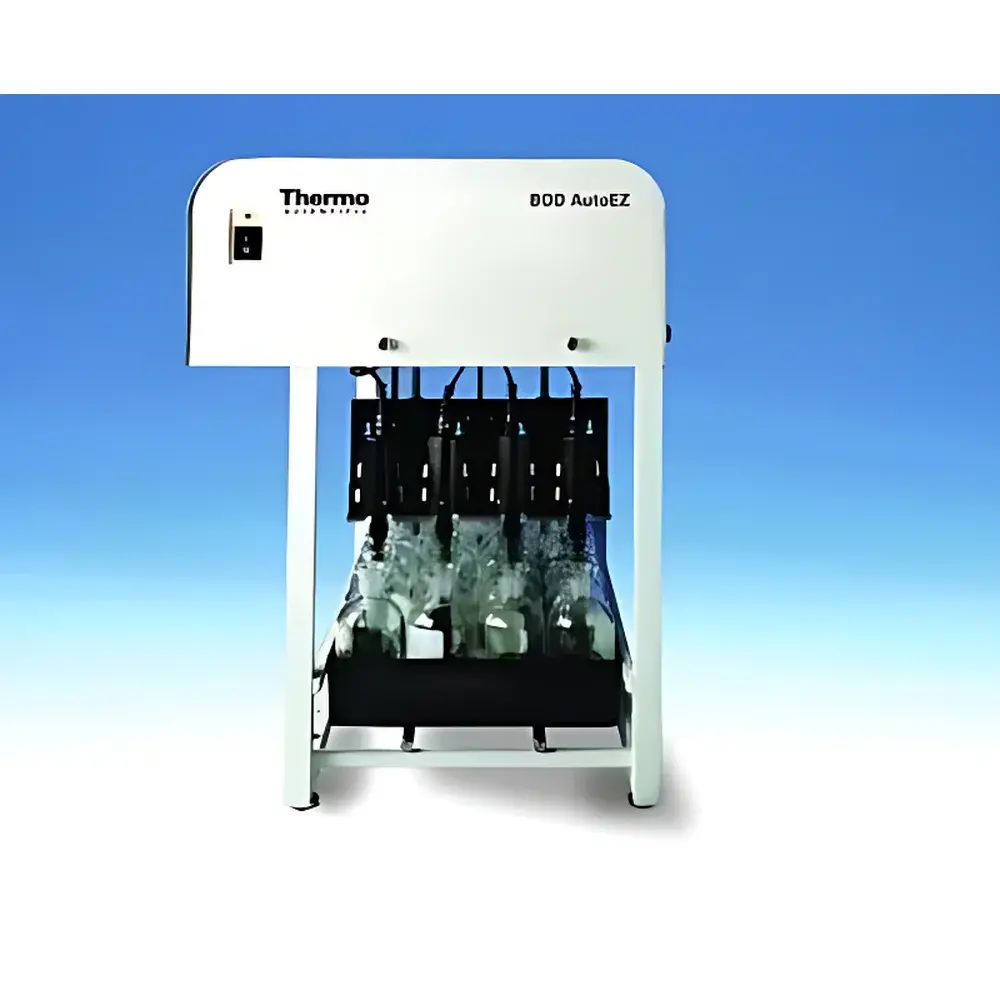
Orion BOD AutoEZ Automated Biochemical Oxygen Demand Analyzer
| Origin | Singapore |
|---|---|
| Manufacturer Type | Authorized Distributor |
| Origin Category | Imported |
| Model | BOD AutoEZ |
| Instrument Type | Laboratory BOD Analyzer |
| Measurement Principle | Microbial Electrode Method |
| Sample Capacity | Up to 36 samples per run (3 trays × 12 BOD bottles) |
| Analysis Time | ~15 minutes for full 36-sample batch |
| Electrode Configuration | Patented quad-electrode, 4-channel dissolved oxygen sensing |
| Report Generation | Fully automated BOD calculation and PDF/CSV export |
Overview
The Orion BOD AutoEZ Automated Biochemical Oxygen Demand Analyzer is an engineered solution for high-throughput, regulatory-compliant BOD5 determination in environmental laboratories. Unlike conventional dilution-based or manometric methods, the BOD AutoEZ employs a validated microbial electrode technique—where a fixed-film biocatalyst layer interacts with biodegradable organic matter under controlled aerobic conditions, generating a current proportional to oxygen consumption. This electrochemical transduction enables real-time, non-destructive monitoring of oxygen depletion kinetics without sample dilution or manual titration. Designed specifically for compliance with ASTM D5210 (Standard Test Method for Determining the Anaerobic Biodegradation of Plastic Materials in the Presence of Municipal Sewage Sludge) and ISO 5815-1 (Water Quality — Determination of Biochemical Oxygen Demand after N Days — Part 1: Dilution and Inoculation Method), the system delivers traceable, auditable results suitable for NPDES permit reporting, wastewater treatment plant performance verification, and regulatory submissions to EPA Region offices or equivalent national agencies.
Key Features
- High-density throughput architecture: Supports up to 36 BOD bottles simultaneously across three modular trays—enabling full-batch analysis in approximately 15 minutes, representing a ≥4× acceleration over manual Winkler titration or single-channel electrode systems.
- Patented quad-electrode measurement engine: Four independent, temperature-compensated dissolved oxygen sensors operate in parallel, each calibrated against NIST-traceable standards; eliminates cross-contamination via integrated ultrasonic and chemical cleaning cycles between sample runs.
- Autonomous electrode diagnostics: Real-time impedance spectroscopy and polarization voltage profiling continuously assess membrane integrity, electrolyte saturation, and biofilm activity—triggering maintenance alerts before drift exceeds ±2% FS per 72 h.
- Regulatory-grade data handling: All measurements are timestamped, user-ID authenticated, and stored with full audit trail metadata—including electrode calibration logs, ambient temperature/humidity readings, and inoculum source identifiers.
- Adaptive protocol logic: Supports multiple inoculation strategies (e.g., unacclimated seed, nitrification-inhibited seed, or site-specific acclimated sludge) with built-in correction algorithms aligned with Section 1060.2 of Standard Methods for the Examination of Water and Wastewater (23rd ed.).
Sample Compatibility & Compliance
The BOD AutoEZ accommodates standard 300-mL glass BOD bottles (ASTM D888-compliant) and accepts both raw influent, secondary effluent, and tertiary-treated waters. It is validated for matrices with turbidity ≤400 NTU and chloride concentrations up to 2,000 mg/L (with optional chloride compensation module). The system meets GLP requirements per 21 CFR Part 58 and supports 21 CFR Part 11–compliant electronic signatures when paired with validated LIMS integration. All firmware and method definitions are version-controlled and exportable for FDA or EMA inspection readiness.
Software & Data Management
The embedded BOD AutoEZ Control Suite (v4.2+) provides role-based access control, customizable report templates (PDF, CSV, XML), and direct export to laboratory information management systems via ASTM E1384-compliant HL7 or ODBC interfaces. Raw sensor data—including millivolt output, temperature-corrected DO concentration (mg/L), and calculated BOD5 (mg O2/L)—are archived with SHA-256 hash integrity verification. Audit trails record all parameter modifications, user logins, and report generation events with immutable timestamps synchronized to NTP servers.
Applications
- Wastewater treatment facility compliance monitoring (NPDES, BAT, and pretreatment program reporting)
- Environmental consulting firms conducting industrial discharge characterization
- Academic and government research labs studying biodegradation kinetics of emerging contaminants (e.g., PFAS precursors, pharmaceutical metabolites)
- Drinking water utility source water vulnerability assessments
- Validation of bioreactor performance in pilot-scale MBR and MBBR systems
FAQ
What regulatory standards does the BOD AutoEZ support?
ASTM D5210, ISO 5815-1, ISO 9562, and Standard Methods 5210B (Microbial Electrode Procedure). Full validation documentation is provided per ISO/IEC 17025:2017 Annex A.2.
Is the system compatible with existing LIMS platforms?
Yes—via configurable ODBC drivers, HL7 v2.5 messaging, or RESTful API endpoints supporting JSON payloads for result ingestion and instrument status polling.
How often must the microbial electrodes be replaced?
Under typical municipal wastewater testing conditions (≤20 samples/day), electrode service life averages 12–16 weeks; the system tracks cumulative exposure time and recommends replacement at 90% functional capacity.
Can the instrument perform BOD measurements beyond 5 days?
Yes—the software allows user-defined incubation durations from 1 to 28 days, with automatic endpoint detection based on oxygen consumption rate thresholds (e.g., <0.1 mg/L·h decline over 2 h).
Does the system require external calibration gases or reagents?
No—zero and span calibration are performed electrochemically using air-saturated deionized water and sodium sulfite solution; no compressed gas cylinders or titrant stocks are needed.
Related Products







