
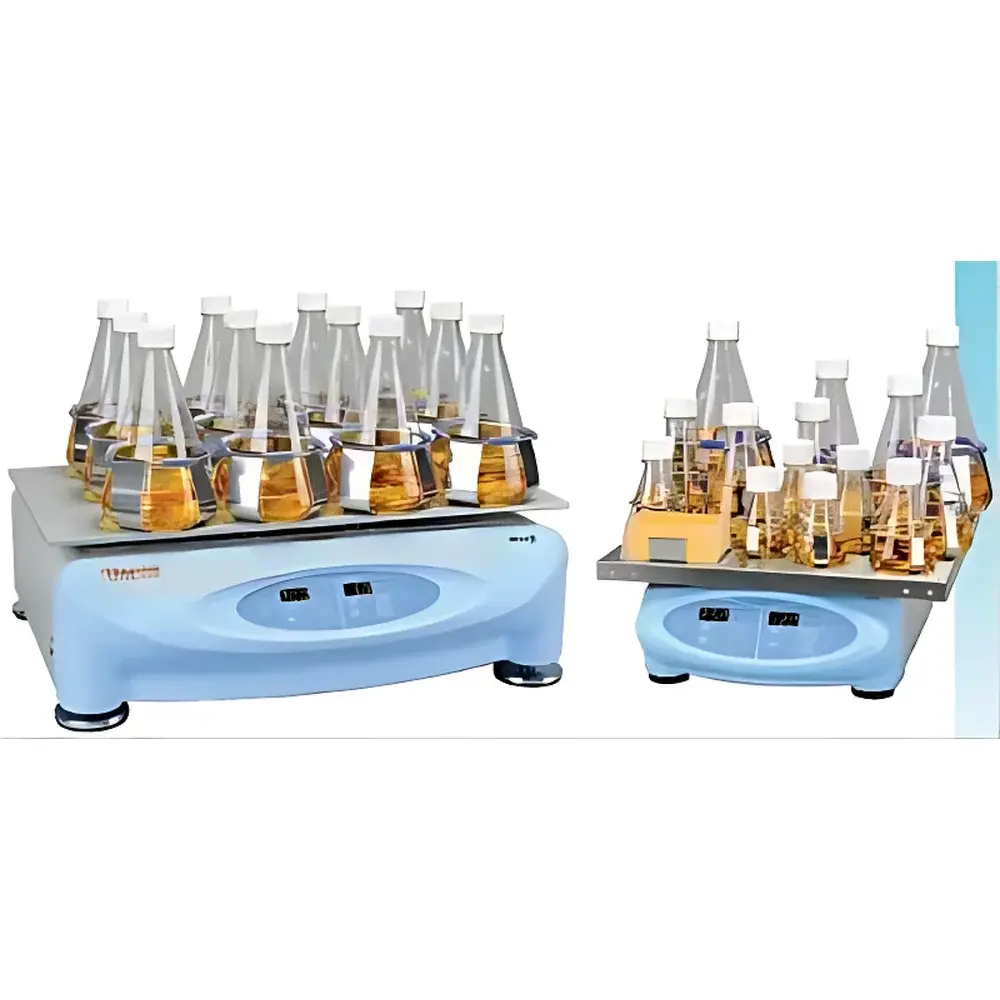
Thermo Scientific MaxQ 2000 & 3000 Orbital Shakers
| Brand | Thermo Fisher Scientific |
|---|---|
| Origin | USA |
| Manufacturer Type | Original Equipment Manufacturer (OEM) |
| Product Category | Imported Instrument |
| Models | SHKE2000-1CE / SHKE2000CO2-1CE / SHKE3000-1C |
| Temperature Range | 0–40 °C |
| Humidity Range | 20–80% non-condensing |
| Max Load Capacity | 15.9 kg (35 lb) for MaxQ 2000 |
| Speed Range (Analog) | 40–400 rpm |
| Speed Range (Digital) | 15–500 rpm |
| Timer Range (Digital) | 0.1 min to 999 min or 0.1 h to 999 h |
| CO₂ Resistance | Up to 10% CO₂ + 95% non-condensing humidity |
| Display | Dual independent LED displays (speed + time) |
| Safety Features | ±10% speed deviation shutdown, imbalance detection with audible/visual alarm, soft-start/soft-stop, power-fail parameter retention & auto-restart |
| Interface | RS232 for remote monitoring |
| Platform Options | 5 standard sizes (27.9 × 33.0 cm to 91.4 × 60.9 cm) |
| Warranty | 2-year on-site service, 5-year parts, 10-year drive mechanism |
Overview
The Thermo Scientific™ MaxQ™ 2000 and 3000 Orbital Shakers are precision-engineered benchtop platforms designed for consistent, repeatable orbital motion across demanding life science and bioprocessing workflows. Operating on the principle of controlled circular oscillation—typically at a fixed 20 mm orbit diameter—these shakers deliver uniform mixing energy without vortexing, making them ideal for suspension-based cultures, gentle reagent homogenization, and low-shear applications where cell integrity must be preserved. Unlike reciprocating or rocking platforms, orbital motion ensures laminar fluid dynamics critical for adherent cell detachment, hybridization kinetics, and solubility profiling. Both series are certified for continuous operation within environmental enclosures—including CO₂ incubators, cold rooms, and humidity-controlled growth chambers—thanks to corrosion-resistant electronics and sealed mechanical architecture.
Key Features
- Two-tier platform capacity: MaxQ 2000 supports up to 15.9 kg (35 lb); MaxQ 3000 accommodates loads up to 22.7 kg (50 lb), enabling scalability from microplate arrays to stacked flasks and large-volume bioreactor vessels.
- Dual control architectures: Analog models feature calibrated rotary dials with mechanical tachometer verification (40–400 rpm); digital variants offer programmable speed (15–500 rpm) and extended timing (0.1 min to 999 h) with real-time dual LED readouts for speed and elapsed time.
- Integrated safety systems include automatic shutdown upon ±10% speed deviation, dynamic imbalance detection with immediate platform halt and dual-mode (audible + visual) alerting, and soft-start/soft-stop algorithms that prevent liquid splashing, meniscus disruption, or condensation-induced vessel wetting.
- RS232 serial interface enables external logging of operational parameters—speed, duration, and status flags—for traceability in GLP/GMP environments compliant with FDA 21 CFR Part 11 requirements when paired with validated data acquisition software.
- CO₂-hardened digital electronics (MaxQ 2000 CO₂ model) resist degradation in 10% CO₂/95% RH atmospheres—critical for long-term incubator integration without electrolytic corrosion or carbonate film formation on PCBs.
- Power-fail resilience retains all user-defined settings and resumes operation automatically upon mains restoration—eliminating manual reconfiguration during facility-wide outages.
Sample Compatibility & Compliance
The MaxQ platform family accepts standardized accessories including universal platforms (unclamped), flask clamps (for Erlenmeyer, Fernbach, and baffled vessels), microplate carriers, and custom-fit inserts for deep-well plates and tube racks. All platforms conform to ISO 13485 manufacturing standards and are CE-marked per IEC 61010-1 for laboratory equipment safety. The MaxQ 2000 CO₂ variant meets ASTM E1910-22 specifications for CO₂-tolerant instrumentation used in mammalian cell culture environments. Devices operate reliably under USP and environmental conditions when deployed in cleanroom-adjacent preparation areas, provided ambient particulate levels remain below ISO Class 8 (100,000). No internal air filtration is required, as the design excludes recirculated airflow—reducing contamination risk in sterile workflow zones.
Software & Data Management
While the MaxQ series operates autonomously via front-panel controls, its RS232 port supports bidirectional communication with third-party laboratory information management systems (LIMS) and electronic lab notebooks (ELN). When integrated with Thermo Fisher’s optional LogTrack™ software suite (sold separately), users gain audit-trail-enabled session logging—including timestamped speed changes, timer resets, and fault events—with export capability to CSV or PDF for regulatory submissions. Calibration verification is performed using NIST-traceable handheld tachometers; user-adjustable offset correction ensures ongoing metrological alignment without factory recalibration. Firmware updates maintain compatibility with evolving cybersecurity protocols, including TLS 1.2 encryption for networked gateway configurations.
Applications
- Cell Culture: Maintenance of suspension CHO, HEK293, and insect cell lines under constant orbital agitation; compatible with serum-free and chemically defined media formulations.
- Molecular Biology: DNA/RNA hybridization in nylon membranes, Southern/Northern blot washing steps, and antibody incubation for Western blots—where uniform buffer exchange and minimal shear are essential.
- Pharmaceutical Development: Solubility screening of API candidates across pH gradients, dissolution testing of solid dosage forms, and extraction efficiency validation per USP .
- Clinical Diagnostics: Antigen-antibody binding kinetics in ELISA plate readers, bead-based immunoassays, and PCR prep mixing—supporting CLIA-certified lab workflows.
- Environmental & Food Testing: Extraction of pesticides from plant matrices, heavy metal leaching from soils, and microbial enrichment in buffered peptone water per AOAC 990.11 and ISO 6887-1.
FAQ
What distinguishes the MaxQ 2000 CO₂ model from the standard MaxQ 2000?
The CO₂ variant features conformal-coated circuit boards, stainless-steel fasteners, and sealed potentiometers specifically engineered to withstand 10% CO₂ and 95% non-condensing humidity—preventing carbonic acid formation and electrochemical corrosion over multi-week incubator deployments.
Can the MaxQ 3000 accommodate stacked 2.8 L Fernbach flasks?
Yes—the 91.4 × 60.9 cm large platform (SHKE3000-1C) supports up to four vertically stacked 2.8 L flasks when used with the optional high-capacity clamp kit (Cat. No. 13-720-21), maintaining stable center-of-mass dynamics at 120 rpm.
Is firmware validation documentation available for GxP-regulated labs?
Thermo Fisher provides IQ/OQ protocol templates and a Device Master Record (DMR) package upon request, supporting installation qualification (IQ), operational qualification (OQ), and periodic performance verification per Annex 11 and ALCOA+ data integrity principles.
Does the RS232 interface support Modbus RTU or only ASCII commands?
The native protocol is ASCII-based with documented command syntax (e.g., “SPD?” for speed query, “RUN” for start); Modbus RTU requires an external protocol converter or middleware layer.
How often should speed calibration be performed?
Per Thermo Fisher’s recommended maintenance schedule, verify speed accuracy quarterly using a NIST-traceable optical tachometer; adjust via front-panel calibration mode if deviation exceeds ±2 rpm at setpoint.
Related Products




