
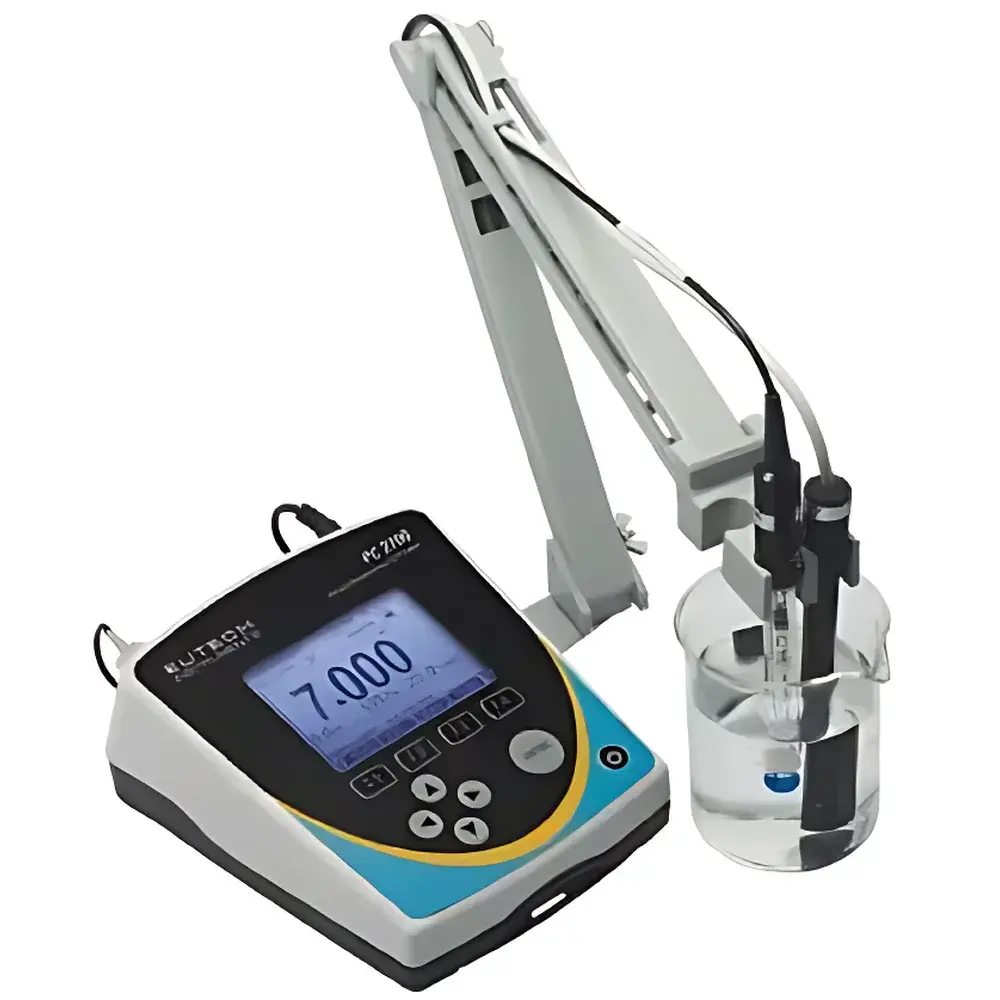
Thermo Fisher Scientific Eutech PC2700 Multi-Parameter Benchtop Meter for pH, ORP, Conductivity, TDS, Salinity, Resistivity and Temperature
| Brand | Thermo Fisher Scientific |
|---|---|
| Origin | Singapore |
| Manufacturer | Thermo Fisher Scientific |
| Type | Laboratory Water Quality Analyzer |
| Model | Eutech PC2700 |
| Instrument Category | Benchtop Multiparameter Water Quality Meter |
| Compliance | GLP-compliant data logging |
| Connectivity | RS232 bidirectional interface |
| Electrode Interface | BNC, 8-pin DIN (2- or 4-ring), DC socket |
| Display | Backlit LCD (5.9 × 7.8 cm) |
| Dimensions (H×W×D) | 17.5 × 15.5 × 6.9 cm |
| Weight | 0.65 kg (unit) |
| Operating Temperature | 0–50 °C |
| Power Supply | 9 V DC regulated adapter (100–240 VAC SMPS) |
Overview
The Thermo Fisher Scientific Eutech PC2700 is a high-precision, benchtop multiparameter water quality analyzer engineered for rigorous laboratory applications in environmental monitoring, municipal water treatment, industrial process control, and academic research. It integrates seven critical water quality parameters—pH, oxidation-reduction potential (ORP), ion concentration (via ISE), conductivity, total dissolved solids (TDS), salinity, and resistivity—within a single, unified platform, all referenced to temperature measurements (0.0–100.0 °C). The instrument operates on potentiometric (pH/ORP/ISE) and conductimetric (conductivity/TDS/salinity/resistivity) measurement principles, with automatic temperature compensation (ATC) algorithms compliant with ASTM D1125 and ISO 7888 standards. Its architecture supports both manual and automated calibration workflows, enabling traceable, reproducible measurements essential for regulatory reporting and method validation under GLP and ISO/IEC 17025 frameworks.
Key Features
- Seven-parameter simultaneous measurement capability with real-time display of temperature, electrode status, calibration history, timestamp, and active measurement values
- High-resolution dual-mode pH measurement: selectable resolution of 0.1 / 0.01 / 0.001 pH with ±0.002 pH accuracy across −2.000 to +20.000 pH range
- Advanced conductivity module featuring auto-calibration with electrode constant calculation; supports 4-ring conductivity electrodes for enhanced accuracy in low- and high-conductivity matrices (0.050 µS/cm to 500.0 mS/cm)
- Configurable multi-point calibration: up to 6-point pH calibration with automatic buffer recognition; 2–8 point ISE calibration with slope and intercept diagnostics
- GLP-compliant data management: 500 internal measurement records stored with date/time stamp, electrode ID, calibration data, and operator ID (when password-enabled)
- Security and audit readiness: password-protected menu navigation and calibration functions; configurable calibration expiry alerts to support scheduled maintenance and quality assurance protocols
- Bidirectional RS232 communication for integration with LIMS or laboratory data management systems; compatible with standard terminal emulation software for raw data export
Sample Compatibility & Compliance
The Eutech PC2700 is validated for use with aqueous samples across diverse matrices—including freshwater, wastewater, seawater, brines, and pharmaceutical process water—provided sample temperature remains within operational limits (0–50 °C) and conductivity does not exceed 500 mS/cm. Its 4-ring conductivity electrode enables stable, polarization-free measurements in high-ionic-strength solutions where 2-ring sensors exhibit drift. All measurement algorithms conform to internationally recognized standards: pH per ISO 3696 (Grade 3 water), conductivity per ISO 7888 and ASTM D1125, and TDS conversion using fixed 0.5–0.75 NaCl-equivalent factors per USP . The instrument meets general electrical safety requirements per IEC 61010-1 and is designed for operation in Class II laboratory environments. While not intrinsically safe, it complies with EMC directive 2014/30/EU for electromagnetic compatibility.
Software & Data Management
Data integrity is ensured through built-in GLP functionality: each stored record includes measurement value, ambient and sample temperature, electrode type and serial number (if encoded), calibration date/time, user-defined ID (optional), and sensor diagnostic flags (e.g., slope deviation, response time). The RS232 interface supports ASCII-formatted output with configurable delimiters and line endings, facilitating direct import into Excel, LabArchives, or custom SQL databases. No proprietary software is required for basic data retrieval; however, optional Thermo Fisher-compatible terminal emulators enable batch export and CSV generation. Audit trails are maintained locally—no cloud dependency—and calibration logs retain full metadata required for FDA 21 CFR Part 11 compliance when paired with institutional electronic signature policies.
Applications
- Environmental laboratories conducting EPA Method 150.1 (conductivity), 150.2 (pH), and 160.1 (TDS) analyses
- Water treatment facilities performing daily QA/QC on influent, effluent, and distribution system samples
- Pharmaceutical manufacturing sites verifying Purified Water (PW) and Water for Injection (WFI) attributes per USP and EU Ph. Eur. 2.2.38
- Academic research labs studying ion transport, membrane fouling, or electrochemical behavior in natural and engineered aquatic systems
- Food & beverage quality control assessing brine strength, rinse water purity, and formulation stability
FAQ
Does the PC2700 support automatic temperature compensation for all measured parameters?
Yes—ATC is applied to pH, ORP, conductivity, TDS, salinity, and resistivity measurements using either integrated Pt1000 or external NTC thermistor probes connected via the 8-pin DIN port.
Can the instrument store calibration data separately for multiple electrodes?
No—the PC2700 does not maintain electrode-specific calibration memory; however, calibration logs include electrode ID input fields, allowing users to manually annotate electrode identifiers for traceability.
Is the RS232 interface compatible with modern Windows/macOS systems without legacy serial ports?
Yes—when used with certified USB-to-RS232 adapters (e.g., FTDI-based), the interface functions reliably under Windows 10/11 and macOS 12+, provided appropriate drivers and terminal settings (9600 baud, 8N1) are configured.
What is the recommended recalibration frequency under GLP conditions?
Per Thermo Fisher application guidance, daily verification with at least one standard is advised; full multi-point calibration should be performed before each analytical batch or every 24 hours—whichever occurs first—and documented in the instrument’s internal log.
Does the PC2700 meet FDA 21 CFR Part 11 requirements out-of-the-box?
It provides foundational capabilities (audit trail, electronic signatures via password, calibration expiry alerts) but requires institutional procedural controls (e.g., SOPs, access management, backup protocols) to achieve full Part 11 compliance.







