
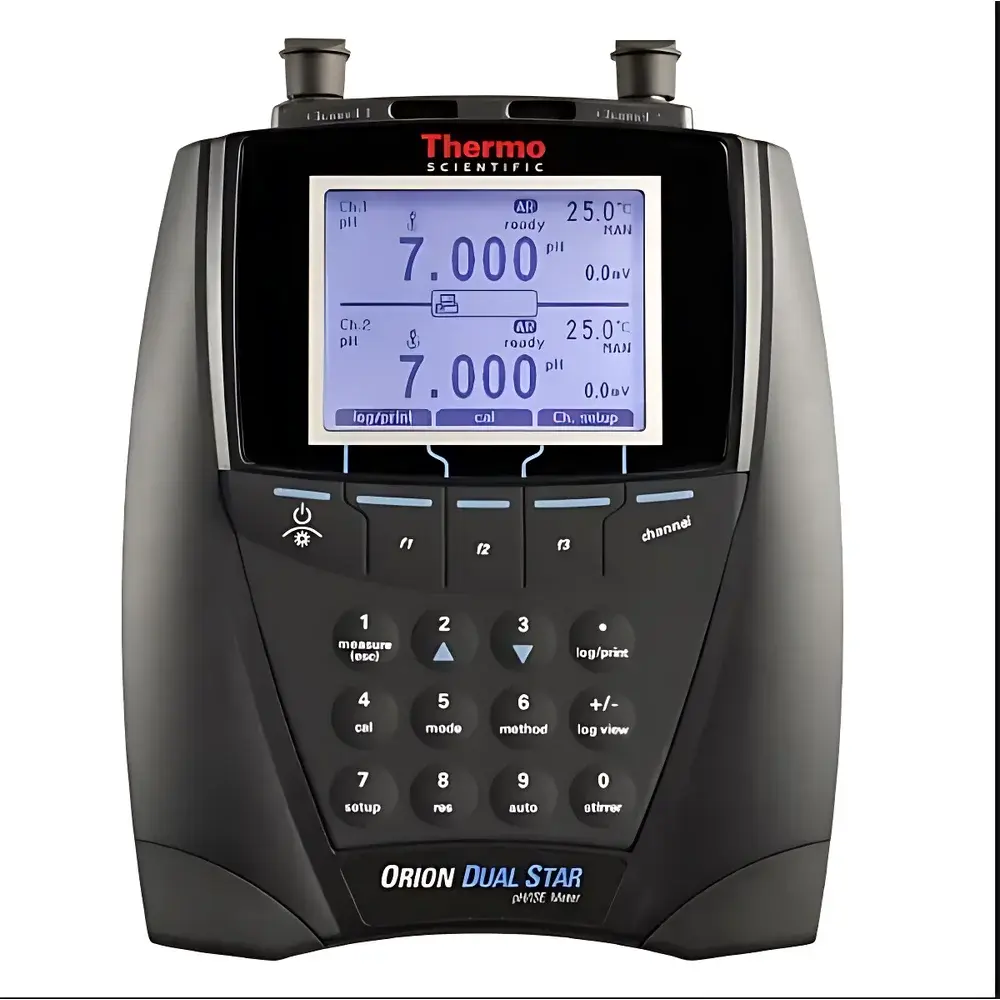
Thermo Fisher Orion Dual Star D10P-06 Low-Level Sodium Ion Concentration Meter
| Brand | Thermo Fisher |
|---|---|
| Origin | USA |
| Manufacturer | Thermo Fisher Scientific |
| Product Type | Imported |
| Model | D10P-06 |
| Instrument Category | Sodium Ion Analyzer |
| Form Factor | Benchtop |
| Measurement Range | 0–19999 (in user-selectable units) |
| Detection Limit | 0.1 ppb (with 8411BNWP electrode and flow cell) |
| Response Time | < 30 s (t₉₀, typical) |
| Accuracy | ±0.1 mV (potential) or ±0.05% of reading (whichever is greater) |
| Temperature Range | −5 to 105 °C |
Overview
The Thermo Fisher Orion Dual Star D10P-06 Low-Level Sodium Ion Concentration Meter is a benchtop ion-selective electrode (ISE) analyzer engineered for trace-level sodium quantification in ultra-pure water systems—particularly critical in power generation, semiconductor ultrapure water (UPW) loops, and pharmaceutical water-for-injection (WFI) monitoring. It operates on the principle of potentiometric measurement using a solid-state, low-sodium-selective membrane electrode (Orion 8411BNWP) coupled with a double-junction Ross reference electrode (800500U). The system measures the potential difference between the ISE and reference electrode, converting it via Nernstian response (−59.16 mV per decade at 25 °C) into concentration values across six orders of magnitude (5 ppb to saturation). Its dual-channel architecture allows simultaneous sodium and pH/ORP monitoring—essential for compensating activity coefficients and verifying sample stability during low-concentration analysis.
Key Features
- Dual-channel capability: Independent measurement of sodium ion activity and pH, ORP, or temperature on a single platform—enabling real-time ionic strength correction and process correlation.
- Trace-sensitivity configuration: Optimized for sub-ppb sodium detection using the 8411BNWP ion-selective electrode with integrated sodium-specific glass membrane and low-drift reference junction; achieves stable readings down to 5 ppb when paired with an optional flow-through cell (e.g., Orion 900100).
- GLP-compliant data integrity: Onboard audit trail, password-protected method editing, time-stamped calibration logs, and 1000-point internal storage—all compliant with 21 CFR Part 11 requirements when used with Orion Star™ software and secure network configuration.
- Advanced calibration flexibility: Supports 2–6 point calibration with single/dual standard addition (known addition/subtraction), enabling accurate quantification in high-resistivity matrices where direct calibration is impractical.
- Rugged benchtop design: IP54-rated enclosure; CE, CSA, UL, TÜV, and FCC Class A certified; operates reliably in ambient conditions from 5–45 °C and 5–85% RH (non-condensing).
- Intuitive dual-line LCD interface: Simultaneous display of primary and secondary parameters (e.g., [Na⁺] and pH), adjustable resolution (1–3 significant digits), and unit selection (ppm, mg/L, mol/L, %, or unitless).
Sample Compatibility & Compliance
The D10P-06 is validated for use with deionized water, boiler feedwater, condensate, steam trap samples, and WFI—provided conductivity remains below 1 µS/cm to minimize interfering cation effects. Sample introduction supports static beaker measurement or continuous flow via Orion flow cells (900100 series) with PTFE wetted parts. All measurements adhere to ASTM D4581 (Standard Test Method for Sodium in Water by Ion-Selective Electrode) and ISO 10523 (Water quality — Determination of pH). When configured with GLP mode enabled and electronic signatures activated, the instrument meets regulatory expectations for data integrity under USP , EP 2.2.38, and GMP Annex 11 frameworks.
Software & Data Management
Data export and method management are supported via bidirectional RS232 communication (USB adapter optional). Orion Star™ Com software enables remote instrument control, automated report generation (PDF/CSV), calibration verification tracking, and electronic signature workflows aligned with FDA 21 CFR Part 11 Subpart C. Stored datasets include electrode ID, calibration history, temperature-compensated mV readings, slope (%Nernst), and offset (mV)—all timestamped and user-attributed. Up to 20 preconfigured methods—including EPA-compliant sodium protocols and custom SOPs—can be saved with parameter locking and version control.
Applications
- Power plant chemistry control: Continuous monitoring of sodium in turbine condensate and boiler feedwater to detect early-stage steam generator tube leakage (per EPRI TR-102556 guidelines).
- Semiconductor UPW validation: Verification of sodium residuals post-EDI and polishing mixed-bed resin, supporting ITRS-defined purity thresholds (<10 ppt).
- Pharmaceutical water systems: Routine testing of purified water (PW) and WFI per USP and EU GMP Annex 1, ensuring compliance with sodium action limits (≤10 ppb).
- Research laboratories: Kinetic studies of sodium leaching from borosilicate glassware or ion exchange resins under controlled pH and temperature gradients.
- Environmental reference labs: Certified reference material (CRM) verification for low-level sodium in matrix-matched standards (e.g., NIST SRM 1643e).
FAQ
What is the lowest detectable sodium concentration achievable with this system?
With the 8411BNWP electrode and flow-through cell under optimized conditions (temperature-controlled, low-background lab air, degassed samples), the practical detection limit is 5 ppb. The instrument’s specified detection limit is 0.1 ppb based on electrode Nernstian slope and noise floor—but real-world performance depends on sample matrix, handling protocol, and calibration rigor.
Can the D10P-06 measure sodium in seawater or high-salinity samples?
No. This configuration is designed exclusively for low-ionic-strength matrices. High-chloride or high-cation samples cause severe interference and electrode fouling. For brine or wastewater applications, a dedicated high-range sodium sensor (e.g., Orion 9720BN) and appropriate ionic strength adjustment are required.
Is automatic temperature compensation (ATC) supported?
Yes. The meter accepts input from a built-in or external MiniDIN temperature probe (e.g., Orion 011008) and applies Nernst equation correction in real time across −5 to 105 °C. Calibration slope and intercept are automatically adjusted for thermal drift.
How often must the 8411BNWP electrode be reconditioned?
Reconditioning (soaking in 10 ppm Na⁺ standard for ≥2 hours) is recommended before first use, after prolonged dry storage, or when observed slope falls below 54 mV/decade. Routine daily use typically requires conditioning only once per week if stored properly in 100 ppm Na⁺ solution.
Does the system support LIMS integration?
Yes—via RS232 ASCII command set or optional USB-to-serial bridge. Orion Star™ Com software provides HL7 and ASTM E1384-compliant output formats for seamless ingestion into laboratory information management systems (LIMS) such as LabWare, Thermo Fisher SampleManager, or Waters Empower.
Related Products







