
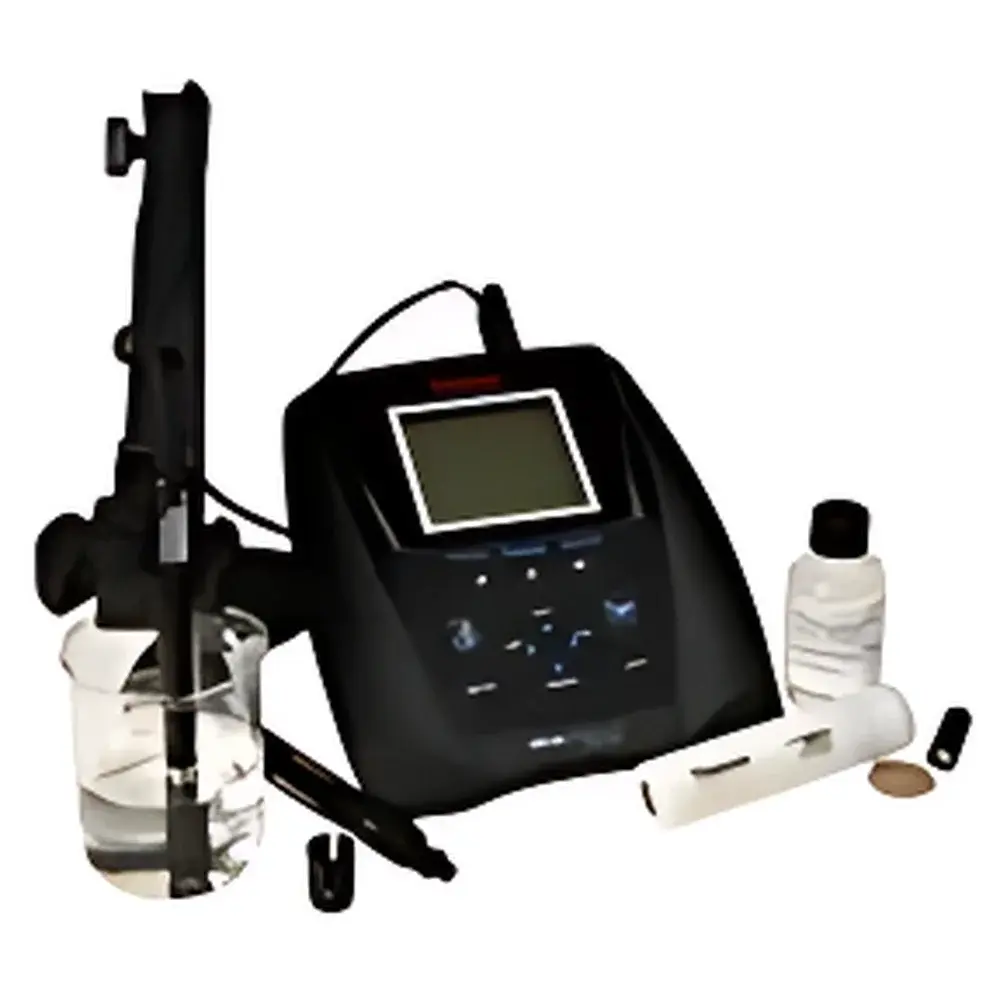
Thermo Fisher Orion Star A BOD Analyzer Model 310D-24A
| Brand | Thermo Fisher |
|---|---|
| Origin | Singapore |
| Manufacturer | Thermo Fisher Scientific |
| Product Type | Laboratory BOD Analyzer |
| Model | 310D-24A |
| Measurement Principle | Polarographic & Luminescent (RDO) Dissolved Oxygen Detection |
| DO Range (Polarographic) | 0–90 mg/L |
| DO Resolution (Polarographic) | 0.1 / 0.01 mg/L |
| DO Accuracy (Polarographic) | ±0.2 mg/L |
| DO Range (RDO) | 0–50 mg/L |
| DO Accuracy (RDO) | ±0.1 mg/L (0–8 mg/L), ±0.2 mg/L (8–20 mg/L), ±10% of reading (20–50 mg/L) |
| Saturation Range (Polarographic) | 0–600% |
| Saturation Range (RDO) | 0–500% |
| Saturation Accuracy | ±2% |
| Temperature Range | 0–50 °C |
| Temperature Accuracy | ±0.1 °C |
| Atmospheric Pressure Compensation | 450.0–850.0 mmHg |
| Salinity Compensation | 0–45 ppt (automatic with conductivity module or manual) |
| Calibration Modes | Saturated air/water, Winkler titration, zero-oxygen water |
| Data Storage | 2000 GLP-compliant entries |
| Interface | 9-pin mini-DIN DO probe port, RS232, USB |
| Power | AC adapter (100–240 V AC) or 4 × AA batteries |
| IP Rating | IP54 |
Overview
The Thermo Fisher Orion Star A BOD Analyzer Model 310D-24A is a high-precision, benchtop dissolved oxygen (DO) and biochemical oxygen demand (BOD5) measurement system engineered for regulatory compliance and laboratory reproducibility. It implements two internationally recognized electrochemical detection principles—polarographic amperometry and luminescent (RDO) optical sensing—to deliver traceable, stable, and method-validated DO data essential for BOD5 determination per U.S. EPA Method 405.1 and China’s HJ 505–2009 standard. Unlike colorimetric or biochemical incubation-only systems, this instrument directly quantifies dissolved oxygen depletion kinetics in sealed BOD bottles over 5-day incubation periods, enabling accurate calculation of BOD5 values via the standard dilution and seeding protocol. Its dual-probe compatibility ensures flexibility across matrix types—from low-salinity freshwater to moderately saline wastewater—while maintaining metrological integrity under variable temperature and barometric conditions.
Key Features
- Simultaneous support for polarographic and RDO (ruthenium-based luminescent) DO probes—eliminating membrane replacement downtime and reducing calibration drift in long-term BOD incubations.
- AUTO-READ™ stabilization algorithm with visual lock indicator, ensuring measurement capture only at thermodynamic equilibrium—critical for minimizing operator-induced variance in multi-sample BOD workflows.
- Multi-language interface (English, Chinese, Spanish, French, German, Portuguese) compliant with international laboratory staffing requirements and multilingual SOP documentation.
- Integrated atmospheric pressure compensation (450.0–850.0 mmHg) and salinity correction (0–45 ppt), either automatic (when paired with optional Orion conductivity modules) or manually entered—ensuring DO concentration accuracy across elevation gradients and estuarine samples.
- Benchtop IP54-rated enclosure—dust-resistant and splash-protected—suitable for shared analytical labs where reagent handling and incubator proximity demand robust environmental tolerance.
- Dual power operation: field-deployable with 4× AA alkaline batteries or continuous operation via universal AC adapter (100–240 V AC), supporting both lab and satellite facility deployment scenarios.
Sample Compatibility & Compliance
The Star A 310D-24A is validated for use with standard 300-mL BOD bottles (glass or BOD-specific plastic) and compatible with all common seeding sources (e.g., domestic wastewater effluent, nitrifying sludge, or commercial seed cultures). Its DO measurement architecture adheres to the fundamental assumptions of the dilution-and-seeding method: linear current response (polarographic mode) or phase-shift linearity (RDO mode) across defined concentration ranges, with documented traceability to NIST-traceable oxygen standards. Data output meets GLP (Good Laboratory Practice) recordkeeping requirements—including timestamped readings, probe ID logging, calibration history, and operator ID fields—facilitating audit readiness for environmental testing laboratories accredited to ISO/IEC 17025. While not inherently 21 CFR Part 11 compliant out-of-the-box, its secure data export protocols (USB/RS232) support integration into validated LIMS environments with electronic signature and audit trail overlays.
Software & Data Management
Data acquisition and post-processing are enabled through Thermo Fisher’s proprietary Orion Com software (v5.0+), distributed as a Windows-compatible desktop application. The software supports direct download of all 2000 stored measurements—including raw DO values, saturation percentages, temperature, pressure, and salinity metadata—with CSV and Excel export options. Batch calibration reports, trend analysis across incubation timepoints, and automated BOD5 calculation (per Equation 1 in HJ 505–2009) are embedded functions. Firmware updates are delivered via USB flash drive or serial upload, preserving instrument validation status without requiring external service dispatch. All data files include immutable GLP headers: instrument serial number, probe calibration dates, user login (if configured), and environmental compensation parameters—enabling full chain-of-custody reconstruction during regulatory review.
Applications
- Regulatory wastewater discharge monitoring per NPDES permits and municipal treatment plant compliance reporting.
- Environmental impact assessment (EIA) studies requiring BOD5 quantification in surface water, groundwater recharge zones, and receiving streams.
- Research-scale biodegradability screening of industrial effluents, pharmaceutical intermediates, and agrochemical formulations.
- Method verification and inter-laboratory comparison exercises organized under national environmental monitoring networks.
- Educational laboratories performing standardized APHA/AWWA/WEF 5210 B procedures with real-world sample matrices.
FAQ
Does the 310D-24A perform BOD5 calculations automatically?
Yes—it calculates BOD5 using user-entered initial and final DO values, dilution factor, and seed correction terms, following the exact formula specified in HJ 505–2009 and EPA 405.1.
Can RDO probes be used interchangeably with polarographic probes on the same instrument?
Yes—the analyzer auto-detects probe type via electrical handshake upon connection and loads appropriate calibration curves and units without manual configuration.
Is temperature calibration required before each BOD run?
No—a single-point temperature calibration (at 25 °C) is sufficient for routine use; the built-in thermistor maintains ±0.1 °C accuracy across 0–50 °C, and all DO readings are internally temperature-compensated.
How is data integrity maintained during extended 5-day incubations?
The instrument retains full measurement logs even during battery-powered operation; no data loss occurs during power cycling, and timestamps remain synchronized via internal real-time clock (RTC) with <±2 seconds/month drift.
Are probe membranes and electrolytes included with purchase?
Polarographic probe membranes and electrolyte solution are consumables supplied separately; RDO probes are maintenance-free with no membranes or fill solutions required.
Related Products







