
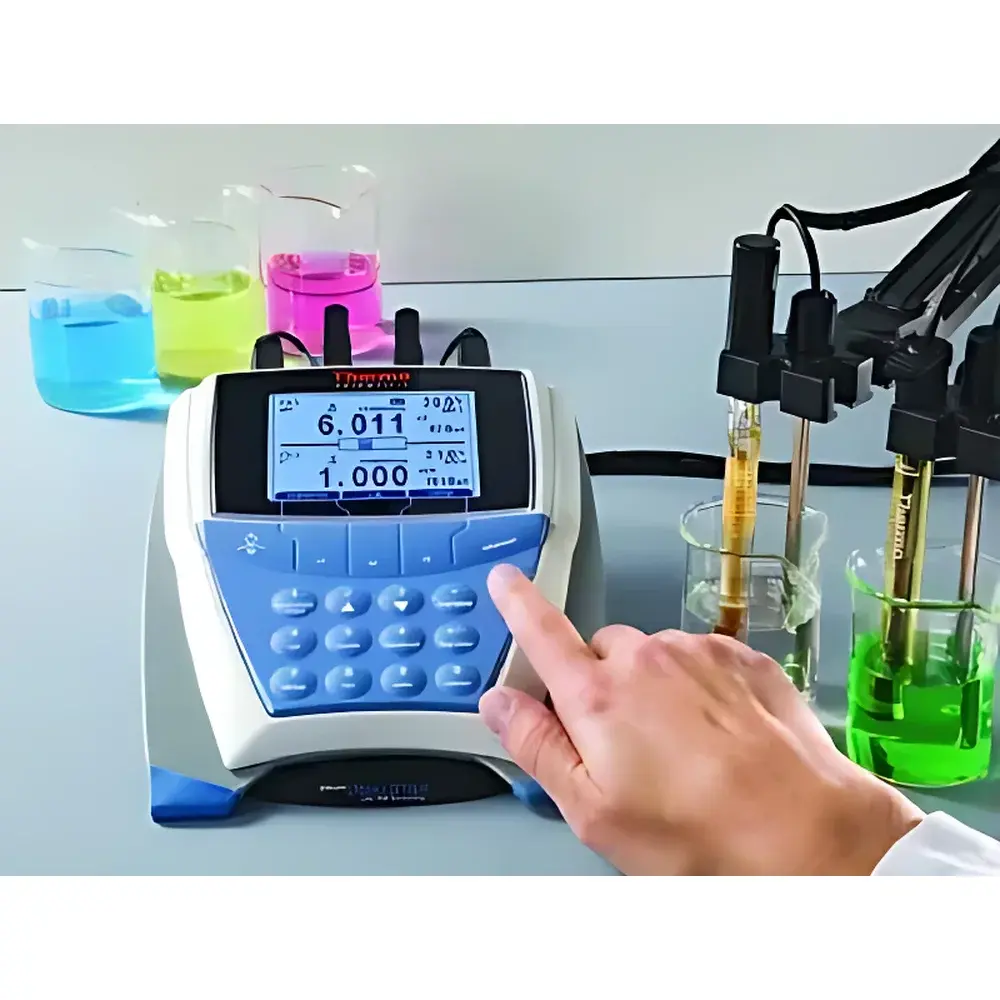
Thermo Fisher Orion Dual Star D10P-17 Chloride Ion Analyzer
| Brand | Thermo Fisher |
|---|---|
| Origin | USA |
| Manufacturer | Thermo Fisher Scientific |
| Product Type | Imported |
| Model | D10P-17 |
| Instrument Category | Chloride Ion Analyzer |
| Electrode | 9617BNWP Chloride Composite Electrode |
| Measurement Range (Electrode) | 1.8–35,500 ppm Cl⁻ |
| pH Range | 2–12 |
| Temperature Range | 10–100 °C |
| Repeatability | ±2% |
| Minimum Sample Volume | 3 mL |
| Electrode Dimensions | 110 mm length × 13 mm body diameter × 16 mm cap diameter |
| Cable Length | 1 m |
| Main Unit | Dual Channel pH/ISE Meter |
| ISE Range | 0–19,999 (ppm, mg/L, M, %, or unitless) |
| ISE Resolution | 1–3 significant digits |
| ISE Accuracy | ±0.1 mV or ±0.05% (whichever is greater) |
| pH Range | −2.000 to +19.999 |
| pH Resolution | 0.1 / 0.01 / 0.001 |
| pH Accuracy | ±0.001 |
| pH Calibration Points | 1–6 |
| ORP Range | ±1999.9 mV |
| ORP Resolution | 0.1 mV |
| ORP Accuracy | ±0.1 mV or ±0.05% |
| Temperature Range | −5 to +105 °C |
| Temp Resolution | 0.1 °C (−5 to 99.9 °C), 1.0 °C (>99.9 °C) |
| Temp Accuracy | ±0.1 °C |
| Display | Dual-channel LCD |
| Inputs | Two BNC, two reference electrode ports, two MiniDIN (for ATC probes) |
| Method Storage | 20 user-defined methods |
| Password Protection | Yes |
| Data Storage | 1,000 readings with timestamp |
| GLP Compliance | Yes (audit trail, calibration history, operator ID support) |
| Data Interface | Bidirectional RS232, optional USB cable |
| Enclosure Rating | IP54 |
| Safety Certifications | CE, CSA, UL, TÜV, FCC Class A |
| Operating Environment | 5–45 °C, 5–85% RH (non-condensing) |
| Power | 4×AA batteries or universal AC adapter |
| Dimensions | 9.4 cm (H) × 17.0 cm (W) × 22.4 cm (D) |
Overview
The Thermo Fisher Orion Dual Star D10P-17 Chloride Ion Analyzer is a dual-channel benchtop potentiometric measurement system engineered for high-reproducibility quantification of chloride ion activity in aqueous samples using ion-selective electrode (ISE) technology. Based on the Nernst equation, the instrument measures the potential difference between a chloride-specific composite electrode (Orion 9617BNWP) and a stable reference electrode, converting the resulting millivolt signal into concentration values—expressed in ppm, mg/L, molarity, or percentage—via built-in calibration algorithms. Designed for environmental monitoring laboratories, municipal water treatment facilities, industrial process control, and academic research, the D10P-17 supports rigorous regulatory workflows by delivering traceable, GLP-compliant data acquisition under ISO/IEC 17025-aligned practices. Its dual-channel architecture enables concurrent measurement of chloride concentration and pH—or two independent ISE parameters—eliminating sequential analysis bottlenecks and improving throughput in multi-parameter water quality assessment.
Key Features
- Dual-channel design with independent BNC inputs, reference electrode ports, and ATC (Automatic Temperature Compensation) MiniDIN interfaces—enabling simultaneous chloride and pH measurement or parallel analysis of two different ions (e.g., Cl⁻ and NO₃⁻).
- Integrated support for standardized ISE measurement protocols including single and double known addition/subtraction methods, ideal for complex matrices such as wastewater, seawater, brines, and soil leachates where ionic strength variation affects activity coefficients.
- Graphical calibration curve display with real-time slope monitoring and R² evaluation—ensuring electrode performance validation before sample analysis.
- GLP-compliant data management: automatic timestamping, operator ID logging, method versioning, and full audit trail for calibration events, measurements, and parameter changes per channel.
- Configurable password protection at both system and method levels—supporting role-based access control required in regulated environments (e.g., EPA-approved labs, drinking water utilities complying with US Safe Drinking Water Act requirements).
- Onboard storage of up to 1,000 measurement records with embedded metadata (date, time, electrode ID, temperature, mV reading, concentration, and method name)—exportable via RS232 to LIMS or spreadsheet software.
- Temperature compensation using the included Orion 927007MD thermistor probe, with optional manual offset adjustment and isothermal point configuration for thermal equilibration studies.
Sample Compatibility & Compliance
The D10P-17 accommodates a broad range of liquid samples—from ultrapure deionized water to high-salinity effluents—with reliable performance across pH 2–12 and temperatures from 10–100 °C. The 9617BNWP chloride composite electrode utilizes a solid-state silver/silver chloride sensing element and integrated reference junction, minimizing clogging and drift in turbid or particulate-laden samples. When used with 5 M NaNO₃ ionic strength adjuster (ISA, product 941709), the system maintains consistent activity-to-concentration conversion across variable matrix compositions. The analyzer meets essential regulatory and quality standards including ASTM D3279 (chloride in water), ISO 9297 (potentiometric determination of halides), and USP for dissolution testing applications requiring chloride monitoring. Its CE, UL, CSA, TÜV, and FCC Class A certifications confirm electromagnetic compatibility and electrical safety compliance for global deployment.
Software & Data Management
Data integrity is ensured through bidirectional RS232 communication supporting direct integration with laboratory information management systems (LIMS) and electronic lab notebooks (ELN). While the instrument operates autonomously without PC dependency, firmware updates are delivered via USB interface, preserving long-term operational continuity. All stored measurements include GLP-mandated fields: calibration date/time, electrode serial number, slope (%/decade), intercept, and user-defined sample ID. The system supports 20 customizable analytical methods—each assignable to specific electrode types and calibration configurations—allowing seamless switching between routine drinking water checks (100–1000 ppm Cl⁻) and low-level groundwater screening (<5 ppm) without recalibration overhead. Audit logs retain historical calibration data for up to six points per method, satisfying FDA 21 CFR Part 11 requirements when paired with validated third-party software.
Applications
- Drinking water and wastewater compliance testing per EPA Method 325.2 and APHA Standard Methods 4500-Cl⁻ B.
- Corrosion monitoring in cooling tower systems and boiler feedwater through chloride threshold detection.
- Soil and sediment pore-water analysis for chloride migration studies in landfill leachate containment assessments.
- Pharmaceutical excipient purity verification where residual chloride must remain below ICH Q5C thresholds.
- Educational laboratories performing fundamental electrochemistry experiments on Nernstian response, selectivity coefficients, and interference evaluation (e.g., Br⁻, I⁻, CN⁻).
- Food and beverage QA/QC for salt content validation in brined products, dairy processing streams, and desalinated irrigation water.
FAQ
What electrode is included with the D10P-17 system?
The standard configuration includes the Orion 9617BNWP chloride composite electrode, the 927007MD temperature probe, 1000 ppm Cl⁻ standard solution, ionic strength adjuster (ISA), magnetic stirrer, electrode stand, and RS232 cable.
Can the D10P-17 measure other ions besides chloride?
Yes—the dual-channel architecture supports any Thermo Fisher Orion ISE, including fluoride, nitrate, ammonia, sodium, potassium, bromide, cyanide, and calcium electrodes, provided appropriate calibration standards and ISA are used.
Is automatic calibration verification available?
While not fully automated, the instrument provides real-time slope calculation during calibration and alerts users if deviation exceeds ±5% from theoretical Nernst slope (−59.2 mV/decade at 25 °C), prompting electrode cleaning or replacement.
How does the system handle non-aqueous or high-viscosity samples?
For viscous or organic-rich matrices, dilution with ISA-containing background electrolyte is recommended to stabilize junction potential and maintain reproducible liquid junction potentials; minimum 3 mL sample volume ensures adequate electrode immersion and stirring efficiency.
Does the D10P-17 support remote operation or network connectivity?
No native Ethernet or Wi-Fi capability is built-in; however, RS232 output allows connection to serial-to-Ethernet converters or programmable logic controllers (PLCs) for integration into SCADA-based environmental monitoring networks.







