
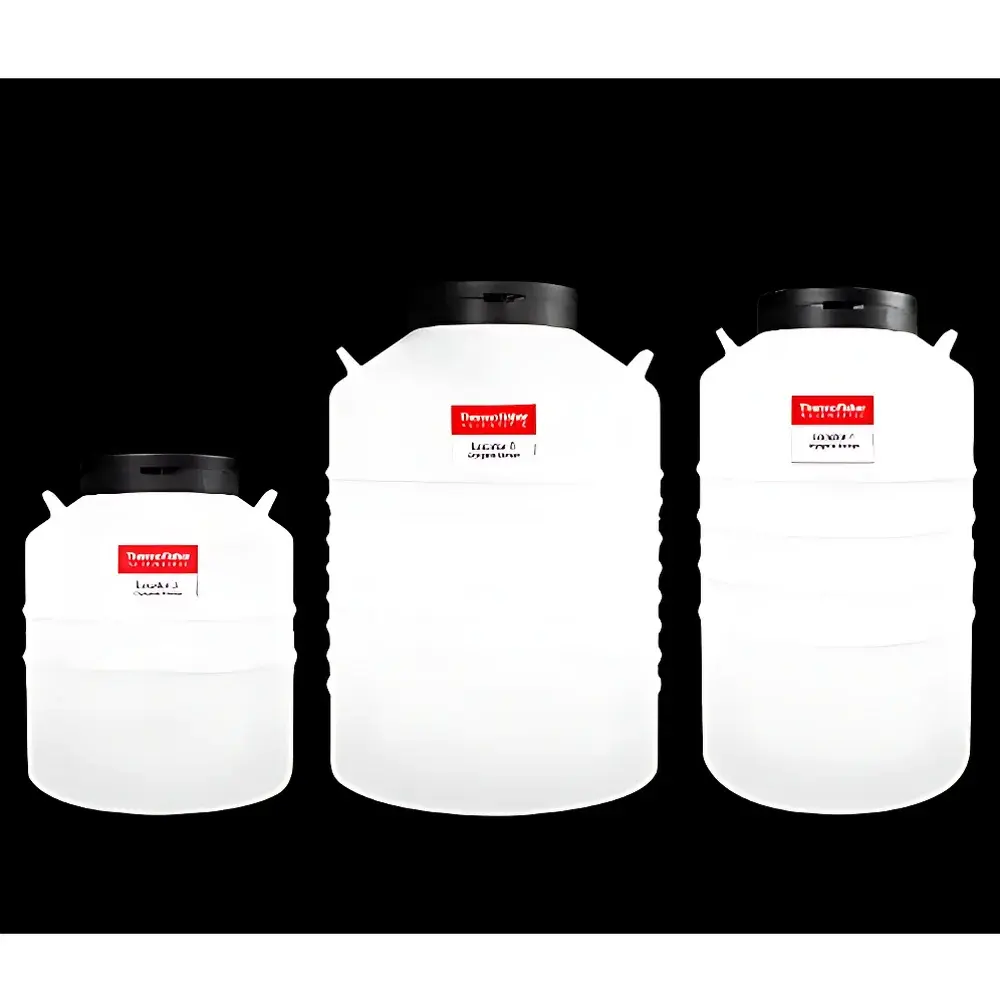
Thermo Scientific™ Locator™ CN Series Liquid Nitrogen Storage Tanks
| Brand | Thermo Scientific |
|---|---|
| Model | CY50925CN, CY50935CN, CY50945CN |
| Capacity Options | 25 L, 35 L, 45 L (nominal) |
| Vacuum Insulation | High-efficiency multilayer vacuum jacket |
| Evaporation Rate | Optimized for reduced boil-off (typical range: 0.8–1.2 L/day depending on model and ambient conditions) |
| Rack System | Standard 2-inch cryovial rack compatibility |
| Central Core Rack Design | Maximizes vertical storage density |
| Security | Integrated mechanical safety latch |
| Optional Accessory | Low-level liquid nitrogen alarm module |
| Compliance | Designed to support GLP/GMP-aligned biobanking workflows |
Overview
The Thermo Scientific™ Locator™ CN Series Liquid Nitrogen Storage Tanks are engineered for reliable, cost-effective long-term cryopreservation of biological specimens—including primary cells, stem cells, embryos, genomic DNA, and clinical biospecimens—in research laboratories, biobanks, and diagnostic facilities. Utilizing high-integrity multilayer vacuum insulation technology, the CN Series achieves significantly reduced liquid nitrogen (LN₂) boil-off rates compared to conventional static storage vessels. This thermal performance translates directly into extended refill intervals—typically ranging from 14 to 28 days depending on model size, ambient temperature, and fill level—thereby lowering operational costs and minimizing manual intervention. The tanks operate in vapor-phase or liquid-phase mode, with optimized heat transfer characteristics ensuring stable temperature gradients throughout the storage chamber (−150 °C to −196 °C). Their structural architecture adheres to internationally recognized design principles for low-temperature containment systems, prioritizing mechanical robustness, thermal stability, and user-defined access control.
Key Features
- High-efficiency vacuum-insulated stainless steel construction with multilayer reflective shielding to suppress conductive and radiative heat ingress
- Central core rack configuration enabling uniform sample distribution and optimal utilization of vertical storage volume
- Standardized 2-inch (50.8 mm) cryovial rack compatibility—supports ANSI/SLAS-compliant tube formats including 1.0 mL, 1.8 mL, and 2.0 mL external-thread vials
- Mechanically interlocked safety latch system preventing unauthorized or accidental lid opening; no electronic components required for basic access security
- Modular interior layout accommodating up to 12–18 standard racks per unit (model-dependent), with scalable expansion via optional accessory trays
- Integrated mounting points for field-upgradable low-level LN₂ alarm modules—provides audible/visual alerts when liquid nitrogen level falls below user-configurable thresholds
Sample Compatibility & Compliance
The Locator™ CN Series is validated for storage of diverse biospecimen types under ISO 20387:2018 (Biobanking — General requirements for biobanking) and aligned with best practices outlined in ISBER Best Practices (4th Edition). Its vapor-phase operation minimizes cross-contamination risk between samples while maintaining temperatures consistently below −135 °C—sufficient for preserving nucleic acid integrity and cellular viability over decades. All wetted surfaces contact only medical-grade 304 stainless steel, certified free of leachable heavy metals per USP and . The mechanical lock design supports institutional access-control policies without reliance on power or network infrastructure, facilitating compliance with HIPAA- and GDPR-aligned data governance frameworks where physical specimen access logs are maintained separately.
Software & Data Management
While the CN Series operates as a standalone passive storage system, its optional low-level alarm module interfaces with facility-wide environmental monitoring platforms via dry-contact relay output (NO/NC). When integrated with compliant Building Management Systems (BMS) or Laboratory Information Management Systems (LIMS), it enables automated event logging—including time-stamped LN₂ depletion alerts—for audit-ready traceability. No embedded firmware or cloud connectivity is present in base configurations, eliminating cybersecurity exposure vectors and supporting environments governed by FDA 21 CFR Part 11 Annex 11 requirements for non-computerized systems. Documentation packages include IQ/OQ templates compatible with GxP validation protocols.
Applications
- Long-term archival storage of human and animal-derived cell lines, iPSCs, and primary isolates in academic and contract research organizations
- Clinical trial biorepositories requiring stable −150 °C vapor-phase conditions for companion diagnostic sample sets
- Veterinary biobanks managing germplasm, oocytes, and semen inventories across regional collection sites
- Pharmaceutical QC labs storing reference standards and stability study samples under ICH M7 and Q5D guidelines
- Public health laboratories maintaining pathogen isolate collections under WHO Biorisk Management Framework protocols
FAQ
What temperature range does the CN Series maintain in vapor-phase mode?
Typically −150 °C to −180 °C at rack level, depending on fill level and ambient conditions. Full liquid-phase immersion yields −196 °C.
Can the tank be validated for GMP use?
Yes—design documentation, material certifications, and IQ/OQ templates are provided to support qualification against EU GMP Annex 15 and PIC/S TR13.
Is remote monitoring supported out of the box?
No native telemetry is included; however, the optional alarm module provides hardwired relay outputs for integration with third-party monitoring hardware.
Are custom rack configurations available?
Standard configurations follow ANSI/SLAS footprint specifications; non-standard tray layouts may be commissioned through Thermo Fisher Scientific’s Custom Solutions Group.
Does the safety latch meet ISO 15197:2013 mechanical access requirements?
The latch satisfies functional equivalence to ISO 15197’s physical barrier clause for specimen integrity protection, though formal certification applies specifically to glucose meters—not cryogenic containers.




