
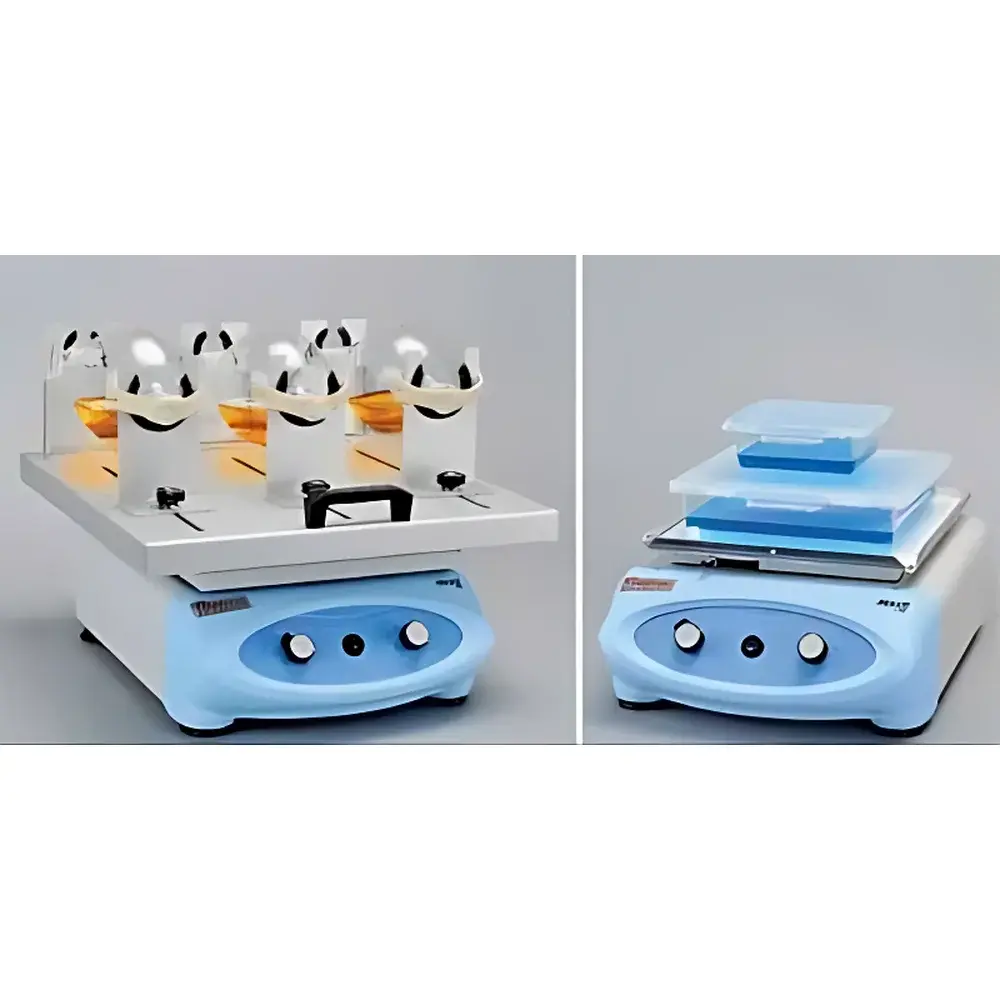
Thermo Scientific MaxQ 2508 & MaxQ 2506 Dual-Mode Orbital and Reciprocal Shakers
| Brand | Thermo Fisher Scientific |
|---|---|
| Origin | USA |
| Manufacturer | Thermo Fisher Scientific |
| Import Status | Imported |
| Model | MaxQ 2508 & MaxQ 2506 |
| Pricing | Upon Request |
Overview
The Thermo Scientific MaxQ 2508 and MaxQ 2506 dual-mode shakers are engineered for precision, flexibility, and reliability in life science laboratories requiring both orbital and reciprocal motion profiles within a single platform architecture. These shakers operate on the principle of controlled mechanical oscillation—either circular (orbital) or linear back-and-forth (reciprocal)—to homogenize, suspend, aerate, or incubate biological samples under defined environmental conditions. Unlike single-motion shakers, the MaxQ 2508/2506 series incorporates a patented dual-drive mechanism that allows users to switch between motion types without hardware modification, enabling seamless adaptation across diverse protocols—from microbial culture expansion and cell suspension to immunoassay plate washing and hybridization kinetics. Designed for integration into temperature-controlled environments—including refrigerated incubators (4 °C), ambient rooms (20–25 °C), and environmental chambers (up to 40 °C)—the units maintain stable operation across a humidity range of 20–80% RH without internal condensation, ensuring long-term mechanical integrity and sample consistency.
Key Features
- Dual-motion capability: Selectable orbital (circular) or reciprocal (linear) shaking modes via front-panel control lever—no tools or recalibration required.
- Modular platform system: Interchangeable deck sizes (279 × 330 mm / 11 × 13 in, 457 × 457 mm / 18 × 18 in, and 457 × 610 mm / 18 × 24 in) accommodate flasks, bottles, microplates, petri dishes, and custom fixtures.
- Robust brushless DC motor drive: Delivers consistent speed control with minimal thermal drift and maintenance-free operation over extended duty cycles.
- Wide operating temperature range: Certified performance from 4 °C to 40 °C; validated for use inside cold rooms, CO₂ incubators, and environmental growth chambers.
- Condensation-resistant design: Sealed electronics, corrosion-inhibited chassis, and optimized airflow pathways prevent moisture ingress under high-humidity conditions (20–80% RH).
- Intuitive analog interface: Dedicated speed dial and mode selector provide rapid, tactile parameter adjustment—ideal for GLP-compliant workflows where digital complexity is unnecessary.
Sample Compatibility & Compliance
The MaxQ 2508 and 2506 shakers support standard laboratory vessels including Erlenmeyer flasks (50–5000 mL), culture tubes, deep-well plates, roller bottles, and custom jigs. Platform clamping systems ensure secure retention during high-speed reciprocal motion (up to 300 rpm) or low-shear orbital agitation (up to 350 rpm). Units comply with IEC 61010-1:2010 for electrical safety in laboratory equipment and meet UL 61010-1 certification requirements. While not inherently classified as medical devices, their construction and operational traceability align with ISO/IEC 17025 quality management principles for testing laboratories. When deployed in regulated bioprocessing or QC environments, the analog control architecture facilitates straightforward validation documentation—eliminating software-based audit trail dependencies required under FDA 21 CFR Part 11.
Software & Data Management
These models feature an analog control system intentionally designed to minimize software dependencies. No embedded firmware, network connectivity, or data logging capabilities are included—reducing validation burden and cybersecurity surface area. Speed settings are manually set and mechanically retained; no calibration certificate is required beyond initial factory verification. For labs requiring electronic recordkeeping, external data loggers (e.g., thermocouple + tachometer inputs) may be integrated via standard analog output ports (0–5 V DC) available on select configurations. This architecture supports straightforward IQ/OQ/PQ execution per ASTM E2500 and USP guidelines for analytical instrument qualification.
Applications
- Microbial and mammalian cell culture: Optimized oxygen transfer in shake flasks under controlled temperature and agitation profiles.
- Protein expression and purification: Consistent mixing during affinity chromatography equilibration and elution steps.
- Environmental microbiology: Soil slurry homogenization and water sample agitation prior to membrane filtration.
- Diagnostic assay development: Uniform reagent dispersion in ELISA and lateral flow strip manufacturing processes.
- Seed germination and plant tissue culture: Gentle reciprocal motion mimicking natural root zone stimulation in growth chambers.
- Quality control testing: Reproducible suspension of particulates in pharmaceutical suspensions per USP .
FAQ
Can the MaxQ 2508 and MaxQ 2506 be used inside a CO₂ incubator?
Yes—both models are rated for continuous operation at 37 °C and 5% CO₂, provided the incubator maintains non-condensing humidity levels (≤80% RH) and adequate ventilation around the unit base.
Is platform interchangeability supported between MaxQ 2508 and MaxQ 2506 units?
Yes—identical mounting interfaces and drive coupling geometries allow full cross-compatibility of all three deck sizes across both models.
Does the shaker include speed calibration traceability?
Each unit ships with a factory-verified speed calibration report referencing NIST-traceable tachometric standards; recalibration is recommended annually or after mechanical impact.
What is the maximum load capacity for the 18 × 24 inch platform?
At 250 rpm orbital mode, the 457 × 610 mm deck supports up to 25 kg distributed load; for reciprocal motion at 300 rpm, the limit is 18 kg to maintain mechanical resonance stability.
Are replacement parts such as motors or control levers available through Thermo Fisher service channels?
Yes—full OEM spare parts inventory, including brushless motor assemblies, motion selector linkages, and deck mounting kits, is maintained under part numbers accessible via Thermo Fisher’s global service portal.





