
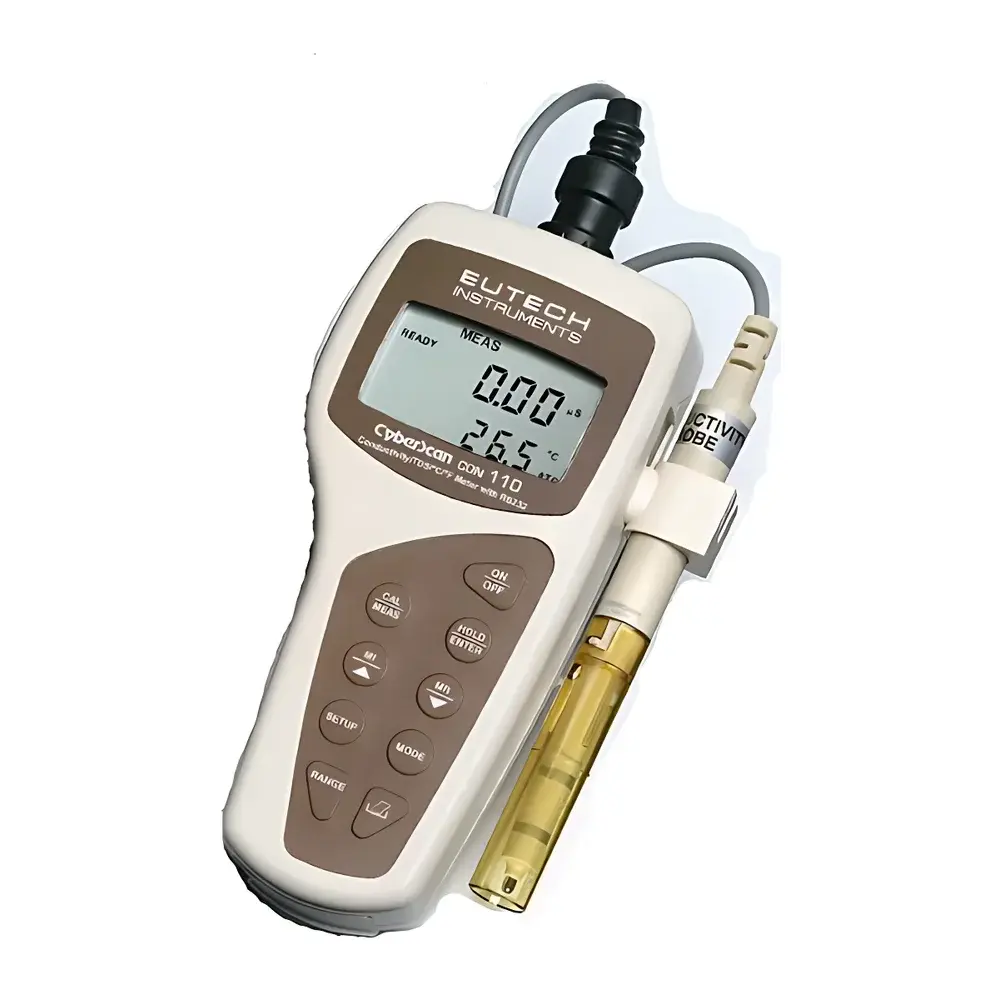
Thermo Fisher Scientific Eutech CON110 Portable Conductivity Meter
| Brand | Thermo Fisher Scientific |
|---|---|
| Origin | Singapore |
| Manufacturer | Eutech Instruments (a Thermo Fisher brand) |
| Type | Portable Conductivity/TDS/Temperature Meter |
| Model | CON110 |
| Conductivity Range | 0–199.9 mS/cm (5 ranges) |
| Resolution | 0.05% of full scale |
| Conductivity Accuracy | ±1% FS + 1 LSD |
| TDS Range | 0–99.9 ppt (adjustable coefficient 0.40–1.00) |
| TDS Accuracy | ±1% FS + 1 LSD |
| Temperature Range | 0–100.0 °C |
| Temp Accuracy | ±0.5 °C |
| Temp Compensation | Automatic/manual (0–80 °C) |
| Calibration | Auto 4-point / Manual 5-point |
| Data Storage | 100 measurement sets with timestamp |
| Electrode Constant Display | Yes (0.1, 1.0, 10.0 cm⁻¹) |
| Interface | RS232C |
| Power | 4×AAA alkaline batteries (200+ hr life) or 9 V DC adapter |
| Dimensions (unit) | 18 × 9 × 4 cm |
| Weight (unit) | 220 g |
Overview
The Thermo Fisher Scientific Eutech CON110 Portable Conductivity Meter is a rigorously engineered field-deployable instrument designed for precise, real-time measurement of electrical conductivity, total dissolved solids (TDS), and temperature in aqueous solutions. Based on the fundamental principle of conductometric analysis—where solution conductivity is determined by applying an alternating current across a pair of electrodes and measuring the resulting current—the CON110 delivers stable, reproducible readings across five overlapping conductivity decades (0–199.9 mS/cm). Its dual-parameter capability (conductivity + TDS) leverages user-selectable TDS conversion factors (0.40–1.00), enabling accurate estimation of dissolved ion concentration in applications ranging from environmental water quality monitoring to industrial process control and laboratory benchtop verification. Engineered for operational robustness, the CON110 features a sealed, impact-resistant housing rated for IP67-equivalent ingress protection during transport and field use, and operates reliably within ambient temperatures of 0–50 °C.
Key Features
- Five-range auto-ranging conductivity measurement (0–19.99 μS/cm to 20.0–199.9 mS/cm) with automatic range switching and full-scale resolution of 0.05%
- Integrated temperature compensation with selectable reference temperatures (20.0 °C or 25.0 °C) and adjustable linear compensation coefficient (0.0–10.0 %/°C)
- Real-time electrode constant display (0.1, 1.0, or 10.0 cm⁻¹) to verify sensor integrity and support traceable calibration validation
- Non-volatile memory with battery-backed data retention—stores up to 100 measurement records including conductivity, TDS, temperature, date/time stamp, and electrode constant
- Dual power options: long-life 4×AAA alkaline batteries (≥200 hours continuous operation) or external 9 V regulated DC supply
- RS232C serial interface compliant with EIA-232 standard for direct connection to PCs, thermal printers, or data loggers; supports ASCII protocol for seamless integration into LIMS environments
- Auto-off function (20-minute timeout) and auto-read lock to minimize operator error and ensure consistent endpoint determination
Sample Compatibility & Compliance
The CON110 is optimized for aqueous samples with conductivity values typical of natural waters, wastewater effluents, boiler feedwater, cooling tower fluids, and nutrient solutions. It accommodates standard 2-electrode conductivity cells (e.g., Eutech CDC401 series) and supports manual or automatic calibration using certified KCl standards (e.g., 84 μS/cm, 1413 μS/cm, 12.88 mS/cm). The instrument meets general requirements for field-portable electrochemical analyzers per IEC 61010-1 (safety) and IEC 61326-1 (EMC). While not intrinsically safe, its low-voltage design and absence of hazardous energy sources permit use in non-hazardous locations per NEC Class I, Division 2 guidelines. Data integrity aligns with GLP principles through timestamped storage and uneditable record structure; when paired with DAS software and secure PC configuration, it supports audit-trail-enabled workflows compatible with FDA 21 CFR Part 11 expectations for electronic records.
Software & Data Management
The included DAS (Data Acquisition Software) provides bidirectional communication via RS232 to import stored measurements, export CSV-formatted datasets, and generate printable reports with configurable headers, units, and metadata fields. The software supports batch export, statistical summary (mean, SD, min/max), and overlay plotting of conductivity vs. temperature trends. All data transfers are validated using checksum protocols to prevent corruption. No proprietary drivers are required—standard Windows COM port enumeration suffices. For enterprise deployment, the CON110’s ASCII output format enables parsing by custom Python, LabVIEW, or SCADA systems without middleware. Firmware updates (if released) are delivered via serial download using documented command syntax, ensuring maintainability over extended service lifecycles.
Applications
- Environmental field surveys: monitoring river, lake, and groundwater conductivity as an indicator of salinity, contamination, or ionic load
- Wastewater treatment plants: verifying discharge compliance with regulatory TDS limits (e.g., EPA NPDES permits)
- Aquaculture and hydroponics: maintaining optimal ionic strength for species-specific growth conditions
- Pharmaceutical water systems: rapid verification of purified water (PW) and water-for-injection (WFI) conductivity against USP stage 1 and stage 2 limits
- Educational laboratories: teaching foundational electrochemistry concepts including Kohlrausch’s law, cell constant derivation, and temperature dependence of electrolyte mobility
- Facility maintenance: troubleshooting cooling tower cycles, reverse osmosis reject streams, and deionized water loop integrity
FAQ
Does the CON110 support GLP-compliant data handling?
Yes—when used with DAS software on a validated PC system, timestamped data logs, immutable storage, and operator-defined ID fields satisfy core GLP documentation requirements.
Can I calibrate the meter with non-standard KCl concentrations?
Manual calibration allows entry of any known standard value (0.01–199.9 mS/cm); however, NIST-traceable KCl solutions are recommended for metrological confidence.
Is temperature compensation mandatory for accurate conductivity readings?
Yes—conductivity is highly temperature-dependent; the CON110 requires either automatic (via built-in thermistor) or manual temperature input to apply correction per ISO 7888 or ASTM D1125.
What happens to stored data during battery replacement?
The unit employs non-volatile memory with capacitor-backed retention—no data loss occurs during routine battery swaps.
How often should the conductivity cell be cleaned and recalibrated?
Cleaning frequency depends on sample matrix; for clean water, quarterly calibration suffices; for high-fouling or high-TDS samples, daily rinsing and weekly calibration is advised per ISO 5667-16 guidance.





