
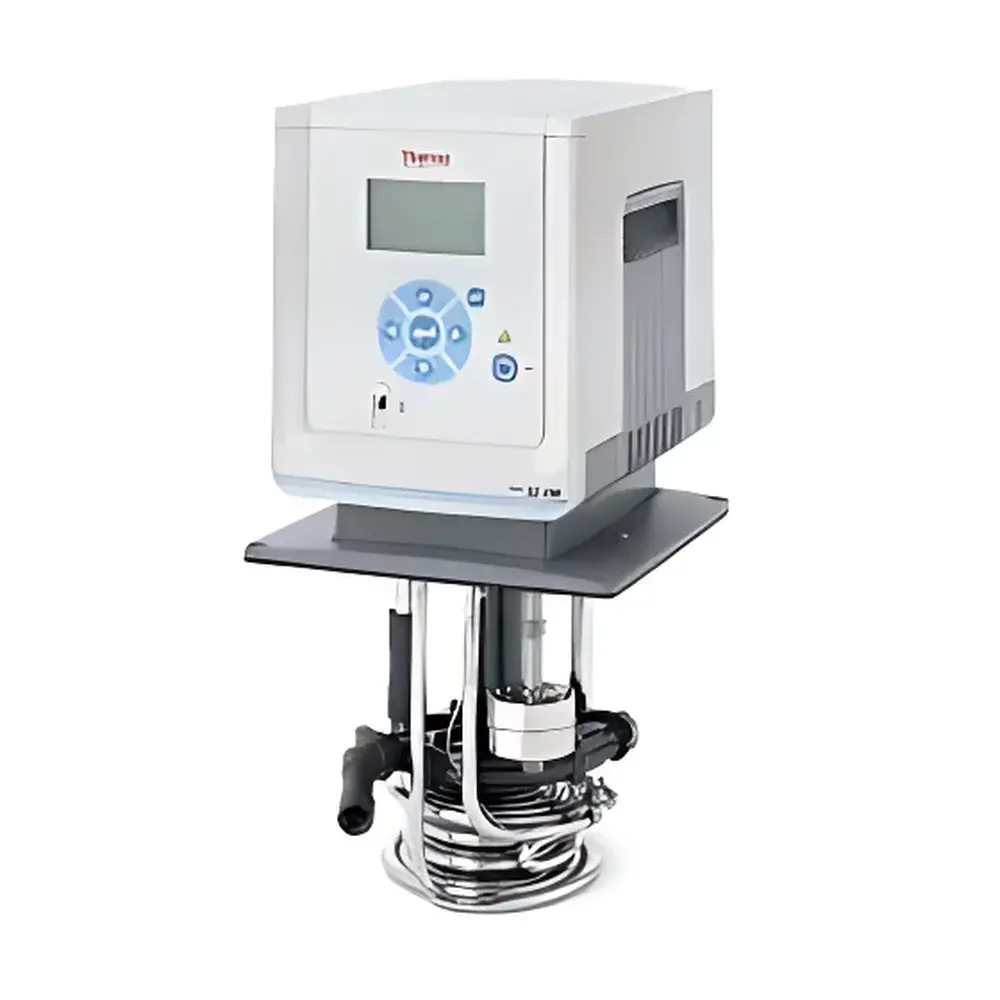
Thermo Scientific SC100/150/150L, AC150/200, PC200/201/300 Immersion Circulators with Single-Heating Control Head
| Brand | Thermo Scientific |
|---|---|
| Origin | USA |
| Manufacturer | Thermo Fisher Scientific |
| Type | Immersion Circulator (Heating-Only) |
| Models | SC100, SC150, SC150L, AC150, AC200, PC200, PC201, PC300 |
| Temperature Range | Ambient to 300 °C |
| Temperature Stability | ±0.01 °C (AC/PC series), ±0.02 °C (SC series) |
| Heating Power | 1.5–3.0 kW (model-dependent) |
| Flow Rate | 17–24 L/min |
| Max Pressure | 300–560 mbar |
| Max Suction | 330–380 mbar |
| Bath Depth Requirement | 150–200 mm |
| Safety Class | DIN 12876-1 Class III / NFL3 |
| IQ/OQ Documentation | Available upon request |
Overview
Thermo Scientific immersion circulators with single-heating control head are precision-engineered thermal management systems designed for laboratory applications requiring stable, controllable heating of external baths—including water, silicone oil, ethylene glycol, and other compatible heat-transfer fluids. These devices operate on the principle of forced convection: an integrated pump circulates fluid from the external bath through a built-in heating element and back, enabling rapid thermal equilibration and high spatial uniformity across the bath volume. Unlike dual-function chillers or refrigerated circulators, this series is optimized exclusively for heating applications—delivering superior energy efficiency, reduced complexity, and enhanced long-term reliability in environments where cooling is unnecessary or handled separately. Each model is calibrated and validated to meet international laboratory standards for temperature accuracy and stability, supporting reproducible experimental conditions in analytical, pharmaceutical, materials science, and quality control workflows.
Key Features
- High-precision digital PID temperature control with real-time feedback loop, ensuring stability of ±0.01 °C (AC/PC models) or ±0.02 °C (SC models) under steady-state conditions
- Dual-mode circulation architecture supporting both internal recirculation (for standalone use) and external loop integration (e.g., jacketed reactors, viscometers, or calorimeters)
- Corrosion-resistant stainless-steel immersion probe and pump housing, rated for continuous operation up to 300 °C with silicone oil and other high-boiling-point media
- Adjustable flow rate and pressure output across model variants—up to 24 L/min at 560 mbar max pressure—enabling compatibility with high-resistance external circuits
- DIN 12876-1 Class III safety certification (NFL3 compliant), including overtemperature cutoff, dry-run protection, and ground-fault circuit interruption
- Modular design with standardized mounting interfaces and cable routing provisions for seamless integration into automated lab platforms or custom thermal enclosures
- Front-panel LED display with intuitive menu navigation, password-protected parameter settings, and optional RS232/RS485 or Ethernet connectivity for remote monitoring
Sample Compatibility & Compliance
These immersion circulators are validated for use with a broad range of non-corrosive, non-flammable heat-transfer fluids—including deionized water, 50/50 ethylene glycol/water mixtures, and industrial-grade silicone oils (e.g., Dow Corning 200 Fluid series). They are not intended for use with flammable solvents, halogenated compounds, or strongly oxidizing agents. All models comply with IEC 61010-1:2010 for electrical safety in laboratory equipment and meet essential requirements of the EU Machinery Directive 2006/42/EC. Optional IQ/OQ documentation packages are available to support GLP, GMP, and FDA 21 CFR Part 11 compliance in regulated environments—including audit-ready calibration records, installation verification checklists, and operational performance test protocols.
Software & Data Management
While these units operate as standalone instruments, select models (AC and PC series) support optional Thermo Scientific™ LabConnect™ software via serial or Ethernet interface. This enables centralized configuration, real-time temperature logging, alarm event history export (CSV/TXT), and synchronized multi-device scheduling. Data integrity features include time-stamped entries, user-access levels, and electronic signature capability—fully aligned with ALCOA+ principles (Attributable, Legible, Contemporaneous, Original, Accurate, Complete, Consistent, Enduring, Available). For facilities implementing LIMS or ELN systems, RESTful API adapters are available under extended service agreements to enable bidirectional data exchange without proprietary middleware.
Applications
- Calibration of thermometers, RTDs, and thermocouples per ASTM E74 and ISO/IEC 17025 requirements
- Temperature-controlled sample preparation for HPLC mobile phase conditioning, dissolution testing (USP <711>), and enzymatic assays
- Stabilization of optical benches, interferometers, and laser sources requiring sub-0.02 °C thermal drift control
- Heating and homogenization of polymer melts, waxes, and bituminous materials prior to rheological or DSC analysis
- Support of accelerated stability studies (ICH Q1A–Q1E) by maintaining constant elevated temperatures in environmental chambers or jacketed vessels
- Integration with automated synthesis platforms for precise reaction temperature ramping and hold profiles
FAQ
Can these circulators be used with flammable solvents such as acetone or ethanol?
No. These units are certified only for non-flammable heat-transfer media. Use with flammable liquids poses fire hazard and voids safety certification and warranty.
Is external bath level monitoring supported?
Not natively. However, third-party float switches or ultrasonic level sensors can be interfaced via dry-contact relay outputs (available on PC-series models) for low-level shutdown automation.
What is the minimum required bath depth for reliable operation?
150 mm for SC and AC models; 200 mm for PC-series units. Insufficient depth risks dry-run activation and thermal cutoff.
Are NIST-traceable calibration certificates included?
Standard shipment includes factory calibration at three points (25 °C, 75 °C, and 150 °C or 300 °C depending on model). NIST-traceable certificates with uncertainty budgets are available as a configurable option.
Can multiple circulators be daisy-chained for synchronized control?
Yes—via Modbus RTU over RS485 (PC/AC series) or optional Ethernet gateway. LabConnect software supports group-based setpoint coordination and fault propagation alerts.



