
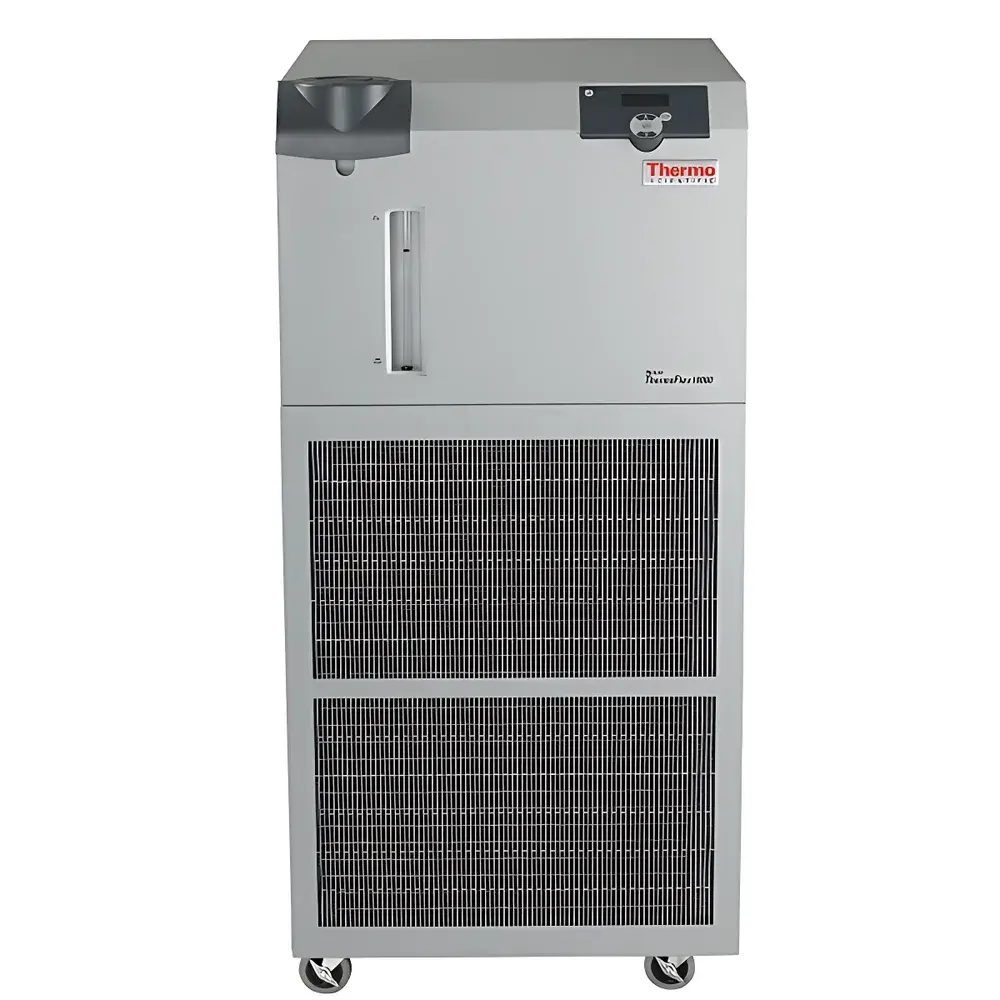
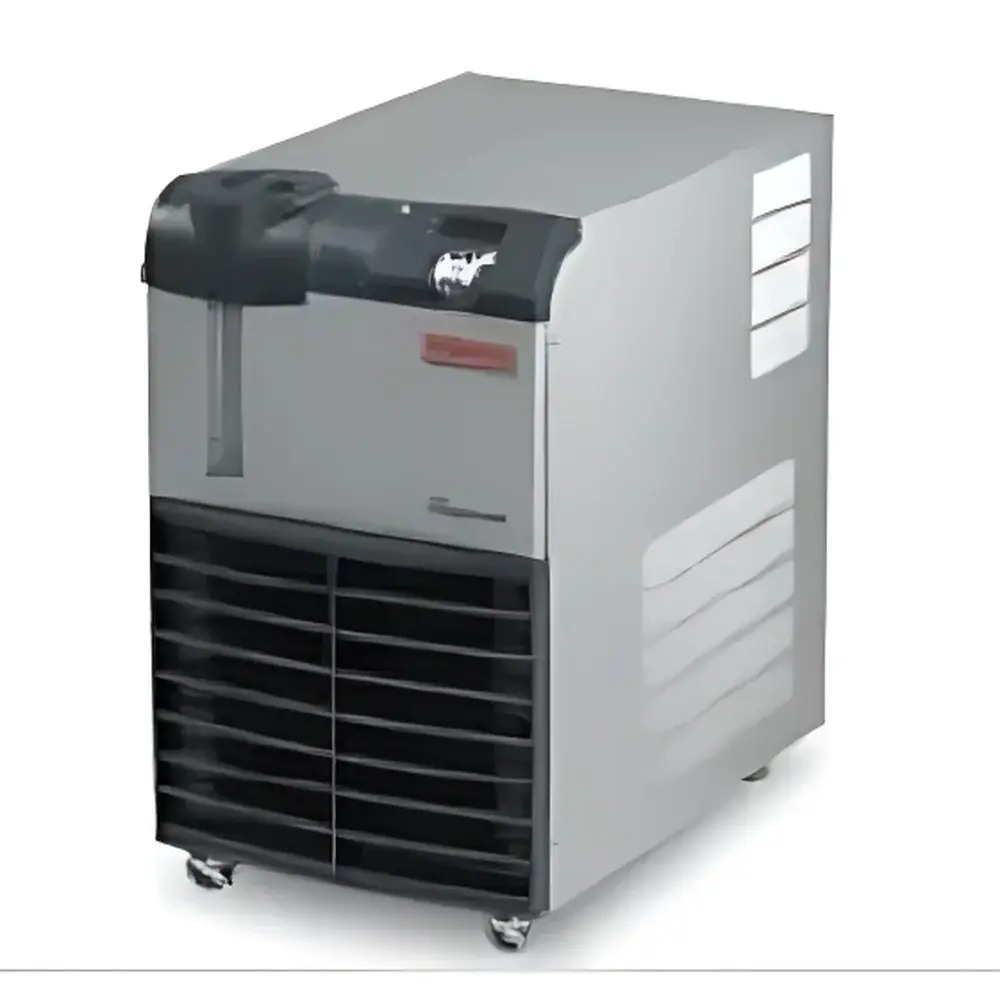
Thermo Fisher ThermoFlex 3500/5000/7500/10000 Series Circulating Chillers
| Brand | Thermo Fisher |
|---|---|
| Origin | USA |
| Manufacturer | Thermo Fisher Scientific |
| Type | Integrated Circulating Chiller |
| Cooling Method | Water-Cooled |
| Temperature Range | –5 °C to +90 °C |
| Refrigeration Capacity | 3500 / 5000 / 7500 / 10000 W @ 20 °C |
| Temperature Stability | ±0.1 °C |
| Reservoir Volume | 7.2 L or 17.9 L |
| Pump Flow & Pressure | Adjustable |
| Operating Mode | Continuous Duty |
| Certifications | CSA, CE, WEEE |
Overview
The Thermo Fisher ThermoFlex 3500/5000/7500/10000 Series Circulating Chillers are engineered for precision temperature control in demanding laboratory and industrial applications requiring stable, continuous thermal management. These integrated chillers operate on vapor-compression refrigeration principles, utilizing high-efficiency scroll compressors, optimized condenser/evaporator heat exchange architecture, and PID-controlled circulation systems to maintain setpoint accuracy across a wide operational envelope (–5 °C to +90 °C). Designed specifically for integration with analytical instruments—including HPLC, ICP-MS, laser systems, semiconductor test equipment, and medical imaging platforms—the ThermoFlex platform delivers consistent thermal load handling under variable ambient conditions and dynamic process demands. Its modular architecture supports application-specific configurations without compromising structural integrity or long-term calibration stability.
Key Features
- Wide, user-selectable temperature range: standard operation from 5 °C to 40 °C; optional high-temperature configuration up to +90 °C; optional low-temperature configuration down to –5 °C—enabling compatibility with both exothermic and endothermic processes.
- Precision temperature regulation with ±0.1 °C stability at setpoint (measured per ASTM E2877-22 methodology), achieved via dual-sensor feedback loops and adaptive PID algorithms calibrated across the full operating range.
- Multiple reservoir options: compact 7.2 L tank for benchtop integration or extended 17.9 L capacity for high-flow or multi-instrument distribution networks.
- Configurable pumping system: choice of positive-displacement (P1/P2), centrifugal (P3/P4/P5), or turbine-type (T1/T5) circulation pumps—each selected based on required head pressure, flow rate consistency, and fluid compatibility (e.g., aqueous, glycol-water mixtures, or low-conductivity deionized water).
- Robust mechanical design: stainless steel reservoirs, corrosion-resistant internal wetted parts, and vibration-dampened compressor mounting to ensure >20,000 hours MTBF under continuous-duty operation.
- Comprehensive safety architecture: over-temperature, low-level, dry-run, high-pressure, and phase-loss protection—all logged with timestamped event records accessible via front-panel interface or remote diagnostics.
Sample Compatibility & Compliance
The ThermoFlex series is validated for use with a broad spectrum of heat-transfer fluids, including deionized water, 30–50% ethylene/propylene glycol blends, and low-conductivity formulations meeting ASTM D1121 and ISO 2531 requirements. All models comply with international electrical safety and environmental directives: CSA C22.2 No. 61010-1, EN 61010-1 (CE marking), and WEEE Directive 2012/19/EU. Units intended for regulated environments (e.g., pharmaceutical QC labs or clinical instrumentation support) meet mechanical and documentation prerequisites for GLP/GMP alignment, including traceable factory calibration certificates and audit-ready service logs. While not inherently 21 CFR Part 11 compliant as standalone devices, the chiller’s digital interface supports integration into validated networked control systems where electronic record integrity is enforced at the supervisory software layer.
Software & Data Management
Each ThermoFlex unit features an embedded microcontroller with real-time clock, non-volatile memory, and RS-485/Modbus RTU communication capability for seamless integration into facility-wide monitoring networks. Optional Ethernet or USB interfaces enable connection to Thermo Fisher’s InstrumentLink™ software suite for centralized fleet management, remote parameter adjustment, alarm escalation, and trend analysis of temperature deviation, pump runtime, and compressor cycle count. All operational data—including setpoints, actual temperatures, error codes, and maintenance alerts—are timestamped and exportable in CSV format for quality assurance documentation. Firmware updates are delivered via secure HTTPS protocol with SHA-256 signature verification to maintain system integrity.
Applications
- Analytical Instrument Cooling: Stable thermal management for HPLC column ovens, mass spectrometer ion sources, and X-ray diffractometers requiring sub-0.2 °C drift control over multi-hour acquisitions.
- Laser Systems: High-capacity heat extraction from CO₂, fiber, and ultrafast lasers—maintaining diode junction temperatures within critical tolerances to preserve beam coherence and output power stability.
- Semiconductor Testing: Precision thermal conditioning of probe stations, wafer chucking systems, and RF test fixtures during parametric characterization and burn-in cycles.
- Research & Development: Support for calorimetry, rheology, and materials testing rigs where reproducible thermal boundary conditions directly impact measurement fidelity.
- Medical Device Validation: Environmental simulation for MRI gradient coil cooling, diagnostic imaging detector arrays, and surgical laser handpieces under ISO 13485-aligned workflows.
FAQ
What temperature ranges are supported across the ThermoFlex model variants?
The base configuration operates from 5 °C to 40 °C. Optional high-temperature kits extend the upper limit to +90 °C; optional low-temperature kits extend the lower limit to –5 °C. Not all models support both extremes simultaneously—consult the specific datasheet for variant-specific capabilities.
Can the ThermoFlex chiller be integrated into a building management system (BMS)?
Yes—via Modbus RTU over RS-485, the unit provides read/write access to key parameters including setpoint, actual temperature, pump status, and fault codes, enabling interoperability with industry-standard BMS platforms.
Is glycol mixture compatibility verified for all ThermoFlex models?
All units are tested and rated for use with aqueous solutions containing up to 50% propylene glycol by volume. Ethylene glycol is permitted but requires adherence to local environmental handling regulations due to toxicity classification.
How is temperature stability validated during factory calibration?
Each unit undergoes 72-hour thermal soak testing at three critical setpoints (5 °C, 25 °C, and 60 °C) using NIST-traceable platinum resistance thermometers (PRTs) per ISO/IEC 17025-accredited procedures; stability is reported as peak-to-peak deviation over the final 24 hours.
What maintenance intervals are recommended for optimal long-term performance?
Compressor oil inspection every 12 months; condenser coil cleaning every 6 months in typical lab environments; full system performance verification annually or after 2000 operating hours—whichever occurs first. Service history is retained in onboard memory and accessible via diagnostic mode.



