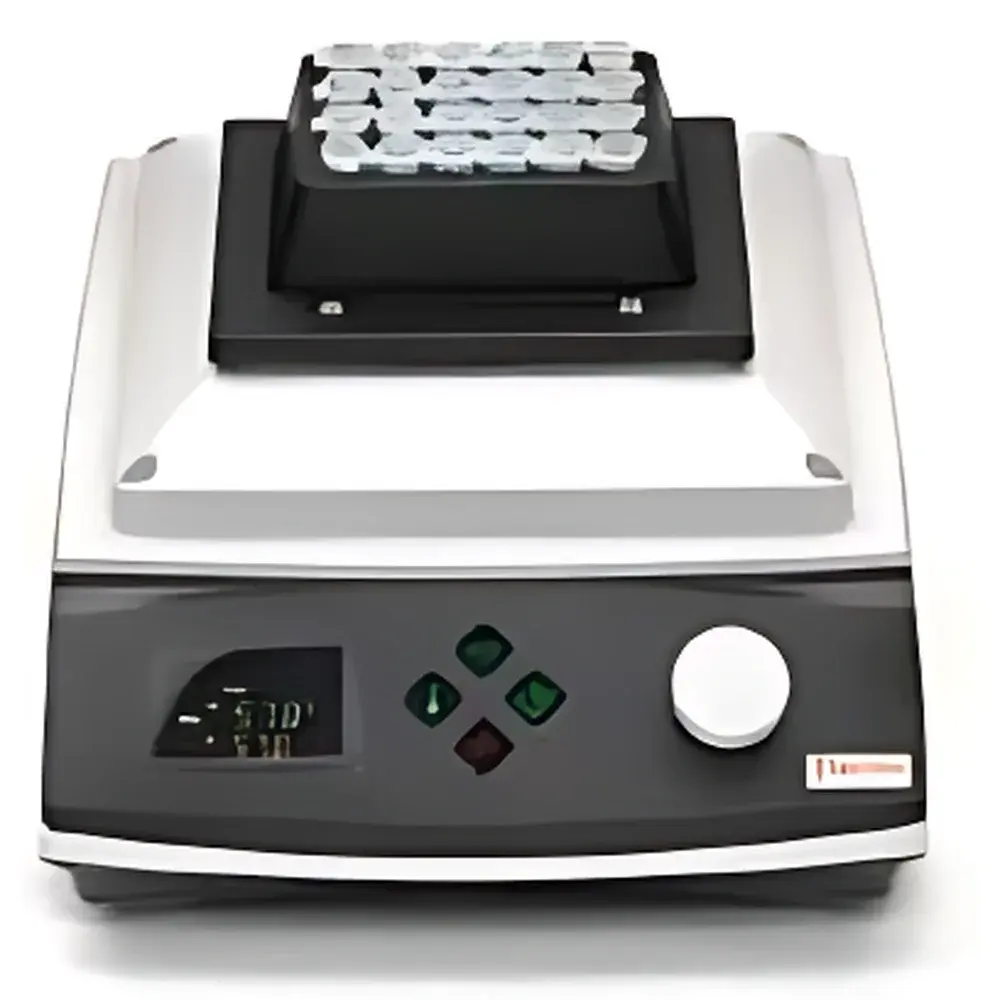
Thermo Scientific Precision Orbital Shaking Incubator Bath
| Brand | Thermo Fisher Scientific |
|---|---|
| Origin | South Korea |
| Manufacturer Type | Original Equipment Manufacturer (OEM) |
| Product Category | Imported Instrument |
| Model | Thermo Scientific Orbital Shaking Metal Block Incubator Bath |
| Price Range | USD 1,400 – 2,800 |
| Instrument Type | Specialty Orbital Shaker with Integrated Thermostatic Control |
| Timer Range | 1 min – 99 hrs 59 min or Continuous Operation |
| Oscillation Speed | 150–1500 rpm (dependent on block configuration) |
| Temperature Range | RT + 5 °C to 100 °C |
| Heating Block Configuration | Single removable block platform |
| Programmability | 10 user-defined protocols, each supporting up to 10 sequential steps (oscillation ON/OFF cycles) |
| Timing Modes | Dual-mode timer — start-on-temperature-reach or immediate start-on-activation |
| Block Exchange | Tool-free, rapid-swap metal block system |
Overview
The Thermo Scientific Precision Orbital Shaking Incubator Bath is an integrated thermal-shaking platform engineered for reproducible sample incubation under controlled orbital agitation and precise temperature regulation. Unlike conventional water baths or standalone shakers, this instrument employs a solid-state metal block architecture with embedded Peltier-based heating and high-resolution PID feedback control to maintain thermal stability ±0.3 °C across the full operating range (RT + 5 °C to 100 °C). Its orbital shaking mechanism operates at speeds from 150 to 1500 rpm with low-vibration eccentric drive design, minimizing mechanical stress on sensitive biological samples while ensuring uniform mixing in tubes, microplates, and vials. The system is designed for applications requiring simultaneous thermal equilibration and gentle-to-vigorous agitation—particularly in molecular biology, enzyme kinetics, cell culture pre-incubation, and reagent solubilization workflows where liquid-phase homogeneity and thermal history are critical process parameters.
Key Features
- PID-controlled thermal regulation with real-time sensor feedback ensures stable setpoint maintenance and minimal overshoot during ramping.
- Orbital shaking motor with brushless DC technology delivers consistent speed accuracy (< ±2 rpm deviation) and long-term operational reliability.
- Single-platform metal block design supports rapid thermal transfer and accommodates interchangeable blocks (e.g., 0.2 mL PCR tube, 1.5/2.0 mL microcentrifuge tube, 15/50 mL conical tube configurations).
- Two independent timing modes: “Temperature-Triggered” mode initiates countdown only after reaching target temperature; “Immediate Start” mode begins timing upon activation—enabling flexible protocol alignment with experimental timelines.
- Onboard memory stores up to 10 multi-step programs, each comprising up to 10 alternating oscillation-on and oscillation-off intervals—ideal for simulating intermittent mixing conditions in enzymatic assays or dissolution testing.
- Front-panel interface with intuitive rotary encoder and LED display provides tactile navigation and clear status visualization—including current temperature, setpoint, speed, elapsed/remaining time, and active program ID.
Sample Compatibility & Compliance
The instrument supports standard laboratory consumables including PCR strips, microcentrifuge tubes (0.2–50 mL), deep-well plates, and glass vials. Its open-block architecture allows unrestricted access for manual loading/unloading and accommodates custom fixtures per user requirements. From a regulatory standpoint, the device complies with IEC 61010-1:2010 safety standards for electrical equipment used in laboratory environments. While not certified for GMP production use, its programmable logging capability, repeatable thermal-shaking profiles, and traceable parameter settings support GLP-aligned documentation practices. It is routinely deployed in QC laboratories performing ASTM D789 (polymer solution viscosity), USP (dissolution apparatus qualification), and ISO 15197:2013 (in vitro diagnostic performance verification) related method development.
Software & Data Management
This model operates as a standalone benchtop unit without native PC connectivity; however, all operational parameters—including temperature setpoint, speed, timer mode, and step sequence—are retained in non-volatile memory across power cycles. For audit-trail compliance in regulated environments, users may integrate external data loggers via analog voltage outputs (0–5 V) corresponding to real-time temperature and RPM signals. Optional RS-232 or USB-to-serial adapters enable basic command-line control (e.g., set temperature, query status) using third-party scripting tools compatible with Python or LabVIEW. All firmware updates are performed locally via USB flash drive, maintaining system integrity without cloud dependency.
Applications
- Enzyme reaction incubation with synchronized agitation to prevent sedimentation of immobilized catalysts.
- Cell suspension culture pre-conditioning prior to transfection or cryopreservation.
- DNA/RNA hybridization optimization requiring precise temperature ramping combined with gentle mixing.
- Solubility screening of small-molecule APIs in buffer matrices under controlled thermal-agitation profiles.
- Standardization of microbiological growth media preparation involving heat-activated components and homogeneous dispersion.
- Calibration of thermocouples and RTDs using traceable reference blocks mounted in the same thermal zone.
FAQ
Is the metal block interchangeable between different Thermo Scientific models?
Yes—the block mounting interface follows Thermo Fisher’s standardized thermal platform specification, enabling cross-compatibility with select Thermo Scientific dry bath and heating-only incubators.
What is the maximum load capacity per block?
Maximum recommended load is 1.2 kg distributed evenly across the block surface; exceeding this may affect thermal uniformity and motor longevity.
Does the unit support external temperature probes for chamber validation?
No built-in probe port exists, but users may insert calibrated PT100 or thermistor sensors through designated clearance gaps adjacent to the block for independent verification.
Can the timer be paused and resumed mid-cycle?
No—the timer operates in non-interruptible mode; however, the oscillation can be manually toggled without resetting the countdown.
What maintenance is required for long-term reliability?
Annual inspection of fan filters and periodic cleaning of block grooves with isopropyl alcohol are recommended; no lubrication or calibration is required under normal operating conditions.
Related Products