
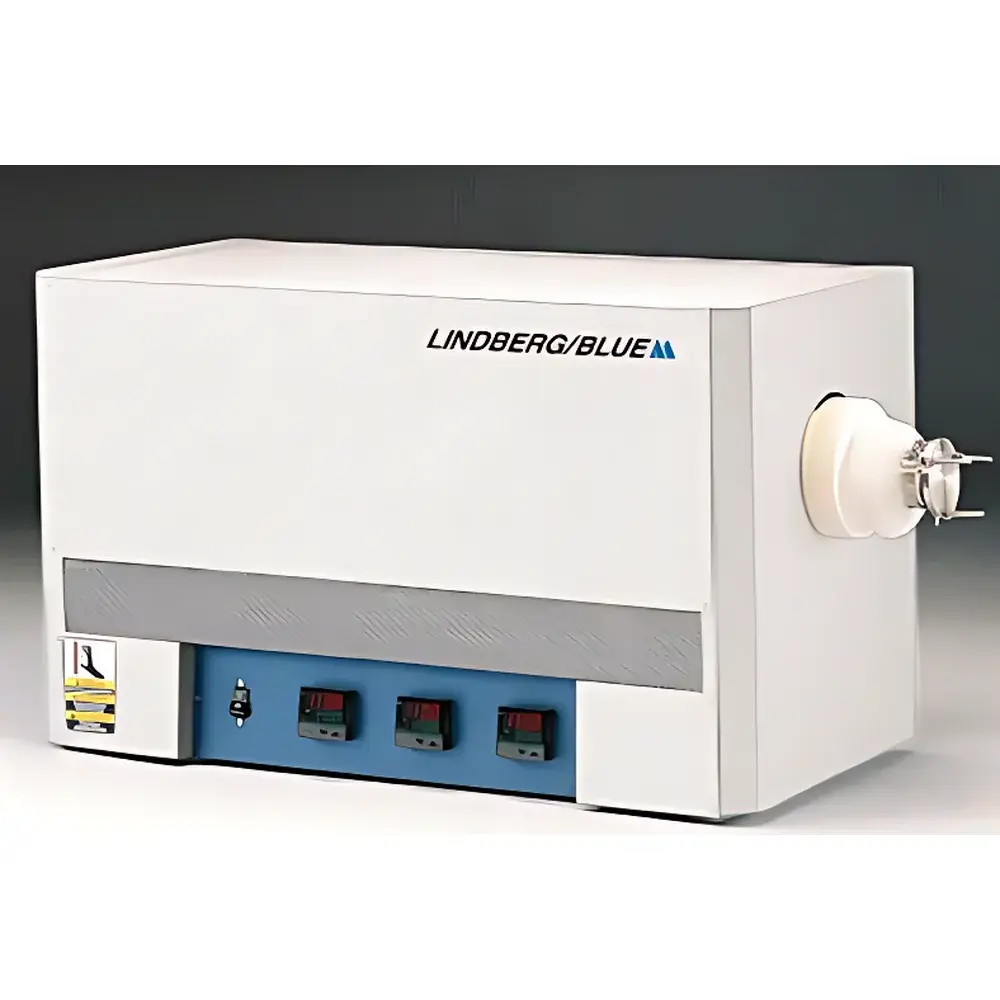
Thermo Fisher Lindberg/Blue M STF55346C-1 Three-Zone Programmable Tube Furnace
| Brand | Thermo Fisher |
|---|---|
| Origin | USA |
| Manufacturer | Thermo Fisher Scientific |
| Product Type | Tube Furnace |
| Max Temperature | 1100°C |
| Temperature Control Accuracy | ±2–4°C |
| Max Power | 3300 W |
| Ramp Rate (to Max Temp) | 6–12°C/min |
| Heating Method | Resistive Wire Heating |
| Internal Chamber Dimensions | 152.4 × 304.8 × 152.4 mm |
| Controller | Microprocessor-Based PID with Multi-Stage Ramp/Soak Programming |
| Thermocouple Type | K-Type |
| Optional Interface | RS485 Digital Communication Port |
| Insulation | Moldatherm™ High-Efficiency Ceramic Fiber with Hollow-Core Air Gap Design |
| Zone Configuration | Independent Three-Zone Heating & Control |
| Safety Features | Adjustable Over-Temperature Cut-Off, Dual-Redundant Thermal Protection |
Overview
The Thermo Fisher Lindberg/Blue M STF55346C-1 is a precision-engineered three-zone programmable tube furnace designed for demanding laboratory and pilot-scale thermal processing applications requiring spatial temperature uniformity, reproducible thermal profiles, and long-term operational stability. Unlike single-zone furnaces, this model features three independently controlled heating zones—typically designated as front, center, and rear—each equipped with dedicated K-type thermocouples and microprocessor-driven PID controllers. This architecture enables precise axial temperature gradient management across the full 609.6 mm heating length, supporting processes such as controlled atmosphere annealing, crystal growth, catalyst activation, and solid-state synthesis where thermal zoning is critical to reaction kinetics and phase evolution. The furnace employs high-purity resistive wire elements embedded within a proprietary Moldatherm™ ceramic fiber insulation system, which integrates a hollow-core air gap layer to minimize radial heat loss, reduce external surface temperature (<60°C at ambient conditions), and improve energy efficiency by up to 25% compared to conventional packed-fiber designs.
Key Features
- Three independent PID-controlled heating zones with individual ramp/soak programming capability for axial thermal profiling
- Moldatherm™ multi-layer insulation with engineered air-gap cavity, delivering rapid thermal response (6–12°C/min to 1100°C) and low external casing temperature
- Microprocessor-based controller with real-time LED display showing both setpoint and actual temperature in °C or °F
- Multi-stage single-program controller supporting up to 16 segments per program, including ramp, hold, and cooling steps
- Adjustable over-temperature safety cutoff with dual-redundant thermal protection circuitry compliant with UL 746C and IEC 61000-6-4
- Standard inclusion of two interchangeable work tube adapters (standard and extended bore options) accommodating quartz or alumina tubes from 25.4 mm to 76.2 mm OD
- RS485 digital interface optional for integration into centralized lab automation systems, enabling remote monitoring and data logging via Modbus RTU protocol
Sample Compatibility & Compliance
The STF55346C-1 accommodates standard and custom-diameter tubular samples up to 76.2 mm outer diameter and 609.6 mm active heating length. Its internal chamber (152.4 × 304.8 × 152.4 mm) supports horizontal or vertical orientation of sample carriers, crucibles, and gas-permeable boats under inert, reducing, or oxidizing atmospheres when used with compatible gas manifolds and purge systems. The furnace meets CE marking requirements for electromagnetic compatibility (EMC) and low-voltage directive compliance. It is engineered to support GLP-compliant thermal validation protocols—including ASTM E220, ISO/IEC 17025 traceability workflows—and is routinely deployed in laboratories adhering to FDA 21 CFR Part 11 requirements when paired with validated data acquisition software featuring audit trail, electronic signature, and user access control.
Software & Data Management
While the base unit operates via its integrated front-panel controller, optional RS485 connectivity enables seamless integration with Thermo Fisher’s optional FurnaceLink™ software suite or third-party SCADA platforms. This configuration supports time-stamped temperature logging at user-defined intervals (1 s to 60 min), real-time graphing of multi-zone thermal profiles, automated report generation (PDF/CSV), and alarm-triggered event capture. All logged data includes metadata such as operator ID, program name, timestamp, and environmental context—enabling full traceability for quality assurance documentation and regulatory submissions.
Applications
- Controlled-atmosphere sintering of advanced ceramics and metal powders
- Thermal treatment of semiconductor precursors and thin-film substrates
- Calcination and decomposition studies under nitrogen, argon, hydrogen, or forming gas environments
- Material aging tests per ASTM D3045 and ISO 2578 standards
- Preparation of catalysts and battery electrode materials requiring precise thermal ramping and dwell cycles
- Calibration of thermocouples and reference materials in metrology labs
FAQ
What is the maximum recommended operating temperature for continuous use?
The STF55346C-1 is rated for continuous operation at 1100°C; however, sustained use above 1050°C may reduce heating element service life and requires periodic verification of thermocouple calibration.
Can this furnace be operated under vacuum conditions?
No—this model is not vacuum-rated. It is designed for atmospheric or positive-pressure gas-purged environments only. Vacuum-compatible variants require reinforced flanges, specialized seals, and modified insulation configurations.
Is NIST-traceable calibration documentation available?
Yes—Thermo Fisher offers factory calibration certificates with NIST-traceable K-type thermocouple verification upon request (additional charge applies).
How is temperature uniformity verified across the three zones?
Uniformity is characterized per ASTM E220 using a five-point axial thermocouple mapping procedure at 800°C and 1000°C; typical axial uniformity is ±5°C over the central 40% of the heating zone.
What maintenance intervals are recommended for optimal performance?
Inspect heating elements and insulation integrity every 200 operating hours; recalibrate thermocouples every 6 months or after 50 thermal cycles exceeding 900°C.



