
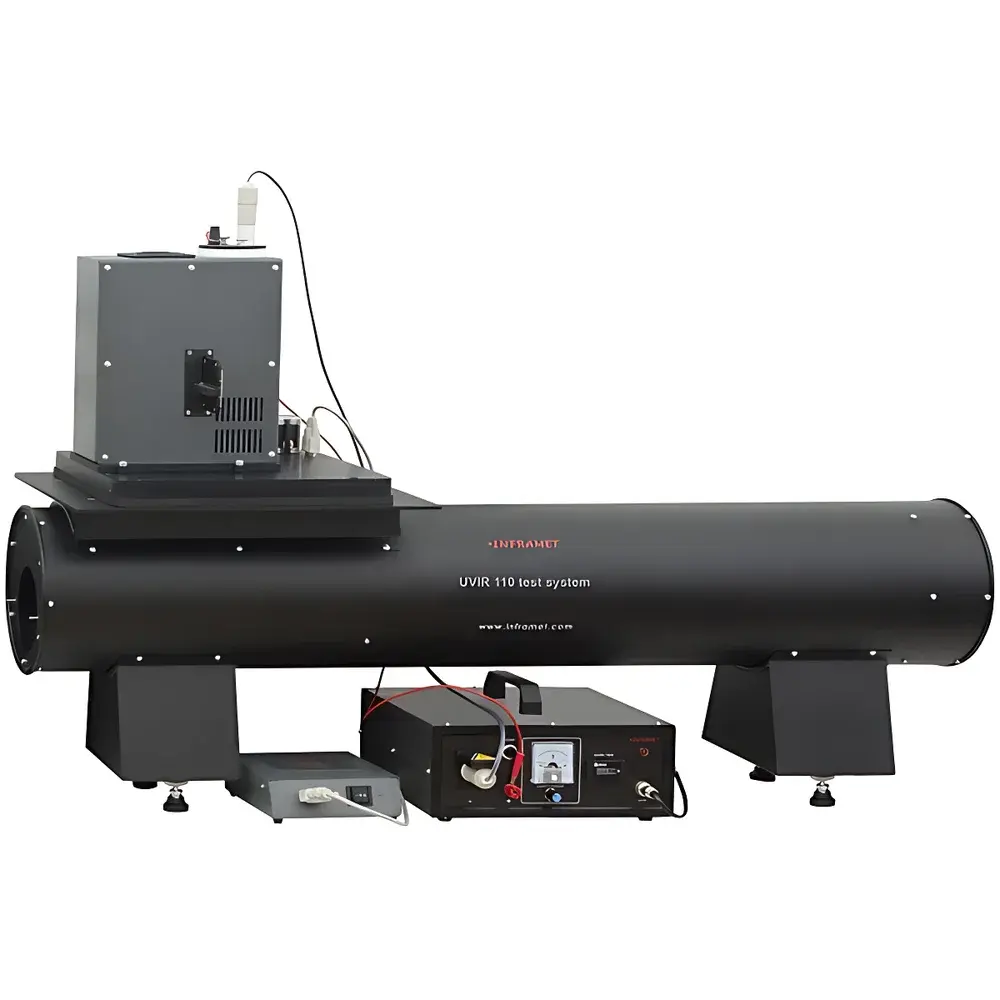
Inframet UVIR Broadband UV-SWIR Imaging Test System
| Brand | Inframet |
|---|---|
| Origin | Poland |
| Model | UVIR |
| Spectral Range | 280 nm – 1700 nm |
| Optical Aperture Support | ≤100 mm (upgradable to 200 mm) |
| Light Source | XE150-A (manually adjustable, uncalibrated) or XE150-B (motorized, NIST-traceable radiometric calibration in cd/m² and W/m²) |
| Dynamic Range (Illumination) | >10⁴ (XE150-A), >10⁷ (XE150-B) |
| Collimator | CDT off-axis reflective telescope, f = 1000 mm, effective aperture = 100 mm (upgradable), FOV = 2.7°, resolution ≥100 lp/mrad, spectral coverage 0.28–15 µm |
| Target Wheel | MRW-8 motorized 8-position turret, 54 mm target diameter |
| Standard Targets | Five contrast-level USAF 1951 charts, FOV/distortion chart, knife-edge target |
| Software | TAS-A (UVIR-A), TAS-B (UVIR-B) — supports MTF, MRC, SNR, NEI, FPN, non-uniformity, responsivity, dynamic range, linearity, distortion, and field curvature analysis |
| Compliance | Designed for ISO 12233, ISO 15739, ISO 17850, ASTM E3062, and MIL-STD-150A test workflows |
| Interface Options | Analog video, Camera Link, GigE Vision, LVDS, HD-SDI, HDMI |
Overview
The Inframet UVIR Broadband UV-SWIR Imaging Test System is a precision-engineered collimated projection platform designed for comprehensive performance characterization of imaging sensors and cameras operating across an exceptionally wide electromagnetic spectrum—from ultraviolet (280 nm) through visible (VIS), near-infrared (NIR), and into the short-wave infrared (SWIR) band (up to 1700 nm). Unlike conventional monochromatic test benches, the UVIR system implements a variable-target collimation architecture based on an off-axis reflective telescope (CDT), enabling high-fidelity, telecentric image projection under controlled irradiance and spectral conditions. Its core measurement principle relies on spatial frequency domain analysis (via USAF and knife-edge targets) combined with radiometric quantification (using calibrated broadband illumination), allowing traceable derivation of both optical transfer function (MTF) and photometric response parameters—including modulation transfer function, minimum resolvable contrast (MRC), signal-to-noise ratio (SNR), noise-equivalent irradiance (NEI), fixed-pattern noise (FPN), photoresponse non-uniformity (PRNU), dynamic range, and spectral responsivity. The system is purpose-built for R&D laboratories, sensor qualification facilities, and defense/aerospace OEMs requiring repeatable, standards-aligned validation of multispectral imaging hardware prior to integration or deployment.
Key Features
- Full-spectrum collimated projection from 280 nm to 1700 nm—enabling unified testing of UV, VIS, NIR, and SWIR imagers without optical reconfiguration
- CDT off-axis reflective collimator with 100 mm clear aperture (field-upgradeable to 200 mm), 1000 mm focal length, and ≥100 lp/mrad spatial resolution—optimized for minimal wavefront error and stray light suppression
- Motorized 8-position MRW-8 target wheel with precision-indexed 54 mm-diameter targets, supporting rapid switching between USAF 1951 contrast series, FOV/distortion grids, and knife-edge edge-spread functions
- Dual-source configuration: XE150-A (manual intensity control, uncalibrated) and XE150-B (motorized radiometric control with NIST-traceable calibration in cd/m² and W/m²; illumination dynamic range >10⁷)
- TAS-B software suite (UVIR-B variant) delivering automated, audit-ready analysis per ISO/IEC 17025-compliant workflows—including MTF curve generation, SNR mapping, FPN correction matrices, and linearity deviation reporting
- Multi-interface image acquisition support: configurable selection among GigE Vision, Camera Link, HD-SDI, LVDS, analog video, and HDMI—ensuring compatibility with industrial, scientific, and military-grade camera platforms
Sample Compatibility & Compliance
The UVIR system accommodates imaging devices with entrance apertures up to 100 mm (extendable to 200 mm via optional CDT retrofit), making it suitable for laboratory-grade scientific cameras, UAV-mounted payloads, satellite-borne imagers, and thermal/NIR surveillance systems. It supports objective-lens-based configurations as well as direct-sensor evaluation using appropriate relay optics. All measurement protocols align with internationally recognized standards: spatial resolution and MTF evaluation follows ISO 12233 (for still imaging) and ISO 15739 (for noise characterization); radiometric calibration adheres to ISO 17850 and ASTM E3062; low-light performance assessment complies with MIL-STD-150A Annex A methodologies. The TAS-B software includes full 21 CFR Part 11 audit trail functionality, electronic signatures, and secure user-role management—meeting GLP and GMP documentation requirements for regulated environments.
Software & Data Management
TAS-B (Test Analysis Suite – Version B) serves as the central analytical engine for UVIR-B systems. It provides real-time image acquisition synchronization, multi-frame averaging, non-uniformity correction, and pixel-level SNR computation across user-defined regions of interest. The software exports fully annotated reports in PDF and CSV formats, including MTF curves with confidence intervals, NEI maps normalized to detector area, and responsivity spectra derived from sequential spectral-band illumination (when used with optional bandpass filters). All raw image data, calibration metadata, and processing logs are stored in a timestamped, immutable database structure compliant with ISO/IEC 17025 record retention policies. Remote operation via TCP/IP and integration with LabVIEW, MATLAB, and Python APIs enable seamless incorporation into automated test cells and digital twin validation pipelines.
Applications
- Pre-delivery verification of UV-enhanced solar-blind imagers for corona detection and flame monitoring
- MTF and distortion mapping of cooled InGaAs SWIR lenses used in semiconductor wafer inspection
- Radiometric validation of scientific CMOS sensors deployed in space-based Earth observation missions
- Dynamic range and linearity benchmarking of hyperspectral push-broom scanners operating across UV-VIS-NIR-SWIR bands
- FPN and PRNU characterization of large-format focal plane arrays destined for defense electro-optical targeting systems
- Development and verification of AI-driven image quality assessment algorithms trained on physically grounded synthetic and empirical datasets
FAQ
What spectral bands does the UVIR system cover?
The system projects collimated imagery from 280 nm (deep UV) to 1700 nm (SWIR), with the CDT collimator rated for extended transmission up to 15 µm—supporting optional mid-wave IR extension via filter substitution.
Can the system test cameras with apertures larger than 100 mm?
Yes—the base CDT module supports up to 100 mm, but an upgraded 200 mm aperture variant is available as a factory-configured option, preserving optical performance and alignment stability.
Is radiometric calibration included with the XE150-B source?
Yes—XE150-B ships with NIST-traceable calibration certificates for luminance (cd/m²) and irradiance (W/m²) across its full spectral output, valid for two years from date of shipment.
Does TAS-B support automated pass/fail decision logic against user-defined specifications?
Yes—threshold-based rule sets can be defined per parameter (e.g., MTF@50% ≥ 0.35 at Nyquist, SNR ≥ 42 dB at 1000 lux), triggering conditional reporting and export to MES/QMS platforms via RESTful API.
How is system alignment verified during routine operation?
TAS-B includes a built-in collimation verification protocol using the knife-edge target and centroid drift analysis, generating alignment stability metrics compliant with ISO 10110-7 tolerancing guidelines.






