
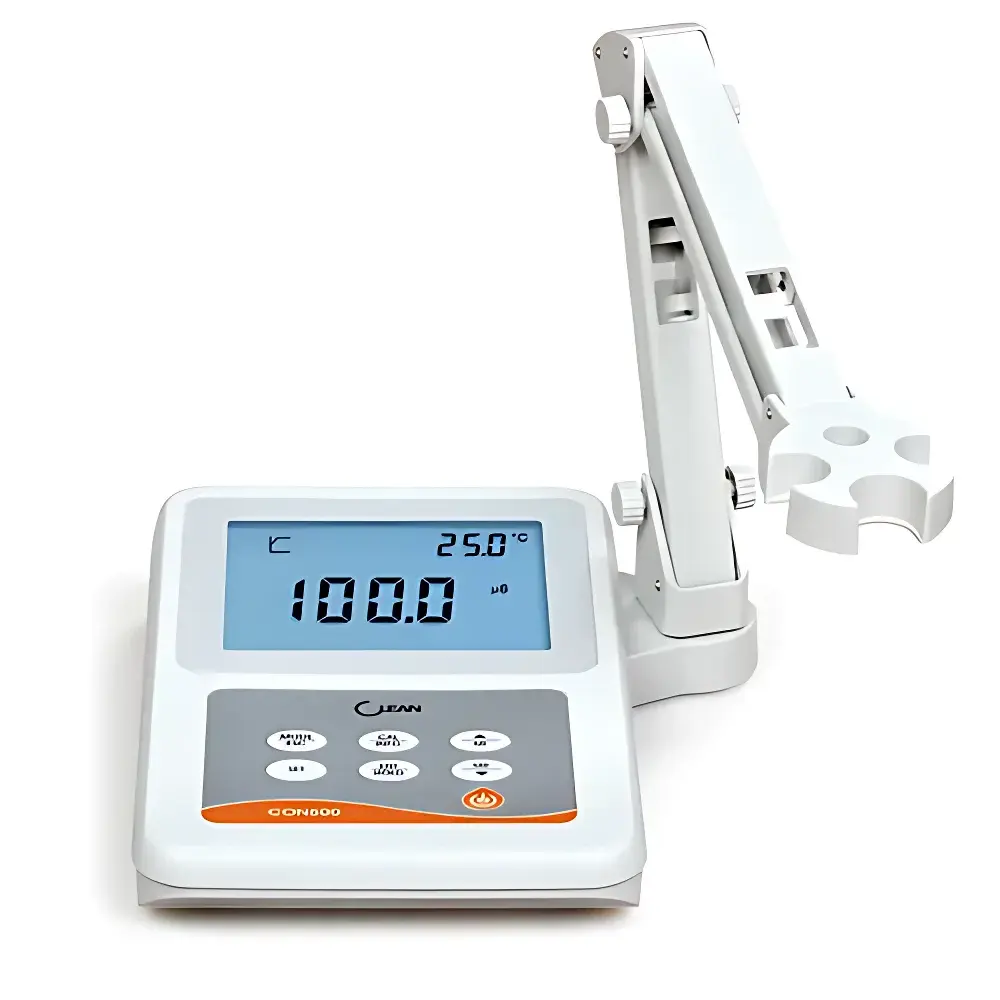
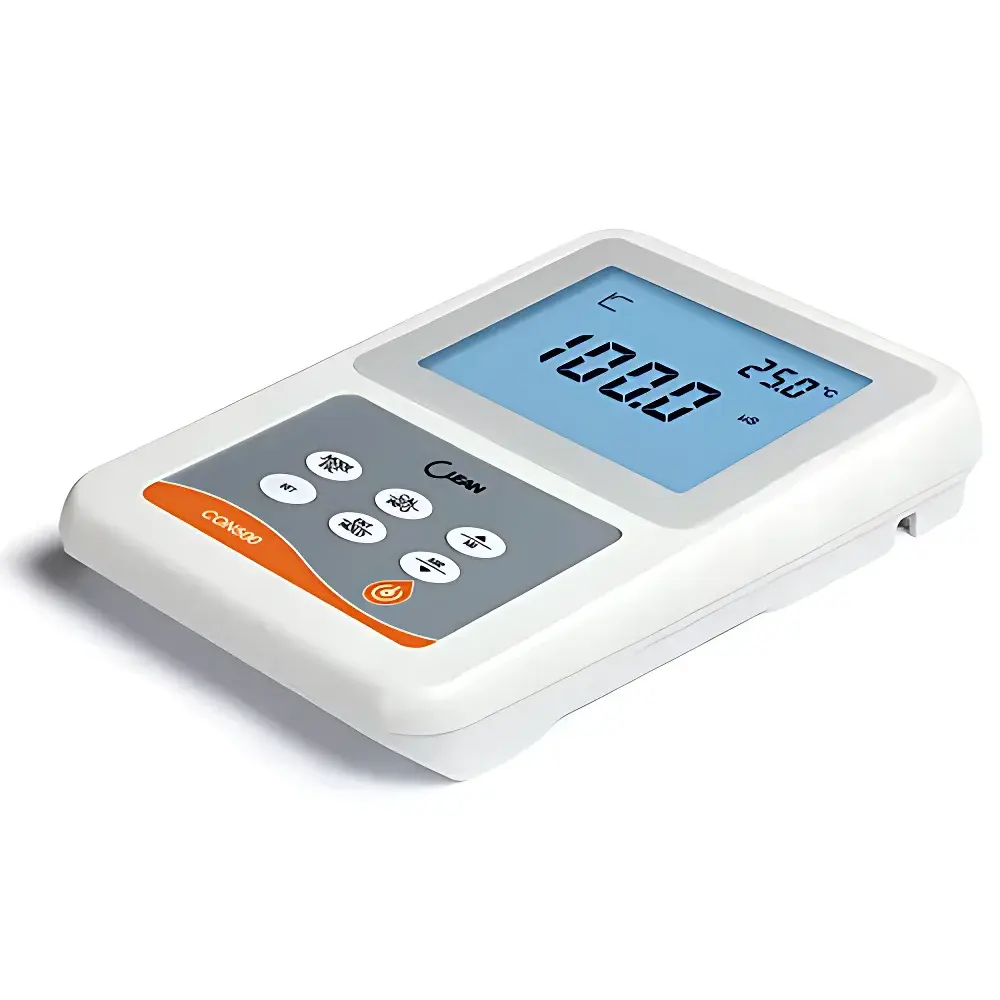
CLEAN CON500 Benchtop Conductivity Meter
| Brand | CLEAN |
|---|---|
| Origin | USA |
| Model | CON500 |
| Form Factor | Benchtop |
| Conductivity Range | 0.000 µS/cm to 400.0 mS/cm |
| TDS Range | 0.000 mg/L to 400.0 g/L |
| Resistivity Range | 0 to 100.0 MΩ·cm |
| Salinity Range | 0.0 to 260.0 g/L |
| Temperature Range | −10.0 °C to 110.0 °C |
| Accuracy | ±0.5% F.S. |
| Minimum Resolution | 0.001 µS/cm |
| Data Storage | 50 sets |
| Auto Power-Off | 10 min (configurable) |
| IP Rating | IP65 |
| Operating Environment | −5 °C to 60 °C, <90% RH |
| Dimensions (W×L×H) | 140 × 210 × 35 mm |
| Weight | 650 g |
Overview
The CLEAN CON500 Benchtop Conductivity Meter is a precision-engineered electrochemical analyzer designed for reliable, multi-parameter measurement of conductivity, total dissolved solids (TDS), resistivity, salinity, and temperature in aqueous solutions. Based on four-electrode or two-electrode conductometric principles—depending on selected sensor configuration—the instrument delivers high reproducibility across an exceptionally wide dynamic range (0.000 µS/cm to 400.0 mS/cm), making it suitable for applications ranging from ultrapure water monitoring in semiconductor-grade deionized systems to high-salinity industrial effluent analysis. Its benchtop form factor integrates laboratory-grade accuracy with operational simplicity, eliminating the need for external calibration stations or PC dependency for routine measurements. The device complies with fundamental metrological requirements outlined in ASTM D1125 (Standard Test Methods for Electrical Conductivity and Resistivity of Water) and supports traceable calibration protocols aligned with ISO/IEC 17025 quality management frameworks.
Key Features
- Benchtop architecture with compact footprint (140 × 210 × 35 mm) and lightweight design (650 g), optimized for space-constrained laboratories, QC rooms, and educational settings.
- High-contrast backlit LCD display (96 × 78 mm) with multi-line readout enabling simultaneous visualization of primary parameter, temperature, unit, and status indicators.
- Auto-ranging conductivity measurement with selectable units: µS/cm, mS/cm, mg/L (TDS), g/L (salinity), and °C—with configurable TDS conversion factor (default 0.65).
- True zero-polarization measurement capability using non-polarizable electrodes, minimizing polarization error and enabling stable readings in low-conductivity samples (<1 µS/cm).
- One-touch parameter review function for immediate access to calibration diagnostics—including zero offset, slope (%), and cell constant—supporting GLP-compliant recordkeeping.
- Detachable electrode holder compatible with standard 12-mm diameter conductivity cells; mountable on either left or right side to maintain precise 90° vertical alignment during immersion.
- IP65-rated enclosure ensures protection against dust ingress and low-pressure water jets, enhancing durability in industrial environments such as wastewater treatment plants or electroplating facilities.
- Configurable auto-power-off (10 minutes default) and battery-backed real-time clock for timestamped data logging without external power dependency.
Sample Compatibility & Compliance
The CON500 accommodates a broad spectrum of aqueous matrices, including deionized water, boiler feedwater, reverse osmosis permeate, cooling tower blowdown, brine solutions, and electroplating baths. Its extended temperature range (−10.0 °C to 110.0 °C) enables direct measurement of hot process streams without pre-cooling. All measurements adhere to standard reference conditions (25 °C), with automatic temperature compensation (ATC) applied via built-in NTC thermistor. The instrument meets general electrical safety requirements per IEC 61010-1 and environmental operating specifications defined in IEC 60751 for Pt100-class temperature sensors. While not certified for intrinsic safety in hazardous locations, its robust construction supports deployment in Class 1, Division 2 environments when used with appropriate enclosures.
Software & Data Management
Data acquisition is managed through internal flash memory supporting up to 50 measurement records, each containing conductivity/TDS/resistivity/salinity values, corresponding temperature, date/time stamp, and calibration metadata. Export functionality is available via optional USB-to-serial adapter (not included), enabling transfer to spreadsheet-compatible CSV files for further statistical analysis or integration into LIMS platforms. The firmware supports audit-trail–capable calibration logging—recording operator ID (manual entry), calibration date, standard used, and deviation from nominal value—facilitating compliance with FDA 21 CFR Part 11 when paired with validated procedural controls. No proprietary software installation is required; raw data export follows open ASCII format conventions.
Applications
- Monitoring resistivity of Type I ultrapure water in pharmaceutical cleanrooms and microelectronics fabrication lines.
- Boiler water chemistry control to prevent scaling and corrosion in steam generation systems.
- Real-time TDS verification in municipal drinking water distribution networks and desalination plant product streams.
- Salinity profiling in aquaculture systems and marine research laboratories.
- Process validation of rinse water conductivity in electroplating and anodizing operations per ASTM B136 and ISO 14631.
- Teaching fundamental electrochemical concepts—including Kohlrausch’s law, ion mobility, and solution conductivity theory—in undergraduate analytical chemistry labs.
FAQ
Does the CON500 support calibration with multiple standard solutions?
Yes—it accepts single-point or two-point calibration using certified KCl standards (e.g., 84 µS/cm, 1413 µS/cm, 12.88 mS/cm) with manual entry of known conductivity values.
Can the instrument measure resistivity directly, or is it calculated?
Resistivity is computed in real time from measured conductivity and user-defined cell constant; no separate sensor is required.
Is the temperature sensor interchangeable or integrated?
The temperature sensor is integrated into the conductivity probe assembly and calibrated as a matched pair; replacement requires recalibration of the full sensor system.
What is the recommended maintenance interval for electrode cleaning?
Electrodes should be rinsed with deionized water after each use; periodic cleaning with mild detergent or dilute HNO₃ (for fouling) is advised based on sample matrix frequency and contamination risk.
Does the CON500 comply with USP for purified water testing?
While not pre-validated for USP , its measurement uncertainty (±0.5% F.S.) and ATC performance meet the technical thresholds specified in the chapter when operated under controlled lab conditions with documented calibration and verification procedures.
Related Products




