
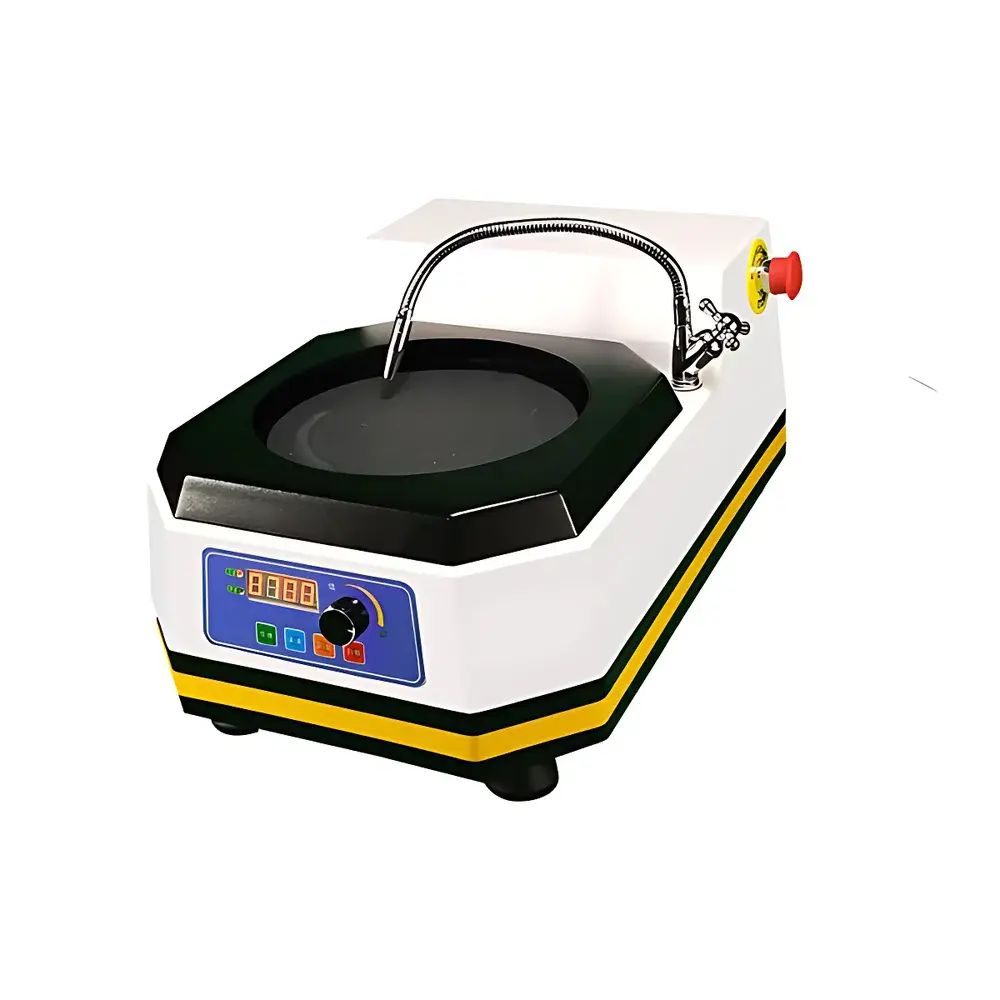
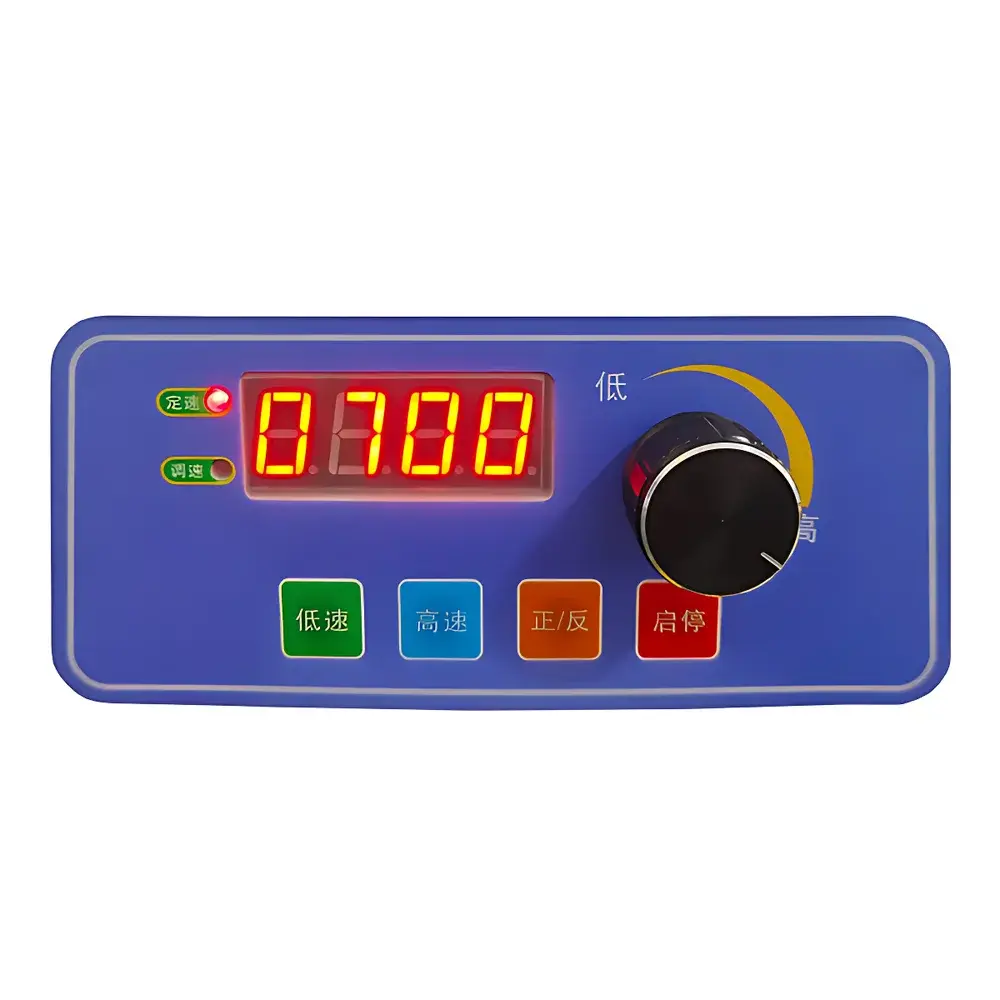
YANRUN MPD-1J Benchtop Single-Disc Metallographic Grinding and Polishing Machine
| Brand | YANRUN |
|---|---|
| Origin | Shanghai, China |
| Manufacturer Type | Direct Manufacturer |
| Country of Origin | China |
| Model | MPD-1J |
| Speed Control | Infinitely Variable 50–1500 rpm + Preset Speed Steps |
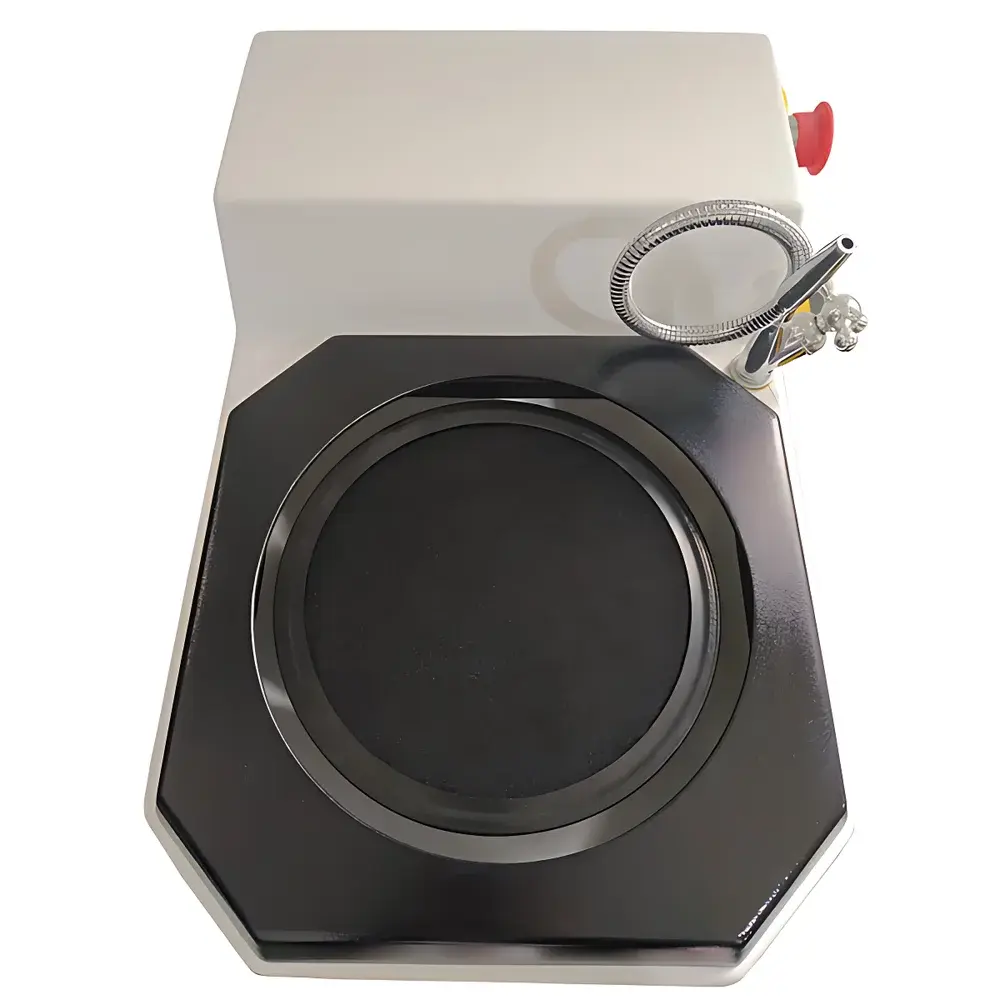
| Platen Diameter | Ø230 mm (optional: Ø200 / Ø250 / Ø300 mm) |
| Number of Platens | 1 |
| Dimensions (L×W×D) | 340 × 520 × 250 mm |
| Motor Power | 750 W |
| Rotation Direction | Bidirectional (Forward/Reverse) |
| Water Nozzle | Adjustable Swivel Spray |
| Voltage | 220 V AC |
Overview
The YANRUN MPD-1J is a precision-engineered benchtop single-disc metallographic grinding and polishing machine designed for reproducible, high-fidelity specimen preparation in metallurgical, materials science, and quality assurance laboratories. It operates on the principle of controlled mechanical abrasion—applying calibrated pressure and rotational motion to progressively remove surface material using abrasive papers, diamond suspensions, or colloidal silica slurries. The machine’s bidirectional platen rotation and servo-based speed regulation ensure uniform material removal across diverse sample geometries and hardness profiles, minimizing edge rounding, relief, and pull-out artifacts commonly observed in suboptimal preparation workflows. Engineered for routine use in ISO/IEC 17025-accredited labs and production QC environments, the MPD-1J supports standardized preparation protocols aligned with ASTM E3, ISO 16809, and EN 10365—enabling traceable, auditable, and inter-laboratory comparable results.
Key Features
- Bidirectional platen rotation (forward/reverse) to enhance symmetry in material removal and reduce directional scratch bias.
- Infinitely variable speed control from 50 to 1500 rpm, supplemented by programmable preset speed steps for rapid method recall—critical for multi-stage preparation sequences (e.g., coarse grinding → fine grinding → polishing → final polishing).
- Servo-motor-driven system delivering stable torque output across the full speed range, ensuring consistent rotational inertia and minimal speed drift under load.
- Adjustable swivel water nozzle enabling precise, localized coolant delivery directly at the sample–abrasive interface—reducing thermal damage, preventing abrasive drying, and improving slurry dispersion.
- Modular platen design accommodating interchangeable Ø200 mm, Ø230 mm, Ø250 mm, and Ø300 mm platens (standard: Ø230 mm), facilitating compatibility with industry-standard consumables and workflow scalability.
- Compact footprint (340 × 520 × 250 mm) optimized for space-constrained lab benches while maintaining structural rigidity and vibration damping for operator safety and long-term calibration stability.
Sample Compatibility & Compliance
The MPD-1J prepares specimens ranging from soft aluminum alloys and copper matrices to hardened tool steels, sintered carbides, ceramic composites, and geological thin sections. Its adjustable pressure interface (via optional manual or pneumatic loading kits) allows optimization for brittle phases (e.g., intermetallics, oxides) and ductile phases (e.g., austenite, α-brass). All operational parameters—including speed, dwell time, coolant flow rate, and abrasive type—are fully documentable to support GLP/GMP compliance. The device meets CE marking requirements for electrical safety (EN 61000-6-2/6-3) and is compatible with laboratory information management systems (LIMS) via RS-232 or optional USB-to-serial interface for audit trail generation per FDA 21 CFR Part 11 guidelines.
Software & Data Management
While the MPD-1J operates via intuitive front-panel controls, its embedded firmware supports parameter logging (date/time-stamped speed, direction, runtime) stored internally for up to 500 cycles. Optional PC connectivity enables export of preparation logs in CSV format for integration into LIMS or electronic lab notebooks (ELN). Firmware updates are performed via secure USB drive, ensuring alignment with evolving ISO/IEC 17025 documentation requirements and internal SOP revisions. No proprietary cloud platform is required—data sovereignty remains fully under institutional control.
Applications
- Metallurgical research: Preparation of cross-sections for SEM-EDS, EBSD, and microhardness mapping.
- Failure analysis laboratories: Replication of service-induced damage zones (e.g., fatigue cracks, corrosion pits, wear tracks) without introducing preparation artifacts.
- Automotive and aerospace QA: Routine preparation of turbine blade superalloys, weld joints, and cast aluminum housings per AMS 2300 and AMS 2640 standards.
- Academic teaching labs: Standardized training in ASTM E3-compliant preparation techniques for undergraduate and graduate metallurgy curricula.
- Ceramic and hardmetal R&D: Surface planarization of SiC, WC-Co, and ZrO₂ samples prior to XRD texture analysis or nanoindentation.
- Forensic engineering: Controlled sectioning of failed components for root cause determination in liability investigations.
FAQ
Does the MPD-1J support automated force application?
No—the base model uses manual sample loading; however, it is mechanically compatible with third-party pneumatic or electromechanical load modules for force-controlled protocols.
Can the machine be used for electropolishing or electrochemical etching?
No—it is strictly a mechanical grinding/polishing platform. Electrolytic processes require dedicated power supplies and corrosion-resistant cell assemblies not integrated into this design.
Is the water spray system compatible with alcohol-based or oil-based lubricants?
The swivel nozzle delivers aqueous coolant only; non-aqueous media require external dispensing systems due to seal and pump material limitations.
What maintenance intervals are recommended for optimal performance?
Platen bearing inspection every 6 months; motor brush replacement after 2,000 operational hours; annual verification of speed accuracy using a calibrated tachometer per ISO 17025 clause 6.4.6.
Are consumables such as grinding discs and polishing cloths supplied by YANRUN?
YANRUN offers OEM-compatible consumables including diamond-impregnated grinding discs (125–30 µm), synthetic polishing cloths (napped and woven), and alumina/ceria slurries—but users may also integrate any standard ISO 12894-compliant consumables.
Related Products



