
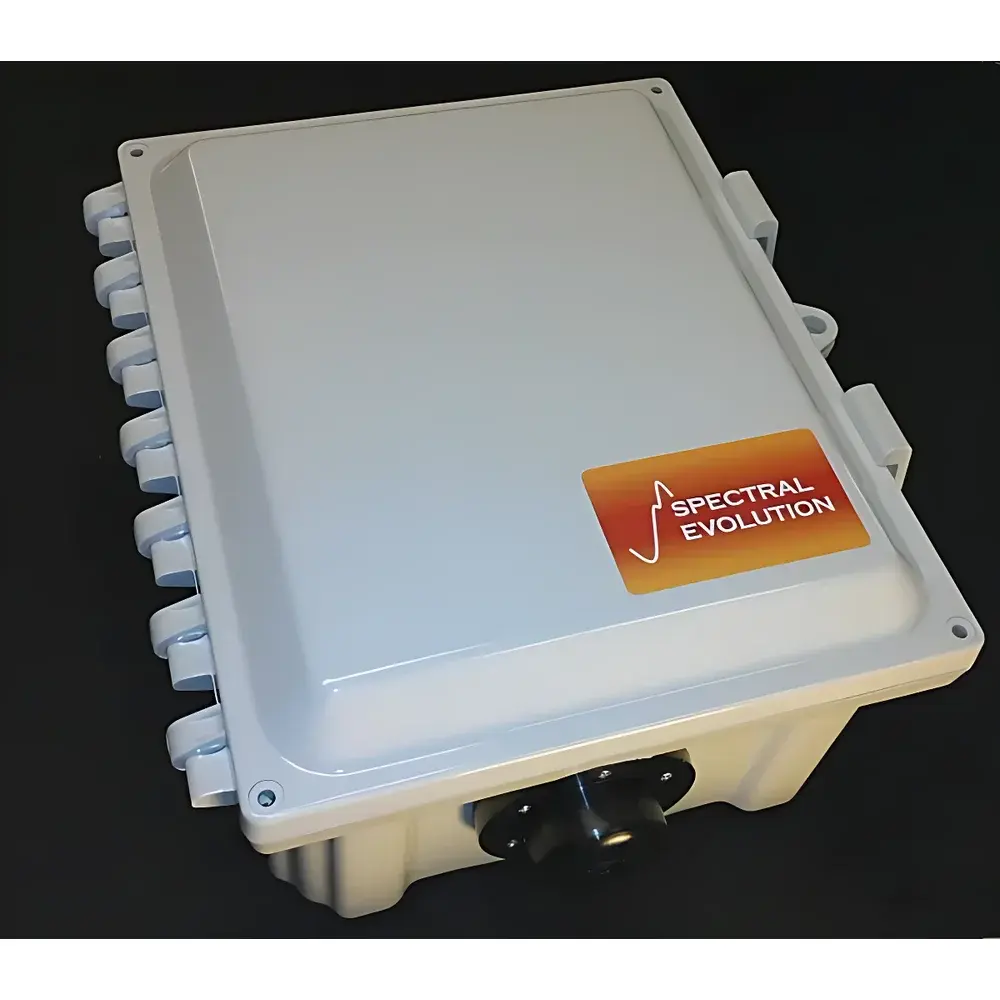
SEI UDS-1100/1100SA Dual-Channel Portable Field Spectroradiometer
| Brand | SEI |
|---|---|
| Origin | USA |
| Model | UDS-1100/1100SA |
| Spectral Range | 320–1100 nm |
| Spectral Resolution | 3.2 nm |
| Sampling Bandwidth | 1.5 nm |
| NEΔL (1 s integration) | 8×10⁻¹⁰ W/cm²/nm/sr @400 nm |
| Radiometric Accuracy | ±5% @400 nm (NIST-traceable calibration) |
| Detector | 512-element Si photodiode array, 25 µm × 2.5 mm pixel size |
| Slit Width | 50 µm |
| A/D Converter | 16-bit |
| Spectral Repeatability | 0.1 nm |
| Spectral Accuracy | ±0.5 nm (FWHM) |
| Integration Time | 8–2000 ms |
| Shutter | Electronic, synchronized dual-channel |
| Auto-Exposure | Yes |
| Communication | USB 2.0 (optional Bluetooth) |
| Enclosure | NEMA 4-rated sealed housing |
| Dimensions | 25 cm × 32 cm × 15 cm |
| Weight | 1.8 kg |
| Power | 6–12 V DC, 0.5 W (optional Li-ion battery: 7.5 V, 24 h operation) |
| Data Storage (UDS-1100SA) | 800 spectra onboard |
| Optical Configurations | Fixed 4° FOV fore-optic for upwelling radiance + cosine-corrected diffuser for downwelling irradiance |
| Software | DARWin SP v6.x (Windows-compatible), supports ASTM E275, ISO 17123-6, and USP <857> spectral data acquisition protocols |
Overview
The SEI UDS-1100/1100SA is a dual-channel portable field spectroradiometer engineered for high-fidelity, simultaneous measurement of spectral radiance (upwelling) and spectral irradiance (downwelling) under ambient outdoor conditions. Based on a fixed-grating, linear silicon photodiode array architecture with thermally stabilized optical path design, the instrument operates on the principle of dispersive spectroscopy using a 512-pixel detector and precision 50 µm entrance slit. Its calibrated spectral response spans 320–1100 nm with a nominal resolution of 3.2 nm (FWHM) and sampling bandwidth of 1.5 nm — enabling robust characterization of vegetation indices (e.g., NDVI, PRI, REIP), water-leaving radiance, snow albedo, and atmospheric transmittance features. The system adheres to radiometric traceability standards via factory calibration against NIST-traceable sources, with absolute uncertainty of ±5% at 400 nm — meeting requirements for scientific-grade field validation in environmental remote sensing and ecological monitoring applications.
Key Features
- Dual-channel synchronous acquisition: Independent optical paths for radiance (4° or 25° FOV fore-optic) and irradiance (top-mounted cosine diffuser) eliminate temporal misregistration during solar-induced reflectance calculations.
- NEMA 4-rated sealed enclosure: IP66-compliant aluminum housing ensures operational reliability in rain, dust, high humidity, and temperature gradients from –10 °C to +50 °C.
- Thermally compensated detector and grating mount: Minimizes spectral drift over extended field deployments (>8 h continuous operation).
- Programmable electronic shutter sequencing: Enables precise time-gated sampling of each channel without mechanical moving parts, ensuring long-term mechanical stability and reproducibility (spectral repeatability ≤0.1 nm).
- Onboard autonomous operation (UDS-1100SA model): Integrated rechargeable Li-ion battery (7.5 V, 24 h runtime), non-volatile flash memory (800-spectrum capacity), and real-time clock support unattended diurnal or multi-day monitoring campaigns.
- Flexible power interface: Accepts 6–12 V DC input; compatible with marine batteries, solar charge controllers, and vehicle power systems — configurable per site-specific energy infrastructure.
Sample Compatibility & Compliance
The UDS-1100/1100SA is designed for non-contact, non-destructive measurement of natural and semi-natural surfaces including vegetative canopies (broadleaf, coniferous, agricultural crops), bare and organic soils, snowpacks, sea ice, coral reef substrates, and open water bodies. Its radiometric calibration conforms to ASTM E275 (Standard Practice for Describing and Measuring Performance of UV–VIS–NIR Spectrophotometers), ISO 17123-6 (Optics and optical instruments — Field procedures for testing geodetic and surveying instruments — Part 6: Optoelectronic distance meters), and supports data integrity requirements under GLP and GMP frameworks when used with DARWin SP’s audit-trail-enabled acquisition mode (21 CFR Part 11 compliant configuration available upon request). All factory calibrations are documented with NIST-traceable certificates, including spectral responsivity, linearity, and stray light characterization reports.
Software & Data Management
DARWin SP v6.x is a Windows-based acquisition and post-processing platform developed specifically for SEI field spectroradiometers. It provides real-time spectral visualization, dark-current subtraction, radiometric correction, and automated calculation of derived indices (e.g., normalized difference water index — NDWI, photochemical reflectance index — PRI). The software supports batch export in ENVI-compatible BIL format, CSV, and HDF5 — facilitating direct ingestion into ENVI, ArcGIS, Python (NumPy/SciPy), and R workflows. For UDS-1100SA deployments, DARWin SP enables remote parameter scheduling via USB or Bluetooth: users define scan intervals (1 min to 24 h), number of averages per scan, integration time ramping, and conditional triggering (e.g., sunrise/sunset detection via integrated light sensor). All acquired spectra include embedded metadata: GPS timestamp (when connected to external GNSS), instrument ID, calibration file version, and environmental sensor readings (optional temperature/humidity module).
Applications
- Vegetation biophysics: Canopy-level chlorophyll content estimation, stress detection (drought, nutrient deficiency), phenological stage classification, and LAI inversion modeling.
- Soil and crop monitoring: Organic matter quantification, moisture content inference, and residue cover assessment using visible–near-infrared spectral signatures.
- Forestry ecology: Bidirectional reflectance distribution function (BRDF) characterization across sunlit/shaded leaf–soil mosaics; understory light environment mapping.
- Marine and coastal optics: In-water constituent retrieval (chlorophyll-a, CDOM, suspended sediments) via above-water radiometry; coral health assessment through spectral bleaching indicators.
- Cryospheric science: Snow grain size evolution tracking, black carbon deposition quantification, and albedo feedback modeling in Arctic and alpine environments.
- Meteorological networks: Long-term UV-B irradiance trend analysis, broadband solar radiation partitioning (direct/diffuse), and aerosol optical depth proxy derivation.
FAQ
What is the difference between UDS-1100 and UDS-1100SA?
The UDS-1100 requires continuous USB connection to a host PC for operation and data streaming. The UDS-1100SA adds autonomous functionality: internal battery, onboard storage (800 spectra), programmable scheduler, and optional Bluetooth telemetry — enabling true unattended deployment.
Can the UDS-1100SA be powered by solar panels?
Yes. The device accepts regulated 6–12 V DC input. When paired with a compatible solar charge controller and deep-cycle battery bank, it supports year-round operation in off-grid locations — typical configurations use 20–40 W panels with MPPT regulation.
Is DARWin SP compatible with macOS or Linux?
DARWin SP is native to Windows 10/11 (64-bit). However, spectral data files (CSV, ENVI BIL) are fully cross-platform; Python and R libraries (e.g., pyspectra, hyperSpec) provide full read/write support on macOS and Linux.
How is calibration maintained during long-term field use?
While factory calibration remains valid for 12 months under normal handling, SEI recommends annual recalibration using NIST-traceable reference sources. Field validation with stable reference panels (e.g., Spectralon® 99% reflectance) is advised before critical measurement campaigns.
Does the system support GPS synchronization?
Yes — via optional external USB GNSS receiver (e.g., u-blox M8T). DARWin SP embeds UTC timestamps and geographic coordinates directly into spectrum headers, enabling spatiotemporal alignment with satellite or drone-acquired imagery.






