
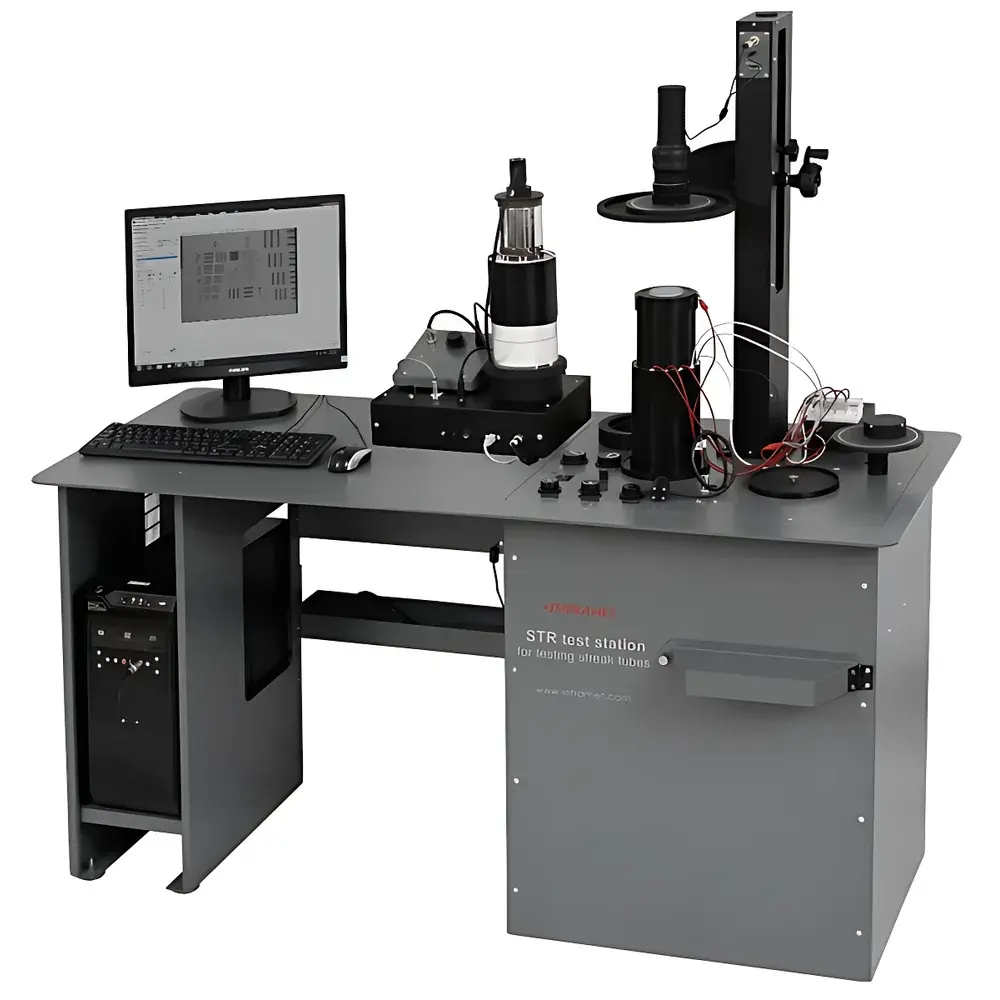
STR Inframet STR High-Performance Streak Tube Characterization System
| Brand | Inframet |
|---|---|
| Origin | Poland |
| Model | STR |
| Radiation Channel | Broadband Halogen Source + Spectral Selector + Radiometric Probes (RP1) |
| Imaging Channel | PC-Controlled LED + High-Resolution Projection System + Dual-Camera Image Analysis (UNI Cameras, MR1/MR2 Imaging Radiometers) |
| Temporal Channel | PC-Synchronized Pulsed Light Source + Fast Photodetector Array (FP1/FP2 + FPP1 Amplifier) |
| Measurable Parameters | Photocathode Luminous Sensitivity (Integral & Spectral), EBI, Radiant Power Gain, Luminance Gain, Dynamic Range, Spatial Resolution (16–81 lp/mm, optional 114 lp/mm), MTF, Magnification, Distortion, Afterglow Time, Temporal Resolution (optional) |
| Compatible Photocathode Diameters | 5–40 mm |
| Max Tube Height | < 480 mm |
| Max Phosphor Screen Diameter | < 56 mm |
| Spectral Range | 400–850 nm (standard), extendable |
| Photocathode Types | All standard types |
| Phosphors | P20, P22, P30, P43 (standard) |
| Mechanical OD | < 150 mm |
| MCP Integration | Supported (with/without) |
Overview
The STR High-Performance Streak Tube Characterization System, developed by Inframet (Poland), is a computer-controlled, modular metrology platform engineered for comprehensive parametric evaluation of electro-optical streak tubes used in ultrafast imaging, laser diagnostics, and time-resolved spectroscopy. Unlike generic photomultiplier or image intensifier testers, the STR system implements a tri-channel architecture—radiometric, imaging, and temporal—each operating with traceable calibration paths and synchronized timing control. Its core measurement principle relies on calibrated illumination of the photocathode followed by quantitative analysis of the resulting phosphor screen emission, enabling direct determination of gain, sensitivity, noise floor, spatial fidelity, and temporal response under defined operational conditions. The system is designed to meet the stringent repeatability and traceability requirements of R&D laboratories, national metrology institutes, and defense-grade component qualification facilities.
Key Features
- Three functionally decoupled yet software-synchronized measurement channels: radiometric (for gain and sensitivity), imaging (for MTF, distortion, and resolution), and temporal (for afterglow and pulse response)
- Automated, script-driven semi-automatic test sequences reducing operator dependency and inter-lab variability
- Modular hardware architecture: interchangeable probes (LP1/LP2 luminance probes, RP1 radiometric probe, CP current probe), dual high-resolution imaging radiometers (MR1/MR2), and calibrated pulsed light source with sub-nanosecond jitter
- Full compatibility with both MCP-intensified and non-MCP streak tubes across industry-standard photocathode diameters (5–40 mm) and phosphor screens (P20, P22, P30, P43, plus optional P46/P47)
- Extendable spectral coverage from 400–850 nm; optional upgrades support UV-enhanced or NIR-optimized configurations
- Integrated analog image acquisition card with 12-bit dynamic range and precise trigger synchronization for low-noise temporal profiling
Sample Compatibility & Compliance
The STR system accommodates streak tubes with mechanical outer diameters up to 150 mm, total heights below 480 mm, and phosphor screen diameters less than 56 mm. It supports all common photocathode materials—including multialkali (S-20), GaAs, and solar-blind variants—and is compatible with legacy and next-generation phosphors (P20, P22, P30, P43 as standard; P46/P47 available via configuration). All optical components are NIST-traceable or ISO/IEC 17025-accredited where applicable. Measurement protocols align with relevant sections of IEC 61966-2-1 (colorimetry), ISO 12233 (spatial resolution), and ASTM E1552 (radiometric calibration of electro-optical devices). Data integrity complies with GLP and GMP audit trail requirements through timestamped, user-logged test records and immutable raw-data export.
Software & Data Management
The STR Control Suite is a Windows-based application written in C++ with Qt framework, providing real-time visualization, parameter mapping, and automated report generation in PDF and CSV formats. Each test module includes configurable pass/fail thresholds, statistical process control (SPC) charts, and comparative analysis against reference tube databases. All measurement data—including raw camera frames, photodetector waveforms, and spectrally resolved radiance traces—are stored with full metadata (instrument ID, calibration date, ambient conditions, operator ID). The software supports FDA 21 CFR Part 11 compliance via electronic signatures, role-based access control, and tamper-evident audit logs. Export interfaces include MATLAB .mat, HDF5, and SI-units-compliant ASCII for integration into lab-wide LIMS environments.
Applications
- Quantitative validation of streak tube performance prior to integration into femtosecond laser diagnostics systems
- Batch qualification and lifetime monitoring of streak tubes in defense electro-optical subsystems (e.g., missile warning sensors, laser rangefinders)
- Development and optimization of novel photocathode-phosphor combinations for high-dynamic-range ultrafast imaging
- Interlaboratory comparison studies supporting ISO/IEC 17025 accreditation of optical testing labs
- Root-cause analysis of spatial nonuniformity, temporal dispersion, or gain drift in field-deployed streak cameras
FAQ
Does the STR system support calibration traceability to national standards?
Yes — all radiometric and photometric probes are supplied with valid calibration certificates traceable to PTB (Germany) or NIST (USA). Optional on-site recalibration services are available through Inframet’s authorized metrology partners.
Can the system characterize streak tubes with microchannel plates (MCP)?
Yes — the STR platform is explicitly designed for both MCP-intensified and direct-conversion streak tubes. Bias voltage sequencing and gain normalization routines account for MCP-specific gain dynamics and saturation behavior.
Is spectral sensitivity measurement limited to the 400–850 nm range?
The base configuration covers 400–850 nm. Extended spectral modules (UV: 185–400 nm; NIR: 850–1100 nm) are available as factory-installed options with recalibrated spectral selectors and detector heads.
What level of spatial resolution uncertainty does the imaging channel achieve?
At 50% MTF, the imaging channel achieves an expanded uncertainty (k=2) of ±0.8 lp/mm for measurements between 16–81 lp/mm. With the optional high-resolution target set and sub-pixel registration algorithm, resolution verification down to 114 lp/mm is supported.
How is temporal resolution verified in the time channel?
Temporal resolution is determined using deconvolution-based analysis of instrument response functions derived from calibrated femtosecond laser pulses (FWHM < 300 fs) and measured screen decay profiles, referenced to ISO 13660 Annex D methodology.




