
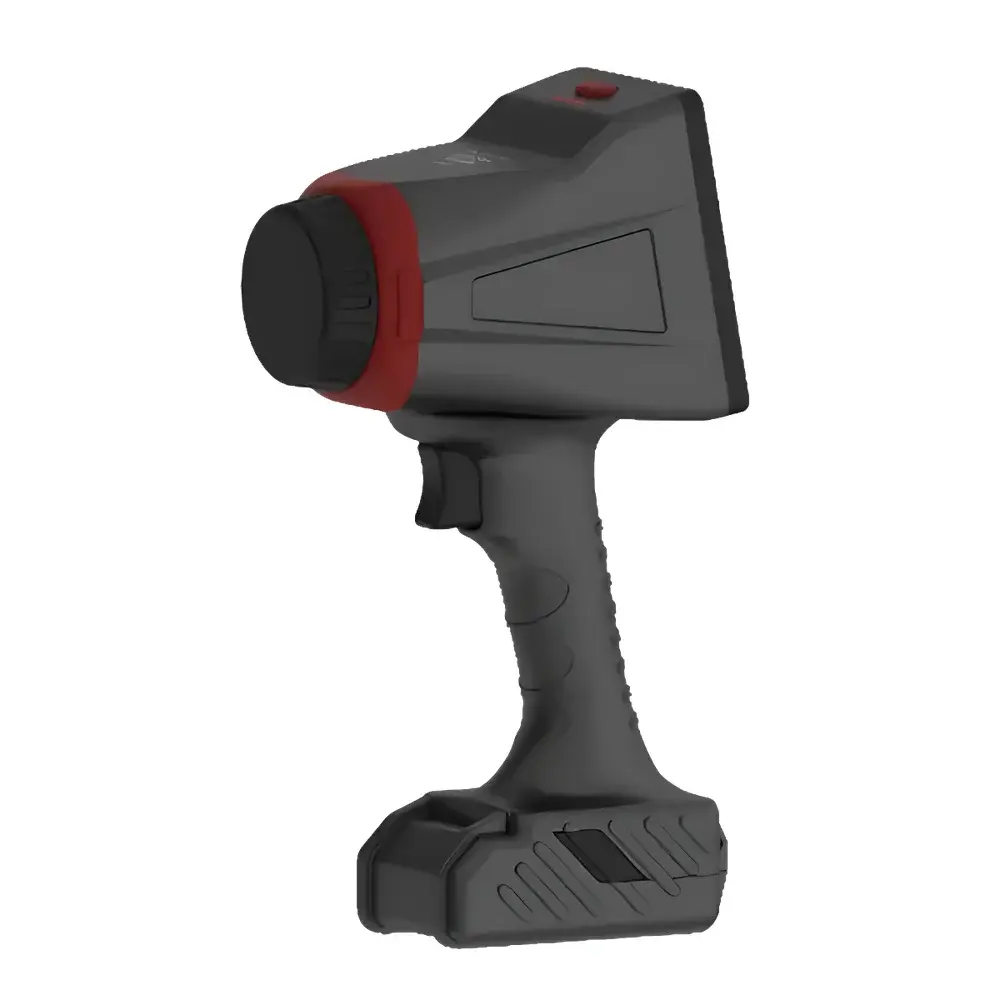
Optec PEM Series Portable Infrared Emissivity Meter
| Brand | Optec |
|---|---|
| Origin | Beijing, China |
| Model | PEM |
| Instrument Type | Portable |
| Spectral Range | 1–50 µm |
| Scan Speed | 3 s per measurement |
| Measurement Principle | Directional-Hemispherical Reflectance (DHR) via Integrating Sphere Reflectometry |
| Output Parameters | Hemispherical Emissivity, Directional-Hemispherical Reflectance at 20° and 60° incidence |
| Measured Bands | Dual-band simultaneous output — 3–5 µm and 8–14 µm (PEM100) |
| Accuracy | ±0.01 (PEM10), ±0.02 (PEM100) |
| Repeatability | ±0.005 (PEM10), ±0.01 (PEM100) |
| Incidence Angles | 20° normal incidence (PEM10) |
| Calibration Standard | Gold-coated reference mirror |
| Power Supply | Rechargeable Li-ion battery |
| Weight | 0.6 kg (PEM10), <1.0 kg (PEM100), both including battery |
Overview
The Optec PEM Series Portable Infrared Emissivity Meter is a field-deployable, self-contained optical metrology instrument engineered for high-accuracy, in-situ determination of spectral and broadband hemispherical emissivity (εh) and directional-hemispherical reflectance (DHR) of solid material surfaces. Operating on the fundamental principle of integrating sphere reflectometry, the PEM system measures bidirectional reflectance distribution function (BRDF)-integrated response under controlled collimated illumination, enabling compliant derivation of emissivity via Kirchhoff’s law (εh = 1 − ρh) under thermal equilibrium assumptions. Unlike conventional Fourier-transform infrared (FTIR) or dispersive spectroradiometric approaches, the PEM series employs a compact, coaxial optical path with internal gold-mirror calibration, eliminating alignment drift and minimizing stray light—critical for repeatable measurements on non-uniform, curved, or large-area industrial surfaces. Its design conforms to ASTM E1933-19 (Standard Test Methods for Measuring and Compensating for Emissivity Using Infrared Imaging Systems) and supports traceable validation per ISO 18434-1 for condition monitoring of thermal management systems.
Key Features
- Integrated optomechanical architecture: All critical subsystems—including tungsten-halogen broadband source, gold-coated integrating sphere (99.5% reflectance ≥0.8–20 µm), thermoelectrically stabilized InSb/MCT dual-detector array, and embedded AI-accelerated signal processor—are housed within a single, rigid aluminum chassis.
- True portable operation: Weighing only 0.6 kg (PEM10) or 4.5 hours on a single charge of its certified UL2054-compliant lithium-ion battery pack; no external power supply or PC tethering required during acquisition.
- Touch-optimized human interface: A 5.7-inch capacitive TFT-LCD display with anti-glare coating delivers intuitive, context-aware navigation—calibration prompts, real-time SNR feedback, and pass/fail compliance indicators are rendered without menu nesting.
- Dual-angle and dual-band capability (PEM100): Simultaneous acquisition at 20° and 60° incidence angles enables angular emissivity profiling per MIL-STD-45662A; concurrent 3–5 µm and 8–14 µm band outputs support aerospace IR signature analysis and atmospheric window characterization.
- Onboard NIST-traceable calibration: Factory-applied correction matrices account for source spectral roll-off, detector quantum efficiency nonuniformity, and sphere wall degradation; users perform routine verification using the included certified gold mirror standard (ρ ≥ 0.985 at 3–14 µm).
Sample Compatibility & Compliance
The PEM series accommodates flat, curved, textured, or coated surfaces with minimum lateral dimension ≥15 mm and surface roughness Ra ≤ 10 µm. It is routinely deployed on turbine blade coatings, spacecraft thermal control paints (e.g., Z-93, Alodine 1200), nuclear fuel cladding, and refractory ceramics. Measurements comply with GLP documentation requirements: each data file embeds timestamp, GPS coordinates (optional external module), operator ID, ambient temperature/humidity (via integrated sensors), and full audit trail of calibration events. Raw spectra and derived emissivity values are exportable in ASTM E2935-compliant CSV and HDF5 formats for integration into LIMS or enterprise QA databases.
Software & Data Management
Optec Emissivity Studio v3.2 (Windows/macOS/Linux) provides post-acquisition analysis, including spectral smoothing (Savitzky-Golay, 7-point), baseline correction (Rubberband algorithm), and multi-sample statistical reporting (Cp/Cpk, GR&R). The software enforces FDA 21 CFR Part 11 compliance via electronic signatures, role-based access control, and immutable audit logs. For automated workflows, a RESTful API supports direct integration with LabVIEW, Python (PyVISA), or MATLAB environments—enabling scripted batch calibration, remote firmware updates, and real-time emissivity trending in predictive maintenance platforms.
Applications
- Aerospace thermal management: Quantifying εh degradation of thermal control coatings after UV/atomic oxygen exposure (per ECSS-Q-ST-70-08C).
- Defense IR signature reduction: Validating low-emissivity finishes on vehicle hulls and sensor domes across military spectral bands (MWIR/LWIR).
- Energy sector asset integrity: Monitoring oxidation-induced emissivity shifts on boiler tubes and heat exchanger surfaces as early indicators of material fatigue.
- Materials R&D: Screening novel metamaterials, selective absorbers, and radiative cooling films where ε(λ) profile governs net radiative heat flux.
- Quality assurance in coating production: In-line verification of emissivity uniformity across large-area substrates (e.g., solar absorber plates, architectural glazing).
FAQ
Does the PEM require annual recalibration by the manufacturer?
While factory recalibration is recommended every 24 months for metrological traceability, users may perform intermediate verification using the supplied gold mirror and Optec’s Certificate of Conformance (CoC) data. Internal diagnostics log all optical throughput deviations exceeding ±0.3%.
Can the PEM measure emissivity of transparent or semi-transparent materials?
No. The instrument assumes opaque, diffusely reflecting surfaces. Transmissive samples (e.g., thin polymer films, glass) yield non-physical results due to unaccounted bulk absorption and rear-surface reflection.
Is GPS geotagging supported natively?
Geolocation is optional via Bluetooth-paired GNSS receiver (e.g., Bad Elf GPS Pro+); coordinates are embedded in metadata but do not affect optical measurement accuracy.
What environmental conditions limit field use?
Operating range: −10 °C to +50 °C, 10–90% RH non-condensing. Rain, snow, or direct solar loading on the aperture must be avoided; optional weatherproof hood (Part #PEM-WPH-1) extends usability to IP54-rated conditions.




