
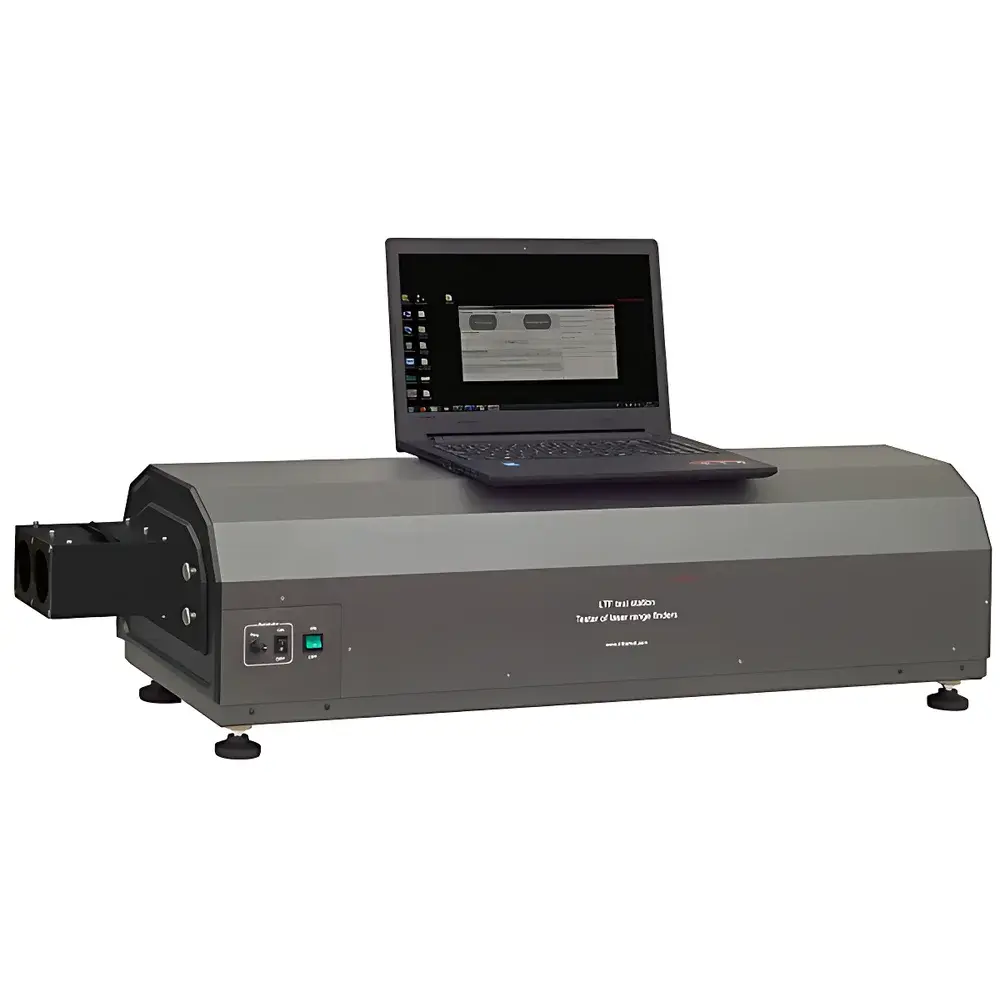
Inframet LTF Laser Rangefinder Performance Test System
| Brand | Inframet |
|---|---|
| Origin | Poland |
| Manufacturer Type | Authorized Distributor |
| Import Status | Imported |
| Model | LTF |
| Price Range | USD 105,000 – 132,000 |
| Spectral Range | 700–1700 nm |
| Calibration Wavelengths | 910 nm, 1060 nm, 1540/1550/1570 nm |
| Simulated Target Quantity | 1 (expandable to 3) |
| Simulated Target Distance | ~1200 m |
| Attenuation Range | ≥40 dB |
| Attenuation Control | Motorized, computer-driven |
| Maximum Target Divergence | 4 mrad |
| Minimum Target Divergence | 0.25 mrad |
| Target Divergence Step Resolution | 5 discrete values |
| Target Divergence Control | Computer-controlled |
| Optical Axis Misalignment Verification | Supported |
| Maximum Transmit Aperture | 50 mm (upgradeable) |
| Maximum Receive Aperture | 50 mm (upgradeable) |
| Dual-Channel Architecture | Standard (supports coaxial LRF testing as optional configuration) |
| Required Optical Overlap | Precise collimation alignment between LTF and DUT optical axes |
| Operating Temperature | 5°C to 40°C |
| Storage Temperature | −5°C to 60°C |
| Relative Humidity | Up to 95% RH (non-condensing) |
| Power Supply | AC 110–230 V, 50/60 Hz |
| Dimensions (Main Unit) | 1360 × 320 × 280 mm |
| Weight | 44 kg |
Overview
The Inframet LTF Laser Rangefinder Performance Test System is a portable, laboratory-grade optical test platform engineered for the quantitative evaluation of electro-optical rangefinding instruments under controlled yet field-representative conditions. Designed around a calibrated fiber-coupled pulse injection architecture, the LTF replicates real-world ranging scenarios by delivering time-synchronized, spectrally matched, and attenuated laser pulses from a simulated distant target back into the receiver path of the device under test (DUT). Its core measurement principle relies on precise temporal and photometric control of pulsed laser signals—enabling direct assessment of critical performance parameters including detection threshold, range accuracy, pulse discrimination capability, and extinction ratio (ER) under variable signal-to-noise conditions. Unlike static benchtop setups, the LTF integrates dynamic optical attenuation, programmable target divergence, and axis misalignment simulation to emulate atmospheric propagation effects, beam walk-off, and off-boresight acquisition challenges encountered during operational deployment. The system operates across the near-infrared spectrum (700–1700 nm), supporting common military and industrial rangefinder wavelengths such as 910 nm, 1060 nm, and the eye-safe 1540–1570 nm band.
Key Features
- Dual-channel optical architecture enabling independent characterization of transmit and receive paths—optionally configurable for coaxial rangefinder validation
- Computer-controlled motorized variable optical attenuation with ≥40 dB dynamic range and sub-decibel resolution
- Programmable target divergence (0.25–4 mrad in five discrete steps), emulating angular size variations of real-world targets at extended ranges
- Integrated optical axis misalignment verification module to assess DUT sensitivity to boresight error and mechanical stability
- Fiber-delivered pulse injection ensures spatial coherence, temporal fidelity, and repeatable beam quality—eliminating free-space alignment drift
- Modular design supports optical aperture upgrades beyond 50 mm for compatibility with large-aperture rangefinders and tracking systems
- Compact footprint (1360 × 320 × 280 mm) and 44 kg mass enable rapid relocation between lab, warehouse, and calibration facility environments
Sample Compatibility & Compliance
The LTF is vendor-agnostic and compatible with all commercially available pulsed laser rangefinders (LRFs), including Class 1M, Class 3B, and Class 4 systems operating within its spectral and pulse energy envelope. It supports standardized test protocols aligned with NATO AEP-97 (Test and Evaluation of Electro-Optical Systems), MIL-STD-810G (environmental survivability), and IEC 60825-1 (laser safety compliance verification). While not itself certified to ISO/IEC 17025, the system is routinely deployed in GLP-compliant metrology laboratories for traceable performance validation prior to field acceptance testing. Its attenuation calibration is referenced to NIST-traceable power meters, and spectral response is verified using calibrated OSA and photodiode-based spectroradiometers. All firmware and software logs maintain timestamped audit trails suitable for internal QA documentation and regulatory review.
Software & Data Management
The LTF is operated via dedicated Windows-based test software that provides full remote control of attenuation, target divergence, axis alignment status, and data acquisition triggers. The application supports automated test sequences—including ramped attenuation sweeps, multi-distance simulation profiles, and ER measurement routines—with exportable CSV and XML datasets compliant with ASTM E2917 (Standard Practice for Data Recording in Metrology). Raw timing data (pulse arrival time, jitter, FWHM) and analog waveform captures are stored with metadata tags (wavelength, temperature, humidity, operator ID). Software architecture complies with FDA 21 CFR Part 11 requirements for electronic records and signatures when configured with user authentication, role-based access control, and immutable audit logging—making it suitable for defense contractor and medical laser OEM validation workflows.
Applications
- Pre-deployment functional verification of military-grade laser rangefinders used in fire control systems, UAV targeting pods, and handheld reconnaissance units
- R&D validation of next-generation eye-safe 1550 nm rangefinders for autonomous vehicle LIDAR integration and civil surveying platforms
- Manufacturing line final test (FT) for production batch sampling and statistical process control (SPC)
- Calibration laboratory support for accredited third-party test houses performing MIL-HDBK-340 and DEF STAN 00-35 compliance audits
- Failure analysis of field-returned units—reproducing marginal detection conditions to isolate receiver gain degradation or timing circuit anomalies
- Development of adaptive ranging algorithms requiring high-fidelity pulse train input under variable SNR and divergence conditions
FAQ
Does the LTF require external laser sources or detectors?
No—the system integrates a stabilized pulsed laser source and reference photodetectors; only the DUT’s optical interface is required.
Can the LTF simulate multiple simultaneous targets?
Yes—up to three independently configurable virtual targets can be enabled via optional hardware expansion modules.
Is the 1200 m simulated distance physically fixed or adjustable?
The effective round-trip delay corresponds to ~1200 m, but time-of-flight can be digitally scaled in software to emulate distances from 100 m to >5 km without hardware modification.
What safety certifications does the LTF hold?
The unit is CE-marked per EN 61000-6-3 (EMC) and EN 60825-1:2014 (laser product classification Class 1); full safety interlock documentation is provided per IEC 61508.
How is traceability maintained for attenuation calibration?
Each unit ships with a factory calibration certificate referencing NIST-traceable optical power standards; annual recalibration services are available through Inframet’s Warsaw metrology center.





