
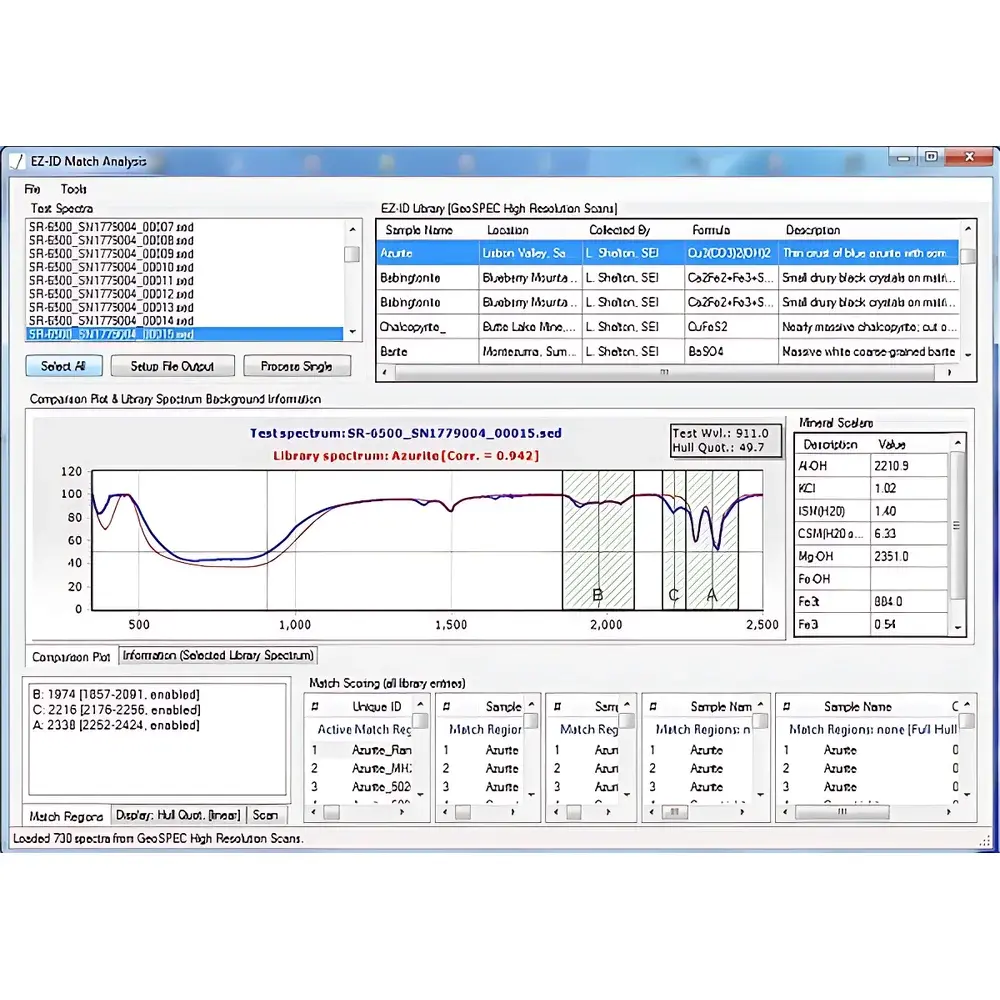
EZ-ID Mineral Identification Software by Spectral Evolution
| Brand | Spectral Evolution |
|---|---|
| Model | EZ-ID |
| Origin | USA |
| Instrument Type | Fiber Optic Spectrometer Software Platform |
| Compatible Hardware | All Spectral Evolution oreX-Series and Full-Range Field & Lab Spectrometers |
| Spectral Library Support | USGS, SpecMIN, GeoSPEC High Resolution (optional), Custom Library Builder |
| File Format Compatibility | ASD (.asd), ENVI, ASCII, CSV |
| Spectral Range Support | 350–2500 nm (dependent on connected spectrometer) |
| Algorithm Suite | Correlation Coefficient, Spectral Angle Mapper (SAM), Euclidean Distance, Feature Band Matching |
| Compliance | GLP-compliant metadata logging, FDA 21 CFR Part 11–ready audit trail (with optional secure user authentication module) |
Overview
EZ-ID is a domain-specific spectral identification software platform engineered for rapid, field-deployable mineral phase identification using reflectance spectroscopy data. It operates on the principle of spectral matching—comparing unknown sample spectra against reference libraries containing laboratory-measured, physically validated mineral endmember spectra. Built exclusively for integration with Spectral Evolution’s oreX-series and full-range fiber optic spectrometers, EZ-ID leverages high-fidelity VNIR-SWIR (350–2500 nm) spectral data to resolve diagnostic absorption features—including crystal-field transitions, vibrational overtones, and combination bands—associated with hydroxyl, water, carbonate, sulfate, and metal-oxygen bonds. Its architecture supports both laboratory-based quantitative analysis and real-time decision-making in geologic field surveys, core logging, and airborne hyperspectral reconnaissance.
Key Features
- Multi-algorithm spectral matching engine: Computes correlation coefficient (R²), spectral angle mapper (SAM), and Euclidean distance metrics—each weighted and visualized independently to support expert interpretation.
- Region-of-interest (ROI) masking: Enables manual or automated selection of diagnostic spectral windows (e.g., 2160–2220 nm for Al-OH; 1390–1420 nm for kaolinite Al-OH stretch) to suppress atmospheric or matrix interference during matching.
- Quantitative abundance estimation: Generates semi-quantitative mineral abundance indices based on band depth normalization and library-constrained linear unmixing—supporting geological inference on alteration intensity and paragenetic sequence.
- Library Builder module: Allows users to import calibrated spectra (ASD .asd, ENVI .hdr/.sli), assign metadata (sample ID, location, grain size, measurement geometry), and validate against NIST-traceable standards before inclusion in custom libraries.
- Cross-platform spectral format translation: Converts proprietary ASD files into open-format ENVI BIL/BIP, ASCII, or CSV with full wavelength calibration retention—ensuring interoperability with GIS, Python (SciPy/NumPy), and MATLAB workflows.
- FDA 21 CFR Part 11–ready configuration: Optional secure login, electronic signature, and immutable audit trail generation for regulated environments requiring traceability per GLP/GMP protocols.
Sample Compatibility & Compliance
EZ-ID processes reflectance, absorbance, or derivative spectra acquired from solid mineral samples—including drill core segments, rock chips, RC cuttings, outcrop surfaces, and powdered standards—under controlled illumination (halogen or solar-simulated) and standardized viewing geometry (typically 0° incidence / 30° collection). It accepts input calibrated to ASTM E275, ISO 11664-5, and USP spectral measurement guidelines. Reference libraries are curated from peer-reviewed sources: the USGS Spectral Library (Version 7, vial and powder measurements), SpecMIN (high-resolution single-crystal spectra), and GeoSPEC HR (field-calibrated regional endmembers). All library entries include full provenance metadata—mineral name, IMA classification, particle size, measurement temperature, and instrument configuration—enabling ISO/IEC 17025–compliant uncertainty propagation.
Software & Data Management
The software employs a modular, database-driven architecture with SQLite backend for local deployment and optional PostgreSQL integration for enterprise-scale spectral data repositories. Each analysis session logs timestamp, operator ID, spectrometer serial number, calibration file hash, and environmental conditions (ambient temperature, relative humidity, barometric pressure). Export options include PDF reports with embedded spectra, annotated match scores, and spectral overlays; georeferenced shapefiles (.shp) for GIS integration; and structured JSON payloads for API-driven automation. Batch processing supports >1,000 spectra per session with configurable ROI templates and auto-flagging of low-confidence matches (R² 0.15 rad).
Applications
- Hydrothermal alteration mapping: Discrimination of kaolinite, alunite, pyrophyllite, and dickite in porphyry Cu-Au systems using 2200 nm Al-OH feature ratios and 1400 nm H₂O overtone shifts.
- Core logging automation: Integration with conveyor-based oreX-2500 systems enables real-time spectral acquisition and mineral ID at 1 cm spatial resolution along continuous core trays.
- Airborne mineral surveying: Onboard processing of pushbroom hyperspectral data (e.g., HySpex VNIR-1800/SWIR-384) via EZ-ID’s lightweight inference engine for near-real-time lithological classification.
- Exploration targeting: Rapid screening of RC chip samples across large tenements to prioritize follow-up XRD or SEM-EDS analysis based on spectral similarity thresholds.
- Academic research: Validation of spectral deconvolution models and development of new mineral indices (e.g., kaolinite crystallinity index, alunite sulfation ratio) using curated library subsets.
FAQ
Does EZ-ID require a Spectral Evolution spectrometer to operate?
Yes—EZ-ID is licensed and validated exclusively for use with Spectral Evolution’s oreX-series, PSR+, and SR series spectrometers. Raw data ingestion, calibration propagation, and hardware-specific noise correction are tightly coupled to firmware-level sensor characterization.
Can I add my own spectral measurements to the USGS library?
No—the USGS library is read-only and digitally signed. However, the Library Builder module allows creation of fully independent, user-managed spectral databases with identical metadata rigor and search functionality.
What spectral resolution is required for reliable alunite vs. kaolinite discrimination?
Discrimination relies on resolving the 1440 nm (alunite) and 1412 nm (kaolinite) doublet; ≥3 nm FWHM resolution in the 1400–1450 nm window is recommended, achievable with oreX-2500 or PSR+3500 instruments.
Is cloud-based processing supported?
EZ-ID runs natively on Windows 10/11 x64 platforms. Cloud deployment is not supported; however, exported spectral datasets and match reports are compatible with AWS S3, Azure Blob Storage, and institutional data lakes via standard APIs.
How frequently are spectral libraries updated?
USGS and SpecMIN libraries are updated biannually per public release cycles. GeoSPEC HR and custom libraries are user-maintained; EZ-ID includes version control and changelog tracking for all imported entries.




