
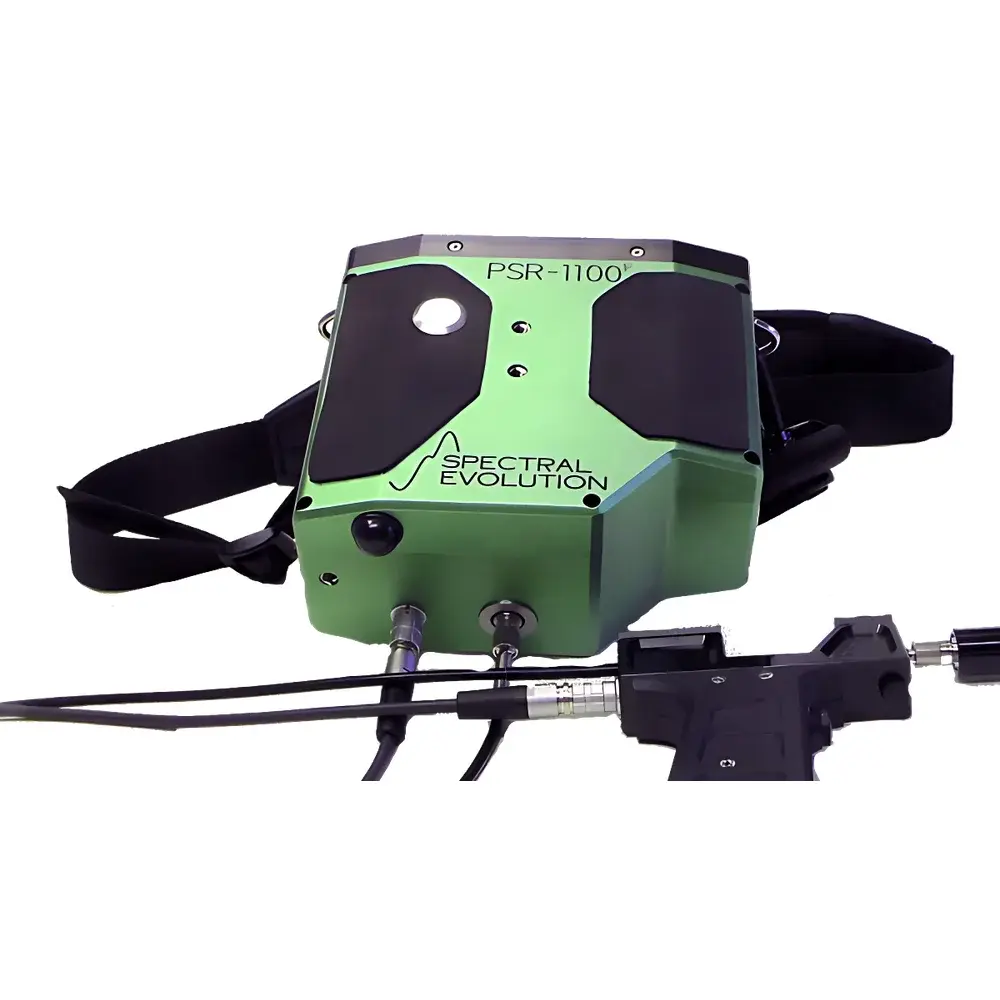
SEI PSR-1100f Handheld Field Spectroradiometer
| Brand | SEI |
|---|---|
| Origin | USA |
| Manufacturer Type | Authorized Distributor |
| Import Status | Imported |
| Model | PSR-1100f |
| Spectral Range | 320–1100 nm |
| Optical Resolution | 3.0 nm @ 600 nm |
| Internal Memory Capacity | 2500 spectra |
| Weight | <1.8 kg |
| Battery | Rechargeable 2800 mAh Li-ion, >4 hours continuous operation |
Overview
The SEI PSR-1100f Handheld Field Spectroradiometer is a compact, field-deployable spectroradiometric instrument engineered for high-fidelity spectral measurement of natural and artificial surfaces under ambient illumination conditions. Operating on the principle of fiber-optic-coupled CCD-based spectroscopy, the PSR-1100f captures radiance or reflectance spectra across the ultraviolet–visible–near-infrared (UV–Vis–NIR) domain (320–1100 nm) with optical resolution of 3.0 nm at 600 nm. Its design emphasizes operational autonomy, rugged portability, and compatibility with standard remote sensing calibration protocols—making it suitable for in situ validation of airborne and satellite-based sensors, as well as for ground-truthing in environmental monitoring campaigns. The instrument integrates a thermally stabilized optical bench and precision-aligned collimating optics to ensure spectral fidelity and long-term repeatability under variable field conditions.
Key Features
- Self-contained data acquisition: Onboard 2500-spectrum storage eliminates dependency on external computing devices during field deployment.
- Integrated rechargeable 2800 mAh lithium-ion battery supporting >4 hours of continuous spectral acquisition without external power.
- Modular optical interface: Standard SMA 905 connector accepts interchangeable fiber-optic probes—including cosine correctors, narrow-angle fore-optics (1°, 3°, 5°, 8°), leaf clip attachments, and underwater immersion probes—for application-specific radiometric configuration.
- Ruggedized magnesium alloy housing rated IP54 for dust and water resistance, optimized for terrestrial, aquatic, and alpine field environments.
- Real-time spectral preview and exposure control via integrated OLED display; configurable integration time from 1 ms to 10 s.
- Optional Bluetooth-enabled PDA or tablet connectivity for synchronized geotagging (GPS coordinates, elevation, timestamp), digital image capture, and voice annotation—fully compliant with FAO and NASA field data metadata standards.
Sample Compatibility & Compliance
The PSR-1100f supports non-contact, non-destructive spectral characterization of heterogeneous natural targets—including vegetation canopies, soil surfaces, snow/ice, inland and coastal water bodies, and man-made materials—under both solar and artificial illumination. Its spectral response is traceably calibrated against NIST-traceable standards (e.g., SRS-01 and SRS-02), and raw data output conforms to the ASTM E275-22 (Standard Practices for Describing and Measuring Performance of UV–Vis–NIR Spectrophotometers) and ISO 17123-8 (Optics and optical instruments — Field procedures for testing geodetic and surveying instruments — Part 8: Spectroradiometers). The instrument meets CE and FCC regulatory requirements and supports GLP-compliant audit trails when used with optional software modules enabling electronic signatures and user-access logging.
Software & Data Management
Data export is supported in multiple interoperable formats including ASCII (.txt), ENVI-compatible BIL/BIP, and HDF5 for seamless integration with ENVI, ArcGIS, Python (via NumPy/Pandas), and R workflows. The bundled SpectraView Pro software provides spectral preprocessing capabilities: dark current subtraction, radiometric calibration, atmospheric correction (using built-in MODTRAN-derived look-up tables), and BRDF normalization. All spectral files include embedded EXIF-style metadata (GPS, UTC timestamp, instrument ID, calibration date, integration time, fiber type, fore-optic FOV) to satisfy FAO’s Minimum Metadata Requirements for Earth Observation Ground Validation. Software compliance with FDA 21 CFR Part 11 is available through optional validated configuration packages, including electronic signature support and immutable audit logs.
Applications
- Validation and vicarious calibration of multispectral and hyperspectral airborne/satellite sensors (e.g., Sentinel-2, Landsat 9, PRISMA, ECOSTRESS).
- In situ chlorophyll-a estimation and CDOM (colored dissolved organic matter) quantification in lakes, rivers, and estuaries using established spectral indices (e.g., MERIS OC3, NIR-red slope).
- Phenological monitoring of crop health and stress detection via red-edge inflection point (REIP) analysis and PRI (Photochemical Reflectance Index) computation.
- Soil organic carbon mapping and mineralogical classification using continuum-removed absorption features in the 900–1100 nm region.
- Urban material identification (roofs, pavements, façades) for albedo modeling and heat island studies.
- Ecological field surveys requiring rapid, GPS-referenced spectral libraries for machine learning training (e.g., Random Forest, CNN-based classification).
FAQ
Is the PSR-1100f calibrated traceable to NIST standards?
Yes—the factory calibration is performed using NIST-traceable irradiance and radiance standards, and certificate of calibration includes uncertainty budgets per ISO/IEC 17025 requirements.
Can the instrument be used underwater?
With the optional waterproof fiber probe and pressure-rated housing (up to 10 m depth), the PSR-1100f supports in-water radiance profiling for aquatic optics applications.
Does the internal memory retain data if the battery is removed?
Yes—non-volatile flash memory ensures full retention of stored spectra without power.
What spectral resampling options are available in post-processing?
SpectraView Pro supports user-defined binning, Savitzky-Golay smoothing, and interpolation to common sensor bandpasses (e.g., Sentinel-2 MSI, MODIS, VIIRS) for cross-platform comparison.
Is firmware upgradeable in the field?
Yes—firmware updates are delivered via USB-C and preserve all user-configured settings and calibration coefficients.






