
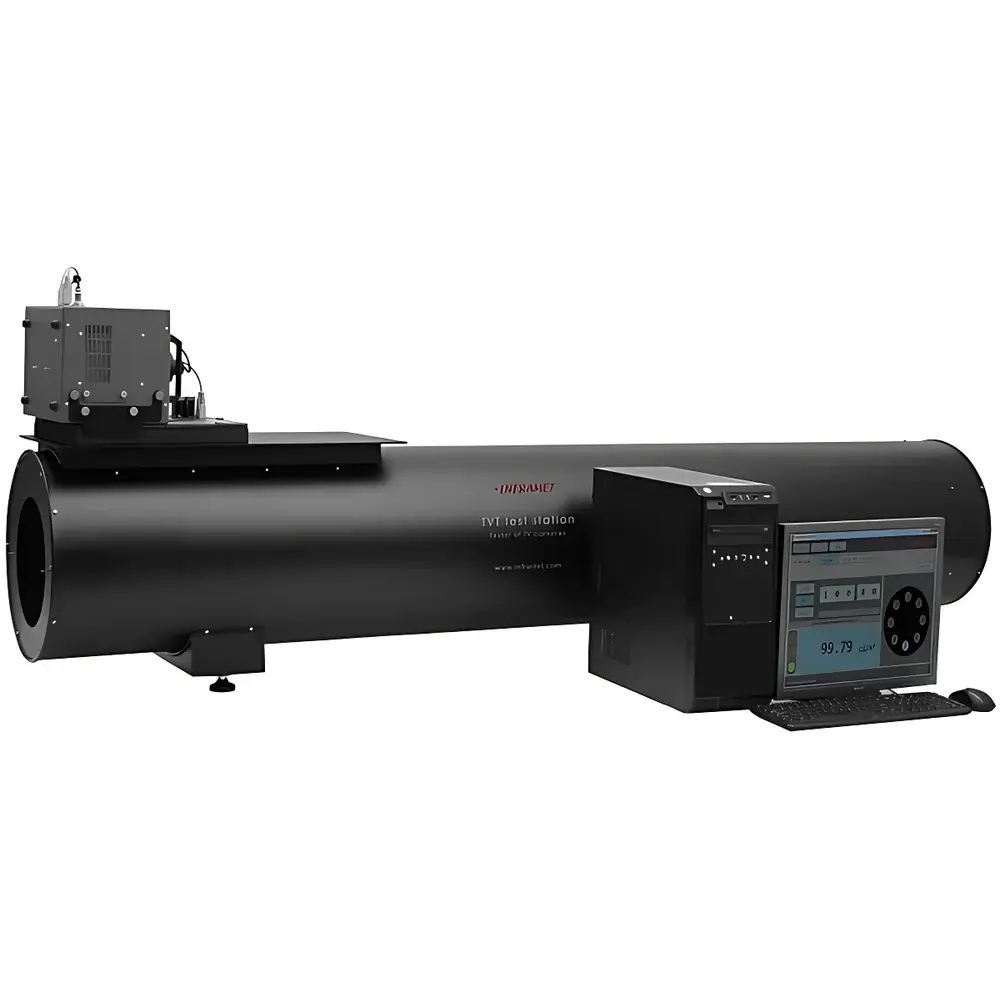
Inframet TVT Long-Range Visible-NIR Camera Test System
| Brand | Inframet |
|---|---|
| Origin | Poland |
| Model | TVT |
| Light Source | Adjustable multi-spectral halogen/LED source (2856K & >5000K) |
| Spectral Range | 400–1000 nm (calibrated) |
| Illuminance Range | 30 μlx – 30 klx (DN mode) |
| Optical Configurations | Off-axis reflective collimator (100/150/200 mm aperture), refractive collimators (70 mm max aperture) |
| Target Set | 6-position USAF 1951 (variable contrast), knife-edge, distortion, grayscale targets |
| Software Suite | DAL Control, SUB-V, TAS-V, Movis |
| Supported Interfaces | GigE Vision, Camera Link, LVDS, SDI, HDMI, USB 3.0, FireWire, Analog HD, CVBS, HD-CVI, HD-TVI, AHD, CoaXPress |
| Measurement Capabilities | MTF, MRC, resolution, distortion, FOV, sensitivity, SNR, NEI, FPN, non-uniformity, 1/f noise, 3D noise, NPSD, PVF, responsivity function, linearity, dynamic range, color fidelity, bad pixel mapping |
| Calibration Traceability | NIST-traceable spectral radiance and illuminance standards |
| Compliance | ISO 12233, ISO 15739, ISO 17850, ASTM E2823, MIL-STD-810G (optical test protocols), supports GLP/GMP audit trails per FDA 21 CFR Part 11 requirements |
Overview
The Inframet TVT Long-Range Visible-NIR Camera Test System is a metrology-grade optical evaluation platform engineered for quantitative performance characterization of visible-to-near-infrared (400–1000 nm) imaging sensors and camera modules operating at medium to long standoff distances (200 m to infinity). It employs a calibrated, spectrally stable illumination architecture—comprising dual-mode broadband sources (2856K halogen for night/cloudy conditions; >5000K white LED for high-irradiance desert-day simulation)—coupled with precision collimation optics to project standardized test patterns under controlled photometric and geometric conditions. Unlike empirical visual inspection methods, the TVT system implements traceable physical measurement principles grounded in radiometric calibration, spatial frequency domain analysis (MTF via slanted-edge and sine-wave methods), modulation transfer theory, and statistical noise modeling (including 3D spatiotemporal noise decomposition). Its modular optical path—featuring interchangeable off-axis reflective collimators (100 mm, 150 mm, or 200 mm clear apertures) and wide-field refractive collimators (up to 70 mm)—enables systematic emulation of real-world angular subtense, depth-of-field constraints, and atmospheric transmission effects relevant to surveillance, reconnaissance, automotive ADAS, and defense electro-optical systems.
Key Features
- Multi-spectral, NIST-traceable illumination: Dual-source architecture (halogen + white LED) enables precise simulation of photopic (day), mesopic (twilight), and scotopic (night) luminance conditions across 30 μlx–30 klx (DN mode)
- Modular collimator system: Off-axis reflective collimators (100/150/200 mm) support high-fidelity long-range MTF and distortion testing; refractive collimators (70 mm) accommodate wide-FOV cameras without vignetting
- Automated target presentation: Motorized 6-position target wheel includes USAF 1951 (6 contrast levels), knife-edge, radial distortion, and grayscale ramp targets—all aligned to optical axis with sub-arcminute repeatability
- Comprehensive noise metrology: Full 3D noise power spectrum density (NPSD), photon transfer curve (PTC), fixed-pattern noise (FPN), temporal noise, 1/f noise, and non-uniformity (NU) quantification per ISO 15739 and ASTM E2823
- High-fidelity data acquisition: Supports 12+ interface standards—including GigE Vision, Camera Link, LVDS, SDI, HDMI, and CoaXPress—ensuring synchronization, low-latency capture, and bit-accurate frame logging
- Regulatory-ready software architecture: TAS-V and SUB-V applications provide full audit trail logging, user role management, electronic signatures, and export compliance with FDA 21 CFR Part 11 and ISO/IEC 17025 documentation requirements
Sample Compatibility & Compliance
The TVT system accommodates monochrome and color visible-NIR cameras with sensor formats ranging from 1/4″ to 4/3″, including global and rolling shutter CMOS/CCD architectures, cooled and uncooled infrared-sensitive silicon detectors, and hybrid VIS-NIR fused imaging modules. All optical components are manufactured to ISO 10110 surface quality specifications (λ/10 RMS wavefront error), and spectral irradiance calibrations are performed using NIST-traceable spectroradiometers and integrating spheres. The system conforms to international standard test methodologies: ISO 12233 (spatial resolution), ISO 15739 (noise and dynamic range), ISO 17850 (electro-optical transfer function), ASTM E2823 (infrared camera MTF), and MIL-STD-810G environmental test protocol annexes for optical validation. Calibration certificates include uncertainty budgets compliant with GUM (Guide to the Expression of Uncertainty in Measurement) and are updated annually by Inframet’s EU-accredited metrology laboratory.
Software & Data Management
The TVT platform integrates three core software modules: DAL Control (light source parameterization and stability monitoring), SUB-V (automated single-frame metric extraction), and TAS-V (full sequence analysis with batch processing, trend reporting, and comparative benchmarking). All applications run on Windows 10/11 x64 with Intel Core i7+ and 32 GB RAM minimum. Raw image data is stored in vendor-neutral TIFF-6.0 format with embedded EXIF metadata (exposure time, gain, temperature, lens ID, collimator configuration). The Movis evaluation suite provides interactive MTF visualization, distortion grid overlays, SNR vs. illuminance curves, and responsivity linearity plots with residual error heatmaps. Audit logs record every operator action, parameter change, calibration event, and report generation with timestamp, IP address, and digital signature—fully satisfying GLP, GMP, and defense contractor documentation mandates.
Applications
- Defense & aerospace: EO/IR sensor qualification for UAV payloads, targeting pods, and long-range surveillance systems per STANAG 4347 and NATO AEP-97
- Automotive: Verification of NIR camera performance under varying ambient illumination for driver monitoring (DMS) and night vision (NV) systems per ISO 26262 ASIL-B functional safety workflows
- Industrial machine vision: Validation of high-dynamic-range (HDR) and low-light silicon cameras used in semiconductor inspection, solar cell grading, and agricultural sorting
- Academic & standards labs: Reference-grade MTF and noise characterization for sensor model development, algorithm benchmarking (e.g., deconvolution, denoising), and inter-laboratory round-robin studies
- Medical imaging R&D: Evaluation of NIR fluorescence endoscope and surgical guidance camera modules operating in 700–950 nm therapeutic windows
FAQ
What illumination standards does the TVT system support for photometric calibration?
The system uses NIST-traceable spectral radiance calibrations across its 400–1000 nm range, with illuminance values validated against CIE S 026/E:2018 and ISO/CIE 19476 for photopic/mesopic/scotopic weighting functions.
Can the TVT system measure MTF beyond the Nyquist frequency?
Yes—via oversampled slanted-edge analysis and through-focus MTF sweeps using motorized focus stages (optional), enabling evaluation of aliasing behavior and optical design margin.
Is remote operation supported for integration into automated test lines?
All software modules expose RESTful APIs and TCP/IP command sets compatible with LabVIEW, Python (PyVISA), MATLAB, and PLC-based factory control systems.
How is thermal drift compensated during extended measurements?
The DAL light source incorporates active thermal stabilization and real-time radiometric feedback; collimator mounts feature low-CTE invar structures, and software applies frame-to-frame dark reference correction synchronized with sensor temperature telemetry.
Does the system support custom target designs for proprietary test protocols?
Yes—customers may supply vector-based (SVG) or bitmap (TIFF) targets; the Movis software auto-registers and scales them to physical angular dimensions based on collimator focal length and working distance.





