
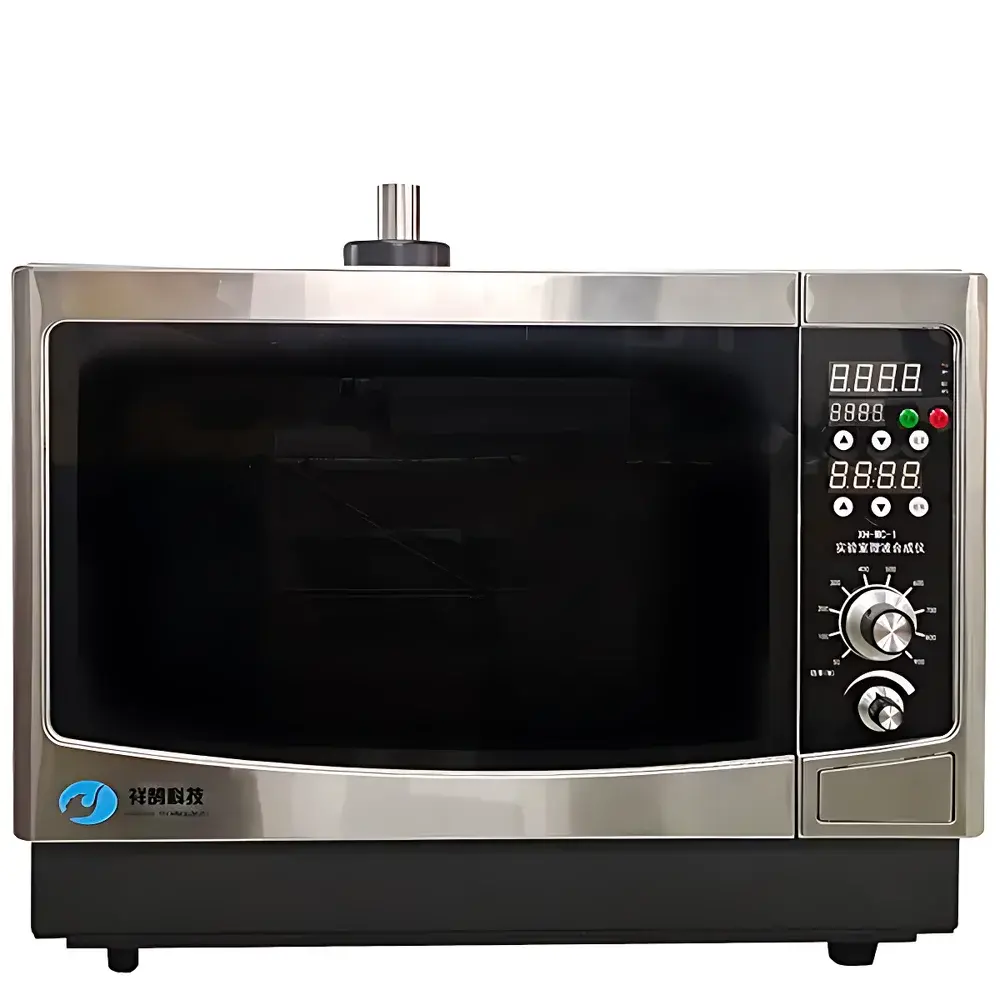
Xianghu XH-MC-1 Microwave Synthesis Reactor
| Brand | Xianghu |
|---|---|
| Origin | Beijing, China |
| Manufacturer Type | Direct Manufacturer |
| Product Origin | Domestic (China) |
| Model | XH-MC-1 |
| Price Range | USD 1,400 – 7,200 |
| Temperature Range | 0–300 °C |
| Pressure Rating | 4 MPa |
| Microwave Power Output | 50–1000 W |
| Magnetron Frequency | 2450 MHz |
| Stirring Mechanism | Adjustable Magnetic Stirring (≥1500 rpm) |
| Reaction Vessel Capacity | 100 mL |
| Temperature Measurement Accuracy | ±0.2 °C |
| Temperature Control Accuracy | ±1 °C |
| Cavity Material | Stainless Steel (Corrosion- and Heat-Resistant) |
| Microwave Leakage | Compliant with GB 10436-2008 (Chinese National Standard, equivalent to IEC 61000-3-2 & EN 61000-3-2 for RF emission limits) |
Overview
The Xianghu XH-MC-1 Microwave Synthesis Reactor is an engineered benchtop system designed for controlled, rapid, and reproducible microwave-assisted chemical synthesis and physical processing under sealed or open-vessel conditions. It operates on the principle of dielectric heating—where polar molecules (e.g., solvents, reagents, or substrates) absorb electromagnetic energy at 2450 MHz, resulting in volumetric, non-contact thermal excitation. This mechanism delivers accelerated reaction kinetics via both thermal (enthalpic) and non-thermal (entropic) contributions, enabling rate enhancements of up to three orders of magnitude compared to conventional conductive heating methods. The instrument is not a generic microwave oven but a purpose-built reactor with integrated real-time temperature monitoring, precise power modulation, and mechanical agitation—features essential for method development, optimization, and scalable synthetic workflows in academic and industrial laboratories.
Key Features
- Digitally controlled microwave output (50–1000 W), manually adjustable in discrete steps for fine-tuned energy delivery across diverse reaction systems.
- High-fidelity contact-type temperature sensor with ceramic-coated probe, rated for continuous operation up to 300 °C and corrosion resistance against common organic and aqueous media; measurement accuracy ±0.2 °C, control stability ±1 °C.
- Stainless steel reaction cavity (304 grade) with reinforced sealing and optimized waveguide geometry to ensure uniform field distribution and minimal standing-wave artifacts.
- Integrated magnetic stirring system with continuously variable speed control (0–1500 rpm), supporting homogeneous mixing and thermal equilibration even in high-viscosity or heterogeneous reaction mixtures.
- Optically transparent quartz observation window enables real-time visual monitoring of color change, phase separation, precipitation, or reflux behavior without interrupting irradiation.
- Open-system compatibility: standard 24/40 or 29/32 ground-glass joints permit direct integration of condensers, dropping funnels, gas inlets, or inert atmosphere lines for reflux, stepwise addition, or anaerobic reactions.
- Comprehensive safety architecture including pressure-rated vessel design (4 MPa burst tolerance), interlocked door switch, and microwave leakage <5 mW/cm² at 5 cm distance—fully compliant with GB 10436-2008 and aligned with international RF exposure guidelines (IEC 61000-3-2).
Sample Compatibility & Compliance
The XH-MC-1 supports a broad spectrum of sample types—including volatile organic solvents (e.g., DMF, ethanol, acetonitrile), aqueous solutions, ionic liquids, solid-supported reagents, and heterogeneous catalysts—within its 100 mL standard reaction vessel. Its modular design accommodates optional vessels ranging from 10 to 1000 mL for scalability studies. The system meets structural and operational requirements for GLP-aligned synthetic protocol documentation and is routinely deployed in laboratories adhering to ISO/IEC 17025 quality management frameworks. While not certified to FDA 21 CFR Part 11 out-of-the-box, its digital temperature/time logging interface supports audit-trail-ready data capture when paired with validated third-party software for regulated environments (e.g., pharmaceutical process R&D).
Software & Data Management
The XH-MC-1 employs an embedded microcontroller-based interface with dual seven-segment LED display showing preset temperature, real-time temperature, and elapsed reaction time. It features built-in temperature self-calibration routines to compensate for sensor drift over extended usage cycles. Though no proprietary PC software is bundled, the unit provides TTL-level serial output (RS-232 compatible) for integration into custom LabVIEW or Python-based data acquisition platforms. Users may log timestamped temperature profiles, power settings, and duration parameters for traceable method replication—critical for publication-grade experimental reporting and internal SOP compliance.
Applications
This reactor is routinely applied across disciplines requiring accelerated reaction screening and mechanistic investigation: organic synthesis (C–C coupling, heterocycle formation, esterification), medicinal chemistry (library synthesis, late-stage functionalization), materials science (MOF crystallization, nanoparticle synthesis), food chemistry (extraction of polyphenols, enzymatic hydrolysis), environmental analysis (microwave-assisted digestion of biological tissues), and polymer chemistry (step-growth polycondensation). Its ability to induce selective thermal activation—without overheating vessel walls or degrading thermolabile intermediates—makes it particularly valuable for reactions involving sensitive biomolecules or chiral catalysts.
FAQ
Is the XH-MC-1 suitable for air-sensitive reactions?
Yes—when used with appropriate Schlenk-line adapters or glovebox-compatible vessel loading, the open-system configuration allows inert gas purging prior to and during microwave irradiation.
Can the instrument operate under reflux conditions?
Yes—the standard flange ports accept standard ground-glass condensers, enabling solvent reflux at atmospheric pressure while maintaining microwave coupling efficiency.
What is the maximum recommended working pressure for routine use?
The vessel is rated for 4 MPa burst pressure, but for routine synthetic applications, users are advised to maintain operating pressures ≤2 MPa to ensure long-term seal integrity and sensor reliability.
Does the system support automated method programming?
No—the XH-MC-1 uses manual parameter setting only; multi-step ramp-and-hold protocols require external timing or sequential manual adjustment.
How is temperature calibration verified?
The unit includes a one-point offset correction function accessible via front-panel menu, allowing users to input a known reference value (e.g., from a calibrated NIST-traceable thermometer) to align displayed readings.



