
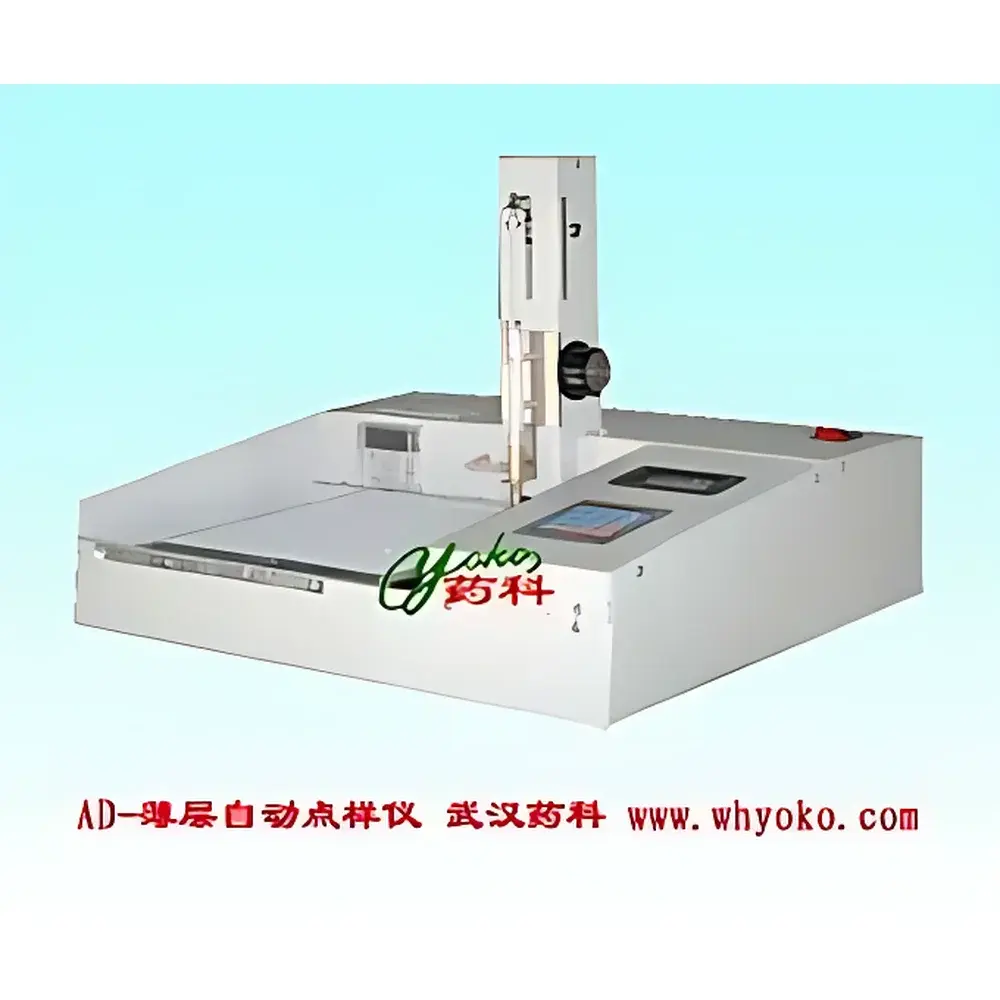
YOKO YOKO-AD Fully Automated Thin-Layer Chromatography (TLC) Sample Spotter
| Brand | YOKO |
|---|---|
| Model | YOKO-AD |
| Instrument Type | TLC Sample Spotter |
| Spotting Method | Contactless Pneumatic Spray & Precision Syringe Deposition |
| Programmable Methods | 50 (100 steps each) |
| Spotting Accuracy | ≥99% |
| Spotting Reproducibility | ≥99% |
| Heating Platform | 0–200 °C, Digital PID Control, Max Plate Size 200 × 200 mm |
| Spotting Range | 0 mm (point) to 190 mm (band/strip) |
| Syringe Options | 10, 25, 50, 100, 500 µL |
| Air Supply | Oil-Free Compressor, 0–0.12 MPa, Flow Rate 0.1–2.0 L/min |
| Power | 220 V ±10%, 50–60 Hz, 650 W |
| Dimensions | 500 × 400 × 330 mm |
| Weight | 18 kg |
Overview
The YOKO YOKO-AD Fully Automated Thin-Layer Chromatography (TLC) Sample Spotter is an engineered solution for high-precision, reproducible sample application onto silica gel, aluminum oxide, or cellulose-based TLC plates. Unlike manual spotters or semi-automated systems, the YOKO-AD implements dual-mode deposition—pneumatically assisted non-contact spray spotting and contact-based syringe-driven micro-volume dispensing—both governed by deterministic motion control architecture. Its core mechanism integrates a high-resolution stepper motor-driven XYZ stage (positioning accuracy ±0.02 mm), a digitally regulated heated platform (0–200 °C), and a proprietary pneumatic nozzle assembly designed to minimize solvent evaporation during deposition and suppress spot diffusion at the plate surface. This architecture directly supports method development, quantitative densitometry, and regulatory-compliant QC workflows where inter-run consistency and traceable parameter logging are essential.
Key Features
- Dual-mode spotting capability: programmable point, band, and segmented deposition—including forward, reverse, and overlapping spotting sequences—enabling both analytical screening and semi-preparative isolation.
- Embedded 50-method memory with up to 100 programmable steps per method; all parameters (coordinates, volume, dwell time, temperature, air pressure) stored non-volatilely for long-term recall and audit readiness.
- Stainless-steel heating platform (210 × 210 mm active area) with digital PID temperature control, optimized to accelerate solvent volatilization post-deposition and reduce radial spreading—critical for achieving baseline-resolved bands in multi-component mixtures.
- Modular syringe interface supporting standard glass or stainless-steel needles (10, 25, 50, 100, and 500 µL); direct aspiration eliminates bubble formation and ensures volumetric fidelity across viscosity ranges (0.5–50 mPa·s typical).
- Oil-free compressed air system (0–0.12 MPa, adjustable flow 0.1–2.0 L/min) integrated with real-time pressure monitoring—eliminates hydrocarbon contamination risks common in oil-lubricated compressors and meets ISO 8573-1 Class 1 particulate/gas purity requirements for pharmaceutical TLC.
- LCD interface with real-time status feedback (motor position, temperature, air pressure, step execution) and independent operation mode—no external PC required for routine runs.
Sample Compatibility & Compliance
The YOKO-AD accommodates standard commercial TLC plates (e.g., Merck Silica Gel 60 F254, Analtech Uniplates, Sorbent Technologies UV254 plates) as well as custom-cut substrates up to 200 × 200 mm. Its non-contact spray mode is particularly effective for volatile or heat-sensitive analytes (e.g., terpenes, aldehydes, low-MW alkaloids), while syringe-based delivery maintains integrity for viscous samples (e.g., plant extracts, polymer solutions, nanoparticle suspensions). The instrument’s design aligns with principles outlined in USP , EP 2.2.27, and ICH Q5A for chromatographic method robustness. Temperature and pressure logs—retained internally—support GLP/GMP documentation needs; optional RS232/USB output enables integration into LIMS environments compliant with FDA 21 CFR Part 11 when paired with validated third-party data acquisition software.
Software & Data Management
Although the YOKO-AD operates autonomously via its onboard controller, it supports ASCII-formatted method export/import via USB flash drive for cross-instrument method portability. All executed runs retain timestamped metadata: date/time, method ID, plate dimensions, ambient temperature/humidity (if externally logged), and final spot coordinates. No proprietary binary formats are used—raw coordinate and parameter files are human-readable and compatible with MATLAB, Python (NumPy/Pandas), or Excel for statistical process control (SPC) analysis. Audit trails are maintained in EEPROM with write-cycle redundancy; no battery-backed RAM is employed, ensuring data persistence without maintenance overhead.
Applications
- Pharmaceutical QC: Uniform spotting of reference standards and test articles for identity/purity testing per pharmacopoeial monographs (e.g., USP, Ph. Eur., ChP).
- Natural product profiling: Multi-band deposition for comparative fingerprinting of herbal extracts across seasonal or geographic batches.
- Reaction monitoring: Time-series spotting of aliquots from parallel synthesis vessels to track intermediate formation and degradation kinetics.
- Semi-preparative isolation: 190-mm band deposition on 20 × 20 cm plates facilitates milligram-scale compound recovery after visualization and scraping.
- Academic teaching labs: Pre-loaded method templates (e.g., “Amino Acid Separation”, “Fatty Acid Methyl Ester Screening”) accelerate student onboarding while enforcing standardized technique.
FAQ
Does the YOKO-AD require a dedicated computer to operate?
No—the instrument features a self-contained controller with LCD interface and full method storage; a PC is only needed for advanced data export or method batch editing.
Can the heated platform accommodate glass-backed or flexible plastic-backed TLC plates?
Yes—temperature uniformity has been verified across rigid glass, aluminum, and polyester-supported layers; maximum recommended thermal load is 200 °C for ≤15 minutes per run.
Is method validation support available for regulatory submissions?
The device provides raw parameter logs and positional repeatability data (≥99% spot-to-spot reproducibility under ISO 5725-2 conditions); users must perform system suitability testing per their SOPs and document environmental controls.
What maintenance is required for the pneumatic spotting module?
Annual inspection of O-rings and nozzle orifice integrity is recommended; no lubrication or calibration tools are required—the stepper motor encoders and thermal sensors are factory-trimmed and field-stable.
Are replacement syringes and needles supplied with traceable calibration certificates?
Standard consumables (10–500 µL syringes, stainless steel needles) are supplied with dimensional certification per ISO 8536-4; volumetric calibration certificates are available upon request for GMP applications.





