
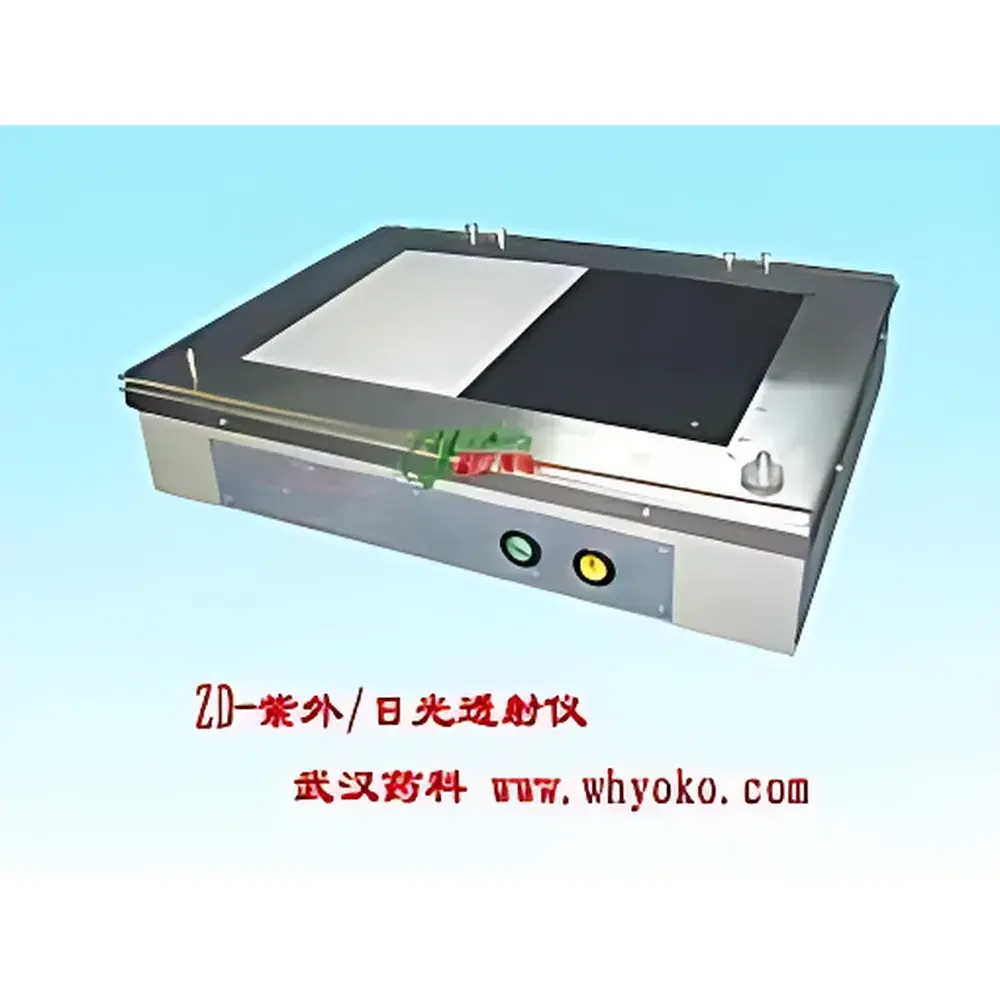
whYOKO ZD UV-Visible Transilluminator
| Brand | whYOKO |
|---|---|
| Origin | Hubei, China |
| Manufacturer Type | Authorized Distributor |
| Country of Manufacture | China |
| Model | ZD |
| UV Lamp | 3 × 12 W U-shaped lamp @ 312 nm (standard), optional 254 nm or 365 nm |
| Visible Lamp | 3 × 12 W U-shaped daylight lamp (380–700 nm) |
| UV Filter | 200 mm × 150 mm, transmittance ≥68% at 254 nm, ≥86% at 365 nm |
| White Diffuser Plate | 200 mm × 150 mm porcelain-white glass |
| Dimensions | 400 mm (L) × 300 mm (W) × 90 mm (H) |
Overview
The whYOKO ZD UV-Visible Transilluminator is a dual-mode laboratory instrument engineered for high-fidelity visualization and documentation of nucleic acid and protein electrophoretic gels under both ultraviolet (UV) and visible (daylight-spectrum) illumination. It operates on the principle of fluorescence excitation—where intercalating dyes (e.g., ethidium bromide, SYBR® Safe, GelRed™) bound to DNA/RNA absorb UV photons and re-emit visible light—and complementary white-light transmission for Coomassie- or silver-stained protein gels, native PAGE, or unstained samples requiring no fluorophore. Unlike single-wavelength transilluminators, the ZD integrates independently switchable UV and visible light sources within a compact, low-profile chassis, enabling rapid mode switching without sample relocation or optical realignment—critical for workflow efficiency in molecular biology core facilities and QC laboratories.
Key Features
- Dual-band optical architecture: Independent 312 nm UV excitation (3 × 12 W U-tube lamps) and broad-spectrum visible illumination (380–700 nm, 3 × 12 W U-tube lamps) with mechanical isolation to prevent spectral crosstalk.
- High-transmission UV filter: 200 mm × 150 mm precision-cut interference filter with certified transmittance ≥68% at 254 nm and ≥86% at 365 nm—optimized for common nucleic acid stains while minimizing photodamage during exposure.
- Uniform white-light diffusion: Porcelain-white glass diffuser plate (200 mm × 150 mm) provides even, glare-free illumination across the entire viewing area, essential for consistent densitometric analysis of protein gels.
- Modular lamp configuration: Standard 312 nm UV source; optional retrofit with 254 nm (for maximum DNA sensitivity) or 365 nm (for reduced photodegradation and safer operation) U-tube lamps—field-upgradable without recalibration.
- Compact benchtop design: 400 × 300 × 90 mm footprint minimizes lab space requirements while maintaining full-size gel compatibility (up to standard 20 × 20 cm minigels).
- Thermal management system: Passive aluminum heat sinks and optimized lamp spacing ensure stable output over extended operation (>30 min continuous use) without thermal drift or filter degradation.
Sample Compatibility & Compliance
The ZD supports standard agarose and polyacrylamide gels (0.5–3.0 mm thickness), including pre-cast and hand-poured formats. It is routinely used for post-electrophoresis detection of ethidium bromide-, SYBR® Gold-, and GelGreen™-stained DNA/RNA, as well as Coomassie Brilliant Blue R-250-, silver-, and fluorescent dye-stained protein gels. The instrument complies with IEC 61010-1:2010 safety standards for electrical equipment for measurement, control, and laboratory use. UV lamp housings meet Class 1 laser product equivalency per IEC 60825-1:2014 when operated with standard filters. While not classified as GLP/GMP-certified hardware, its stable output and reproducible illumination profile support data integrity in regulated environments when paired with validated imaging systems and documented SOPs.
Software & Data Management
The ZD is a hardware-only transilluminator and does not include embedded software or digital capture functionality. It is designed for seamless integration with third-party gel documentation systems—including CCD-based imagers (e.g., Bio-Rad ChemiDoc™, Azure Biosystems Sapphire™) and DSLR/mirrorless cameras equipped with UV-blocking lens filters. For regulatory traceability, users are advised to record lamp type, filter lot number, exposure duration, and ambient conditions in electronic lab notebooks (ELN) compliant with 21 CFR Part 11 requirements. Audit trails for image acquisition and analysis should be maintained separately in validated image analysis platforms (e.g., ImageLab™, AlphaView SA).
Applications
- Nucleic acid gel documentation: Rapid visualization and photography of DNA/RNA bands in agarose and denaturing PAGE gels.
- Protein electrophoresis verification: Detection of Coomassie- and silver-stained proteins in SDS-PAGE, native PAGE, and 2D gels without UV-induced band distortion.
- Enzyme activity assays: Monitoring zymogram gels (e.g., MMP, protease, esterase) under visible light post-incubation.
- Educational laboratories: Dual-mode capability enables comparative teaching of nucleic acid vs. protein detection principles in undergraduate biochemistry and molecular biology courses.
- QC release testing: Supporting visual pass/fail inspection of gel purity and integrity in biopharmaceutical manufacturing (e.g., plasmid prep validation, recombinant protein identity checks).
FAQ
Is the ZD compatible with ethidium bromide and newer alternative dyes such as SYBR® Safe?
Yes—the 312 nm primary emission peak aligns optimally with the excitation maxima of ethidium bromide (254/302 nm), SYBR® Safe (280/300 nm), and GelRed™ (300 nm), ensuring strong signal-to-noise ratios.
Can I replace the UV lamps with 254 nm or 365 nm versions myself?
Yes—lamp sockets and ballasts are mechanically and electrically identical across 254 nm, 312 nm, and 365 nm U-tube configurations; replacement requires only physical substitution and verification of filter alignment.
Does the instrument include a camera or imaging software?
No—the ZD is a dedicated illumination platform. Digital capture must be performed using external cameras or imager systems.
What safety precautions are recommended during UV operation?
Always wear UV-blocking safety goggles (OD ≥3 at 254–365 nm) and nitrile gloves; minimize direct exposure time; use opaque shielding or a darkroom enclosure during imaging to prevent operator exposure and ambient light contamination.
Is calibration or annual certification required?
No formal calibration is specified by the manufacturer; however, periodic verification of UV irradiance (using a calibrated radiometer) and visible illuminance (lux meter) is recommended for labs operating under ISO/IEC 17025 or GxP frameworks.




