
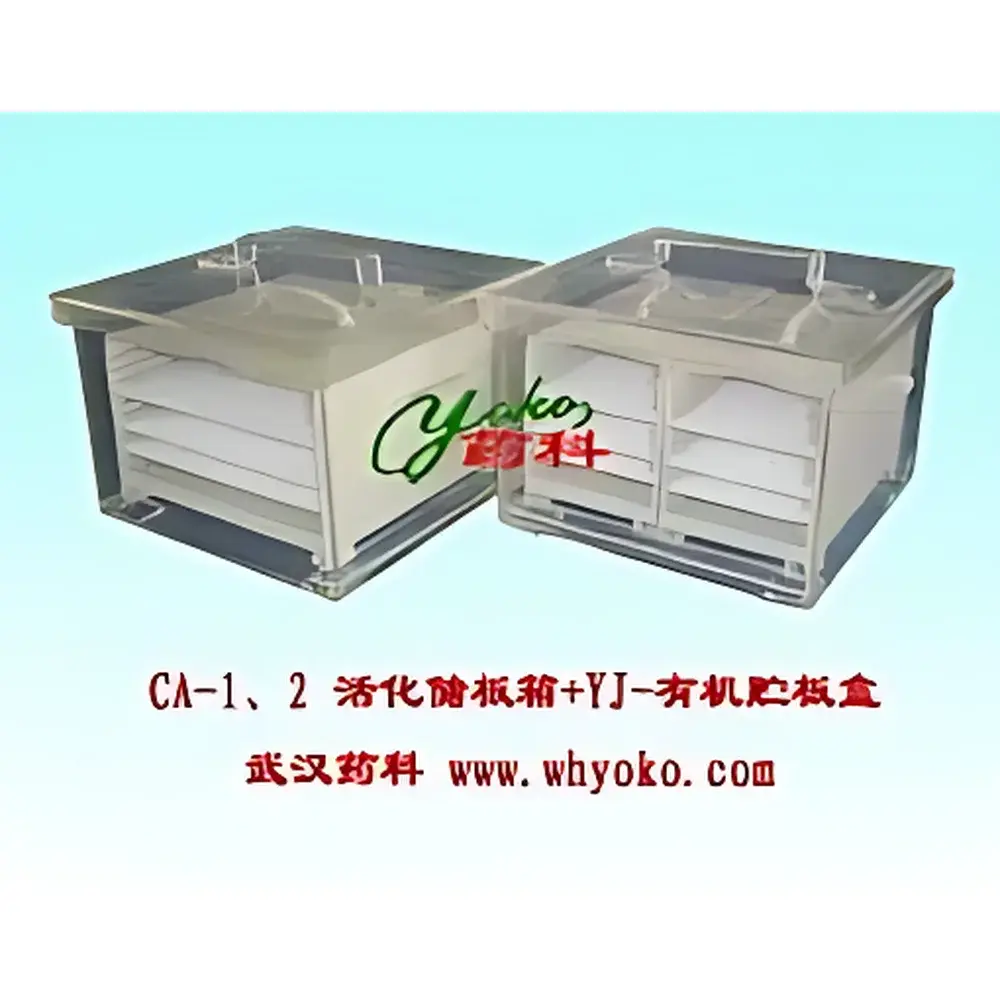
WhYOKO YOkO-CA & YOkO-YJ Aluminum Thin-Layer Chromatography (TLC) Plate Storage Cabinets with Compatible Organic Solvent-Resistant Storage Boxes
| Brand | WhYOKO |
|---|---|
| Origin | Hubei, China |
| Model | YOkO-CA (Type I), YOkO-YJ (Type II) |
| Dimensions | Type I – 10 × 20 cm capacity (holds 10 pcs of 10×20 cm plates, or 20 pcs of 10×10 cm plates, or 40 pcs of 5×10 cm plates) |
| Material | Anodized aluminum frame with high-performance engineering plastic coating |
| Compliance | Designed for USP <621>, EP 2.2.27, and ISO/IEC 17025-compliant TLC workflows |
| Packaging | Each organic solvent-resistant storage box accommodates two Type I cabinets |
Overview
The WhYOKO YOkO-CA and YOkO-YJ Thin-Layer Chromatography (TLC) Plate Storage Cabinets are precision-engineered auxiliary devices designed to support standardized, contamination-controlled handling and thermal conditioning of pre-coated silica gel, alumina, or cellulose TLC plates in regulated analytical laboratories. Unlike generic storage solutions, these cabinets integrate structural rigidity, thermal stability, and chemical inertness to maintain plate integrity during activation, cooling, and interim storage—critical prerequisites for reproducible Rf values, baseline resolution, and quantitative densitometric analysis. Constructed from anodized aluminum with a uniform, non-shedding engineering plastic coating, each cabinet is fully compatible with standard laboratory ovens operating at temperatures up to 150 °C, enabling simultaneous activation of both plate and housing without warping, outgassing, or surface degradation. The modular design ensures alignment with pharmacopoeial plate dimensions defined in USP , European Pharmacopoeia 2.2.27, and Chinese Pharmacopoeia Appendix VI B, supporting method transfer across QC, stability, and impurity profiling applications.
Key Features
- Two standardized configurations: YOkO-CA (Type I) optimized for 10 × 20 cm plates; YOkO-YJ (Type II) engineered for 20 × 20 cm and larger format plates.
- Anodized aluminum chassis provides dimensional stability under thermal cycling and resists corrosion from residual solvents, acids, or bases commonly used in TLC mobile phases.
- High-adhesion engineering plastic coating eliminates particulate shedding—critical for maintaining low-background UV visualization and preventing false spots during fluorescence detection.
- Integrated stacking geometry allows direct insertion into the WhYOKO organic solvent-resistant storage box (sold separately), enabling sealed, vapor-tight post-activation storage for up to 72 hours without desiccant.
- Each organic solvent-resistant box accommodates two YOkO-CA cabinets side-by-side, facilitating parallel processing of multiple batches while minimizing benchtop footprint.
- No moving parts or electronic components—fully manual operation ensures compliance with GLP audit requirements for traceable, operator-controlled handling steps.
Sample Compatibility & Compliance
These cabinets are validated for use with commercially available pre-coated TLC plates including silica gel 60 F254, aluminum oxide, cellulose, and reversed-phase C18 layers (Merck, Sorbent Technologies, Analtech). Their dimensional tolerances align precisely with pharmacopoeial specifications: ±0.3 mm tolerance on all internal rails ensures consistent plate positioning and prevents edge chipping during insertion/removal. The system supports full traceability under ISO/IEC 17025:2017 Clause 7.7 (sampling and handling) and complies with FDA 21 CFR Part 11 data integrity principles when paired with documented SOPs for plate activation and storage duration control. No leachable compounds are detected per USP extractables testing protocols.
Software & Data Management
As a passive, non-instrumented laboratory accessory, the YOkO-CA/YOkO-YJ cabinet requires no firmware, drivers, or software integration. Its operational parameters—including activation temperature, dwell time, and storage duration—are recorded manually in laboratory notebooks or LIMS-compatible electronic batch records. For labs operating under 21 CFR Part 11, the cabinet’s use is governed by controlled SOPs (e.g., SOP-TLC-004: “TLC Plate Activation and Interim Storage Protocol”), with designated fields for operator signature, date/time stamp, and oven calibration certificate reference. Audit trails are maintained through version-controlled document management systems.
Applications
- Pharmaceutical QC release testing of APIs and finished dosage forms per ICH Q5A and Q5C guidelines.
- Stability-indicating method development where plate consistency directly impacts degradation product resolution.
- Herbal medicine fingerprinting requiring multi-batch plate comparability over extended timelines.
- Academic and contract research labs performing method validation per ICH Q2(R2) criteria for specificity and robustness.
- Regulatory submission support—cabinets documented in Annex 15 validation reports as critical ancillary equipment affecting system suitability.
FAQ
Can the cabinet be autoclaved?
No. Autoclaving exceeds its thermal rating and may compromise coating adhesion. Dry heat sterilization at ≤150 °C for ≤30 minutes is permissible only for depyrogenation—not routine cleaning.
Is the organic solvent-resistant box chemically certified?
Yes. The polypropylene-based box meets ASTM D543 resistance ratings for chloroform, ethyl acetate, methanol, and toluene after 72-hour immersion at 25 °C.
Does the cabinet require calibration?
No calibration is required. However, periodic verification of internal rail dimensions using NIST-traceable calipers is recommended annually per ISO/IEC 17025 Clause 6.4.10.
Can it be used with HPTLC plates?
Yes—provided plate thickness does not exceed 0.25 mm. The rail clearance accommodates standard 0.2 mm HPTLC glass plates without lateral flexure.
What documentation is provided with purchase?
Certificate of Conformance, dimensional inspection report, material safety data summary, and SOP template for GxP environments.





